
CEACAM-3 (carcinoembryonic antigen-related cell adhesion molecule 3; also CD66d and CGM1) is a 31 - 34 kDa member of the CEACAM subfamily of the CEA family of proteins. It is expressed by neutrophils and serves as a microbial receptor for a wide range of microorganisms. Mature human CEACAM-3 is a 218 amino acid (aa) type I transmembrane glycoprotein. Its extracellular domain (aa 35 - 155) shows one V-type Ig-like domain (aa 35 - 142). There are two alternate splice forms of CEACAM-3. One shows a 40 aa substitution for the C-terminal 116 amino acids (aa 137 - 252), while a second shows a 31 aa substitution for the C-terminal 71 amino acids. No definitive rodent CEACAM-3 has been reported.
CEACAM3/CD66d Antibody (417009) [CoraFluor™ 1]
Novus Biologicals | Catalog # FAB4166CL1

Scientific images may be resized, cropped, or adjusted for brightness or contrast for presentation purposes. These updates are limited to presentation and do not affect the underlying scientific interpretation of the data. Where available, additional source data may be provided upon request.
Key Product Details
Species Reactivity
Human
Applications
Western Blot
Label
CoraFluor 1
Antibody Source
Monoclonal Mouse IgG2A Clone # 417009
Loading...
Product Specifications
Immunogen
Mouse myeloma cell line NS0-derived recombinant human CEACAM‑3/CD66d isoform 1
Lys35-Gly155
Accession # P40198
Lys35-Gly155
Accession # P40198
Specificity
Detects human CEACAM‑3/CD66d in direct ELISAs and Western blots. In direct ELISAs and Western blots, no cross-reactivity with recombinant human CEACAM-1, -4, -5, or -6 is observed.
Clonality
Monoclonal
Host
Mouse
Isotype
IgG2A
Description
This conjugate is made on demand and is not held in inventory. Each order represents a unique lot. All conjugates are generated using validated conjugation protocols and meet strict degree of labeling (F/P) specifications; additional information is available upon request. The antibody concentration is provided on the individual product label.
For specialized conjugation needs, like large quantities, specific concentrations, and defined F/P ratios, bulk and custom antibody conjugation services are available.
For specialized conjugation needs, like large quantities, specific concentrations, and defined F/P ratios, bulk and custom antibody conjugation services are available.
Scientific Data Images for CEACAM3/CD66d Antibody (417009) [CoraFluor™ 1]
Product Feature: CoraFluor Probes for TR-FRET
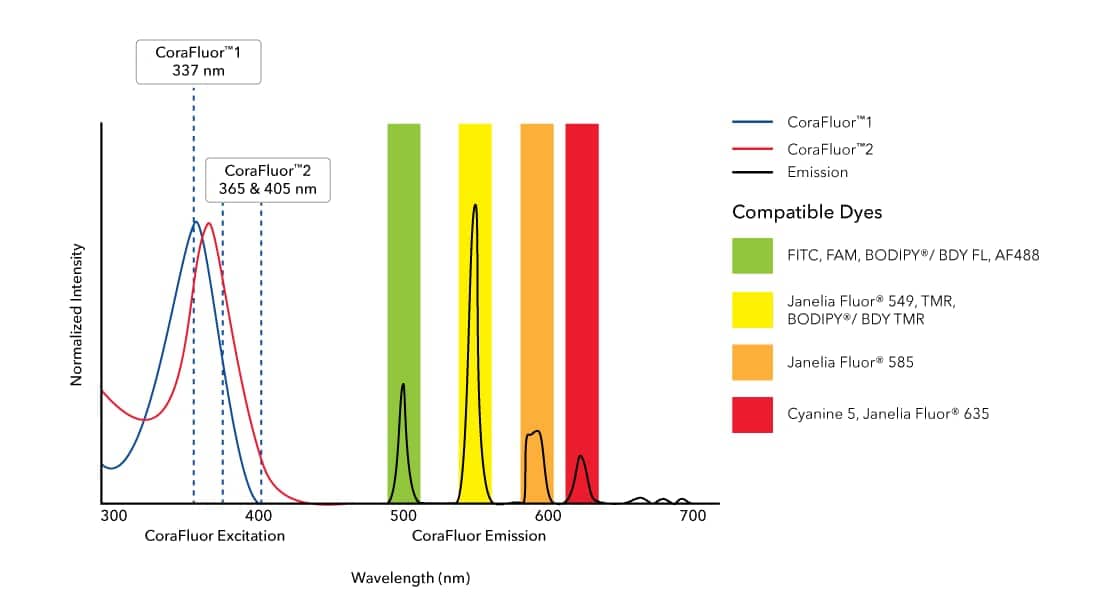
CoraFluor™ 1, amine reactive (Catalog:7920) and CoraFluor™ 2, amine reactive (Catalog # 7950) are terbium-based probes that have been developed for use as TR-FRET donors. They emit wavelengths compatible with commonly used fluorescent acceptor dyes such as BODIPY® (or BDY) and Janelia Fluor® dyes, FITC (Catalog # 5440), TMR and Cyanine 5 (Catalog # 5436). CoraFluor™ fluorescence is brighter and more stable in biological media than existing TR-FRET donors, leading to enhanced sensitivity and improved data generation. CoraFluor™ 1 exhibits excitation upon exposure to a 337 nm UV laser.Applications for CEACAM3/CD66d Antibody (417009) [CoraFluor™ 1]
Application
Recommended Usage
Western Blot
Optimal dilutions of this antibody should be experimentally determined.
Application Notes
Recommended applications are based on validated applications from the unconjugated base product MAB4166. This conjugated antibody is not kept in inventory and is made to order using validated conjugation protocols.
Formulation, Preparation, and Storage
Purification
Protein A or G purified from hybridoma culture supernatant
Formulation
PBS
Preservative
No Preservative
Concentration
Please see the vial label for concentration. If unlisted please contact technical services.
Shipping
The product is shipped with polar packs. Upon receipt, store it immediately at the temperature recommended below.
Stability & Storage
Store at 4C in the dark. Do not freeze.
Background: CEACAM-3/CD66d
Long Name
Carcinoembryonic Antigen-related Cell Adhesion Molecule 3
Alternate Names
CD66d, CGM1
Gene Symbol
CEACAM3
Additional CEACAM-3/CD66d Products
Product Documents for CEACAM3/CD66d Antibody (417009) [CoraFluor™ 1]
Certificate of Analysis
To download a Certificate of Analysis, please enter a lot or batch number in the search box below.
Product Specific Notices for CEACAM3/CD66d Antibody (417009) [CoraFluor™ 1]
Sold for research purposes only under agreement from Massachusetts General Hospital, US Patent No. 12,134,721. A license is required for development of new commercial assay platforms (e.g., microarrays, microfluidics), diagnostic use or other unlicensed uses. Please contact Technical Support for further details: techsupport@bio-techne.com.
This product is for research use only and is not approved for use in humans or in clinical diagnosis. Primary Antibodies are guaranteed for 1 year from date of receipt.
Customer Reviews for CEACAM3/CD66d Antibody (417009) [CoraFluor™ 1]
There are currently no reviews for this product. Be the first to review CEACAM3/CD66d Antibody (417009) [CoraFluor™ 1] and earn rewards!
Have you used CEACAM3/CD66d Antibody (417009) [CoraFluor™ 1]?
Submit a review and receive an Amazon gift card!
$25/€18/£15/$25CAN/¥2500 for a review with an image
$10/€7/£6/$10CAN/¥1110 for a review without an image
Submit a review
Protocols
Find general support by application which include: protocols, troubleshooting, illustrated assays, videos and webinars.
- Cellular Response to Hypoxia Protocols
- R&D Systems Quality Control Western Blot Protocol
- Troubleshooting Guide: Western Blot Figures
- Western Blot Conditions
- Western Blot Protocol
- Western Blot Protocol for Cell Lysates
- Western Blot Troubleshooting
- Western Blot Troubleshooting Guide
- View all Protocols, Troubleshooting, Illustrated assays and Webinars
Loading...
Associated Pathways
