
Chloroquine Inhibitor
Novus Biologicals | Catalog # NBP2-29386

Key Product Details
Applications
Product Specifications
Application Notes
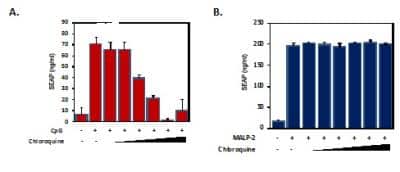
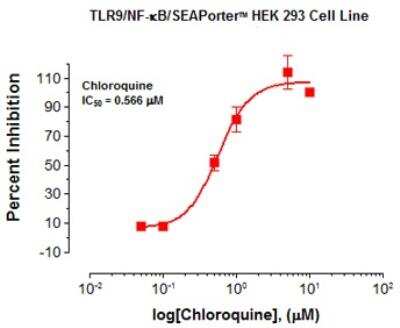
Scientific Data Images for Chloroquine Inhibitor
Formulation, Preparation, and Storage
Formulation
Form : White Solid (Powder)
Concentration
Shipping
Storage
Background: Chloroquine
Additional Chloroquine Products
Product Documents for Chloroquine Inhibitor
Certificate of Analysis
To download a Certificate of Analysis, please enter a lot or batch number in the search box below.
Product Specific Notices for Chloroquine Inhibitor
This product is for research use only and is not approved for use in humans or in clinical diagnosis. Inhibitors are guaranteed for 1 year from date of receipt.
Citations for Chloroquine Inhibitor
 Powered by Bioz
Customer Reviews for Chloroquine Inhibitor
There are currently no reviews for this product. Be the first to review Chloroquine Inhibitor and earn rewards!
Have you used Chloroquine Inhibitor?
Submit a review and receive an Amazon gift card!
$25/€18/£15/$25CAN/¥2500 for a review with an image
$10/€7/£6/$10CAN/¥1110 for a review without an image
Submit a review
Protocols
View specific protocols for Chloroquine Inhibitor (NBP2-29386):
1. To make 100 mM stock solution, dissolve 200 mg chloroquine in 3.9 ml water by gentle vortex.
2. Filter sterilize through a 0.22 um filter.
3. Store at 4oC (Note: Chloroquine solution is light sensitive).
4. For TLR signaling inhibition study, perform a pilot inhibitory test with the different concentrations of chloroquine ranging from 1 to 10 mM to optimize your experiments.
FAQs for Chloroquine Inhibitor
-
Q: I am looking to test the effect of blocking the TLR9 on animal model (pigs with sternotomy) by chloroquine, Can you kindly advice me regarding whether is it possible to try it in vivo for approximatley 50kg animal and what is the optimum dose for better effect aftrer few hours of adminstration of the dose?
A:
We evaluate Chloroquinone on TLR9 Stably Transfected cell lines, but have not evaluated Chloroquine in animals. However, Chloroquine has been widely published for in vivo use. I would encourage you to review the scientific literature regarding the use of Chloroquine in animals for inhibiting TLR9, for example please seee this LINK.