
Exostosin-like 3 (EXTL3) is an ER-resident type II transmembrane protein belonging to the EXT family of tumor suppressor genes. EXT family members are glycosyl transferases that are involved in the synthesis of the glycosaminoglycan chains of heparan sulfate proteoglycans. EXTL3 was also reported to be a receptor for the REG protein, a pancreatic beta-cell regeneration factor. The lumenal domains of human, mouse and rat share 97% amino acid sequence identity.
Human Exostosin-like 3/EXTL3 Lumenal Domain Antibody
R&D Systems | Catalog # AF2635

Scientific images may be resized, cropped, or adjusted for brightness or contrast for presentation purposes. These updates are limited to presentation and do not affect the underlying scientific interpretation of the data. Where available, additional source data may be provided upon request.
Key Product Details
Species Reactivity
Validated:
Human
Cited:
Human, Rat
Applications
Validated:
Western Blot
Cited:
Immunohistochemistry-Paraffin, Western Blot
Label
Unconjugated
Antibody Source
Polyclonal Goat IgG
Loading...
Product Specifications
Immunogen
Mouse myeloma cell line NS0-derived recombinant human Exostosin-like 3/EXTL3 Lumenal Domain
Thr52-Ile919
Accession # O43909
Thr52-Ile919
Accession # O43909
Specificity
Detects human Exostosin-like 3/EXTL3 Lumenal Domain in direct ELISAs and Western blots.
Clonality
Polyclonal
Host
Goat
Isotype
IgG
Scientific Data Images for Human Exostosin-like 3/EXTL3 Lumenal Domain Antibody
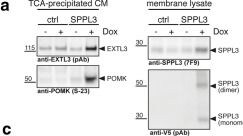
Detection of Exostosin-like 3 by Western Blot
N-terminome analysis of CM of HEK293 cells overexpressing SPPL3. a Immunoblots of TCA-precipitated CM (left) and lysates of carbonate-washed membranes (right) of untransfected (ctrl) and SPPL3-V5 WT-transfected Flp-In™ T-REx™ HEK293 cells. Treatment with doxycycline (Dox) induces SPPL3 overexpression and leads to increased release of EXTL3 and POMK into the CM. b Volcano plots showing peptides detected following HYTANE enrichment of CM from doxycycline-treated and untreated Flp-In™ T-REx™ SPPL3-V5 HEK293 cells (three technical replicates). Samples were analysed in parallel on the indicated LC–MS systems. 2,817 and 1,608 unique N-terminal peptides are plotted, respectively, and labelling/filtering is performed as outlined in Fig. 2e with x = 30 aa. Dashed lines represent threshold values (± 2 SD for log2 difference and p = 0.05). c Schematic overview and mapping of neo-N peptides found to be changed in abundance in CM (see Fig. 2h). Arrow height indicates relative intensities (mean of doxycycline-treated samples) for membrane-proximal peptides changed upon SPPL3 overexpression Image collected and cropped by CiteAb from the following open publication (https://link.springer.com/10.1007/s00018-022-04163-y), licensed under a CC-BY license. Not internally tested by R&D Systems.Applications for Human Exostosin-like 3/EXTL3 Lumenal Domain Antibody
Application
Recommended Usage
Western Blot
0.1 µg/mL
Sample: Recombinant Human Exostosin-like 3/EXTL3 Lumenal Domain
Sample: Recombinant Human Exostosin-like 3/EXTL3 Lumenal Domain
Formulation, Preparation, and Storage
Purification
Antigen Affinity-purified
Reconstitution
Reconstitute at 0.2 mg/mL in sterile PBS. For liquid material, refer to CoA for concentration.
Loading...
Formulation
Lyophilized from a 0.2 μm filtered solution in PBS with Trehalose. *Small pack size (SP) is supplied either lyophilized or as a 0.2 µm filtered solution in PBS.
Shipping
Lyophilized product is shipped at ambient temperature. Liquid small pack size (-SP) is shipped with polar packs. Upon receipt, store immediately at the temperature recommended below.
Stability & Storage
Use a manual defrost freezer and avoid repeated freeze-thaw cycles.
- 12 months from date of receipt, -20 to -70 °C as supplied.
- 1 month, 2 to 8 °C under sterile conditions after reconstitution.
- 6 months, -20 to -70 °C under sterile conditions after reconstitution.
Calculators
Background: Exostosin-like 3/EXTL3
Additional Exostosin-like 3/EXTL3 Products
Product Documents for Human Exostosin-like 3/EXTL3 Lumenal Domain Antibody
Certificate of Analysis
To download a Certificate of Analysis, please enter a lot or batch number in the search box below.
Note: Certificate of Analysis not available for kit components.
Product Specific Notices for Human Exostosin-like 3/EXTL3 Lumenal Domain Antibody
For research use only
Related Research Areas
Citations for Human Exostosin-like 3/EXTL3 Lumenal Domain Antibody
 Powered by Bioz
Customer Reviews for Human Exostosin-like 3/EXTL3 Lumenal Domain Antibody
There are currently no reviews for this product. Be the first to review Human Exostosin-like 3/EXTL3 Lumenal Domain Antibody and earn rewards!
Have you used Human Exostosin-like 3/EXTL3 Lumenal Domain Antibody?
Submit a review and receive an Amazon gift card!
$25/€18/£15/$25CAN/¥2500 for a review with an image
$10/€7/£6/$10CAN/¥1110 for a review without an image
Submit a review
Protocols
Find general support by application which include: protocols, troubleshooting, illustrated assays, videos and webinars.
- Cellular Response to Hypoxia Protocols
- R&D Systems Quality Control Western Blot Protocol
- Troubleshooting Guide: Western Blot Figures
- Western Blot Conditions
- Western Blot Protocol
- Western Blot Protocol for Cell Lysates
- Western Blot Troubleshooting
- Western Blot Troubleshooting Guide
- View all Protocols, Troubleshooting, Illustrated assays and Webinars
Loading...