
Human MIS RII (Mullerian inhibiting substance type II receptor), also known as AMHRII (anti-Mullerian hormone type II receptor), is an 82 kDa serine/threonine receptor with a single transmembrane domain that belongs to the family of type II receptors of the TGF-beta superfamily (1). The MIS RII precursor is 573 amino acids in length, with a 17 amino acid (aa) signal sequence, a 127 aa extracellular region that also contains two potential N-linked glycosylation sites, a 26 aa transmembrane region, and a 403 aa cytoplasmic region that contains the serine/threonine kinase domain (1). Human MIS RII shares 82%, 78%, and 77% aa sequence identity with rabbit, mouse, and rat MIS RII, respectively. It is expressed in the mesenchyme surrounding the fetal Mullerian duct, in fetal and postnatal granulosa cells, and in Sertoli cells (1-6). MIS RII is a receptor for Mullerian inhibitor substance (MIS), also known as anti-Mullerian hormone (AMH), which is responsible for regression of the Mullerian duct, the anlagen of the uterus, Fallopian tubes, and upper vagina in male fetuses (1-6). Mutations in MIS RII result in persistent Mullerian duct syndrome (PMDS), an extremely rare form of pseudohermaphroditism (5, 6).

Scientific images may be resized, cropped, or adjusted for brightness or contrast for presentation purposes. These updates are limited to presentation and do not affect the underlying scientific interpretation of the data. Where available, additional source data may be provided upon request.
Key Product Details
Species Reactivity
Applications
Label
Antibody Source
Product Specifications
Immunogen
Pro18-Ser144
Accession # Q16671
Specificity
Clonality
Host
Isotype
Scientific Data Images for Human MIS RII Antibody [Biotin]
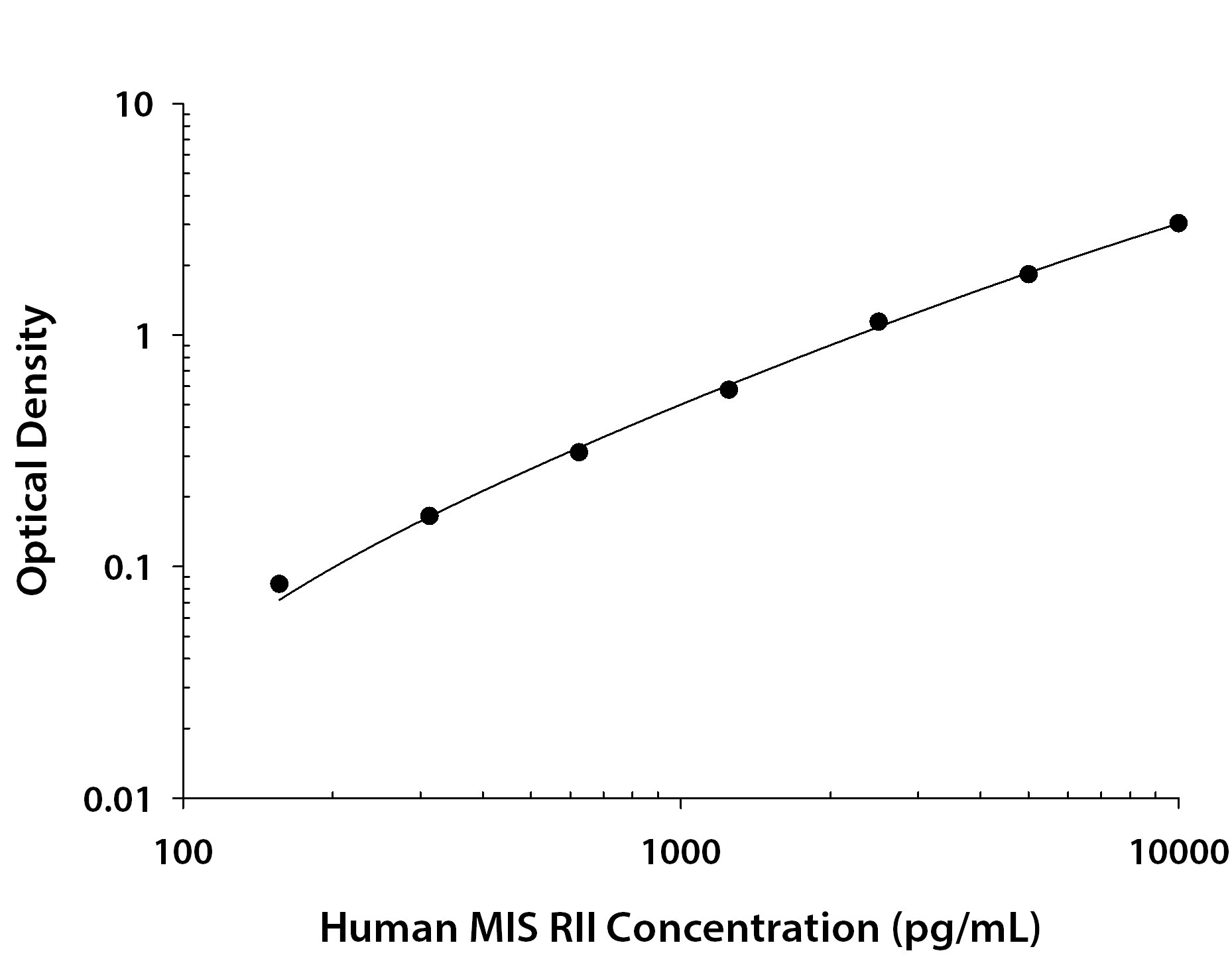
Human MIS RII ELISA Standard Curve.
Recombinant Human MIS RII protein was serially diluted 2-fold and captured by Mouse Anti-Human MIS RII Monoclonal Antibody Catalog # MAB4749) coated on a Clear Polystyrene Microplate (Catalog # DY990). Sheep Anti-Human MIS RII Biotinylated Antigen Affinity-purified Polyclonal Antibody (Catalog # BAF4749) was incubated with the protein captured on the plate. Detection of the standard curve was achieved by incubating Streptavidin-HRP (Catalog # DY998) followed by Substrate Solution (Catalog # DY999) and stopping the enzymatic reaction with Stop Solution (Catalog # DY994).Applications for Human MIS RII Antibody [Biotin]
Western Blot
Sample: Recombinant Human MIS RII Fc Chimera (Catalog # 4749-MR)
Formulation, Preparation, and Storage
Purification
Reconstitution
Reconstitute at 0.2 mg/mL in sterile PBS.
Formulation
Shipping
Stability & Storage
- 12 months from date of receipt, -20 to -70 °C as supplied.
- 1 month, 2 to 8 °C under sterile conditions after reconstitution.
- 6 months, -20 to -70 °C under sterile conditions after reconstitution.
Calculators
Background: MIS RII
References
- Imbeaud, S. et al. (1995) Nat. Genet. 11:382.
- Baarends, W.M. et al. (1994) Development 120:189.
- di Clemente, N. et al. (1994) Mol. Endocrinol. 8:1006.
- Teixeira, J. et al. (1996) Endocrinology 137:160.
- Salhi, I et al. (2004) Biochem. J. 379:785.
- Imbeaud, S. et al. (1996) Hum. Mol. Genet. 5:1269.
Long Name
Alternate Names
Gene Symbol
UniProt
Additional MIS RII Products
Product Documents for Human MIS RII Antibody [Biotin]
Certificate of Analysis
To download a Certificate of Analysis, please enter a lot or batch number in the search box below.
Note: Certificate of Analysis not available for kit components.
Product Specific Notices for Human MIS RII Antibody [Biotin]
For research use only
Customer Reviews for Human MIS RII Antibody [Biotin]
There are currently no reviews for this product. Be the first to review Human MIS RII Antibody [Biotin] and earn rewards!
Have you used Human MIS RII Antibody [Biotin]?
Submit a review and receive an Amazon gift card!
$25/€18/£15/$25CAN/¥2500 for a review with an image
$10/€7/£6/$10CAN/¥1110 for a review without an image
Submit a review
Protocols
Find general support by application which include: protocols, troubleshooting, illustrated assays, videos and webinars.
- Cellular Response to Hypoxia Protocols
- R&D Systems Quality Control Western Blot Protocol
- Troubleshooting Guide: Western Blot Figures
- Western Blot Conditions
- Western Blot Protocol
- Western Blot Protocol for Cell Lysates
- Western Blot Troubleshooting
- Western Blot Troubleshooting Guide
- View all Protocols, Troubleshooting, Illustrated assays and Webinars