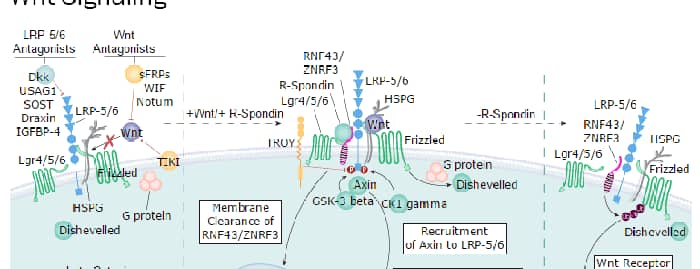
Mouse Wnt-9b, previously called Wnt-14b or Wnt-15, is one of about 19 vertebrate members of the Wingless-type MMTV integration site (Wnt) family of highly conserved, cysteine-rich secreted glycoproteins important for normal developmental processes (1‑3). Wnts mainly transduce signals by binding to receptors of the Frizzled family, in conjunction with a coreceptor of the low-density lipoprotein receptor-related protein family (LRP-5 or -6) (1, 2). The 359 aa mouse Wnt-9b precursor contains a 336 aa mature region with 24 conserved cysteines (3). Mature mouse Wnt-9b shares 93%, 98%, 92%, 92% and 91% aa identity with human, rat, canine, equine and bovine Wnt-9b, respectively. It is evolutionarily related to Wnt-9a and Wnt-3, which share 63% and 32% aa identity, respectively (4). Wnt-9b mRNA is expressed in late embryos and in adult kidney, with lesser amounts in brain and liver (3, 4). It appears to direct mesenchymal-to-epithelial transition in the kidney and other tissues (5). During kidney development, it is expressed in the ureteric bud and induces mesonephric and metanephric tubulogenesis, nephron development, and caudal extension of the Mullerian duct, acting upstream of Wnt-4 (5‑7). Induction is dependent on beta -catenin activity, implicating the canonical signaling pathway (7). Mice devoid of Wnt-9b die shortly after birth due to kidney agenesis, while low expression results in small kidneys with fewer nephrons (1, 5, 6). Mutations of Wnt-9b also cause incompletely penetrant cleft lip and palate in mice, indicating its involvement with facial midline morphogenesis (8, 9). It has weak transforming activity compared to other transforming Wnts (4).

Scientific images may be resized, cropped, or adjusted for brightness or contrast for presentation purposes. These updates are limited to presentation and do not affect the underlying scientific interpretation of the data. Where available, additional source data may be provided upon request.
Key Product Details
Species Reactivity
Applications
Label
Antibody Source
Product Specifications
Immunogen
Ala46-Glu90 & Lys228-Tyr298
Accession # O35468.2
Specificity
Clonality
Host
Isotype
Scientific Data Images for Wnt-9b Antibody (406612)
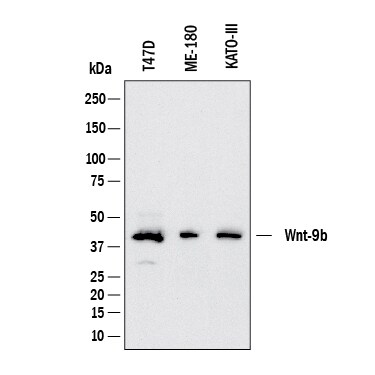
Detection of Human/Mouse Wnt‑9b by Western Blot.
Western blot shows lysates of T47D human breast cancer cells, ME‑180 human cervical epithelial carcinoma cells and KATO‑III human gastric carcinoma cells. PVDF membrane was probed with 5 µg/mL of Rat Anti-Human/Mouse Wnt‑9b Monoclonal Antibody (Catalog # MAB3669) followed by HRP-conjugated Anti-Rat IgG Secondary Antibody (Catalog # HAF005). A specific band was detected for Wnt‑9b at approximately ~40 kDa (as indicated). This experiment was conducted under reducing conditions and using Western Blot Buffer Group 1.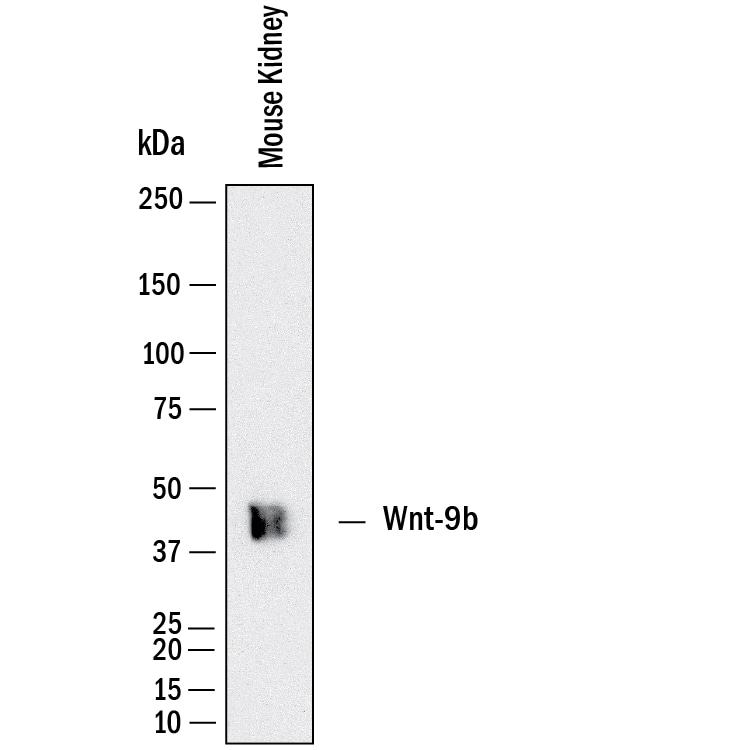
Detection of Mouse Wnt‑9b by Western Blot.
Western Blot shows lysates of mouse kidney tissue. PVDF membrane was probed with 5 µg/ml of Rat Anti-Human/Mouse Wnt‑9b Monoclonal Antibody (Catalog # MAB3669) followed by HRP-conjugated Anti-Rat IgG Secondary Antibody (Catalog # HAF005). A specific band was detected for Wnt‑9b at approximately 40 kDa (as indicated). This experiment was conducted under reducing conditions and using Western Blot Buffer Group 1.Applications for Wnt-9b Antibody (406612)
Western Blot
Sample: T47D human breast cancer cells, ME‑180 human cervical epithelial carcinoma cells, KATO‑III human gastric carcinoma cells, and mouse kidney tissue
Formulation, Preparation, and Storage
Purification
Reconstitution
Formulation
Shipping
Stability & Storage
- 12 months from date of receipt, -20 to -70 °C as supplied.
- 1 month, 2 to 8 °C under sterile conditions after reconstitution.
- 6 months, -20 to -70 °C under sterile conditions after reconstitution.
Calculators
Background: Wnt-9b
References
- http://www.stanford.edu/group/nusselab/cgi-bin/wnt/
- Logan, C. Y. and R. Nusse (2004) Annu. Rev. Cell Dev. Biol. 20:781.
- Kirikoshi, H. and M. Katoh (2002) Int. J. Mol. Med. 9:135.
- Qian, J. et al. (2003) Genomics 81:34.
- Carroll, T. J. et al. (2005) Dev. Cell 9:283.
- Merkel, C. E. et al. (2007) Pediatr. Nephrol. 22:1825.
- Park, J-S. et al. (2007) Development 134:2533.
- Lan, Y. et al. (2006) Dev. Dyn. 235:1448.
- Juriloff, D. M. and M. J. Harris (2008) Birth Defects Res. A Clin. Mol. Teratol. 82:63.
Long Name
Alternate Names
Gene Symbol
UniProt
Additional Wnt-9b Products
Product Documents for Wnt-9b Antibody (406612)
Certificate of Analysis
To download a Certificate of Analysis, please enter a lot or batch number in the search box below.
Note: Certificate of Analysis not available for kit components.
Product Specific Notices for Wnt-9b Antibody (406612)
For research use only
Related Research Areas
Customer Reviews for Wnt-9b Antibody (406612)
There are currently no reviews for this product. Be the first to review Wnt-9b Antibody (406612) and earn rewards!
Have you used Wnt-9b Antibody (406612)?
Submit a review and receive an Amazon gift card!
$25/€18/£15/$25CAN/¥2500 for a review with an image
$10/€7/£6/$10CAN/¥1110 for a review without an image
Submit a review
Protocols
Find general support by application which include: protocols, troubleshooting, illustrated assays, videos and webinars.
- Cellular Response to Hypoxia Protocols
- R&D Systems Quality Control Western Blot Protocol
- Troubleshooting Guide: Western Blot Figures
- Western Blot Conditions
- Western Blot Protocol
- Western Blot Protocol for Cell Lysates
- Western Blot Troubleshooting
- Western Blot Troubleshooting Guide
- View all Protocols, Troubleshooting, Illustrated assays and Webinars
Associated Pathways