
Human phospho-BTK (Y551) Antibody (797837)
R&D Systems | Catalog # MAB7659

Scientific images may be resized, cropped, or adjusted for brightness or contrast for presentation purposes. These updates are limited to presentation and do not affect the underlying scientific interpretation of the data. Where available, additional source data may be provided upon request.
Key Product Details
Validated by
Species Reactivity
Validated:
Cited:
Applications
Validated:
Cited:
Label
Antibody Source
Product Specifications
Immunogen
Specificity
Clonality
Host
Isotype
Scientific Data Images for Human phospho-BTK (Y551) Antibody (797837)
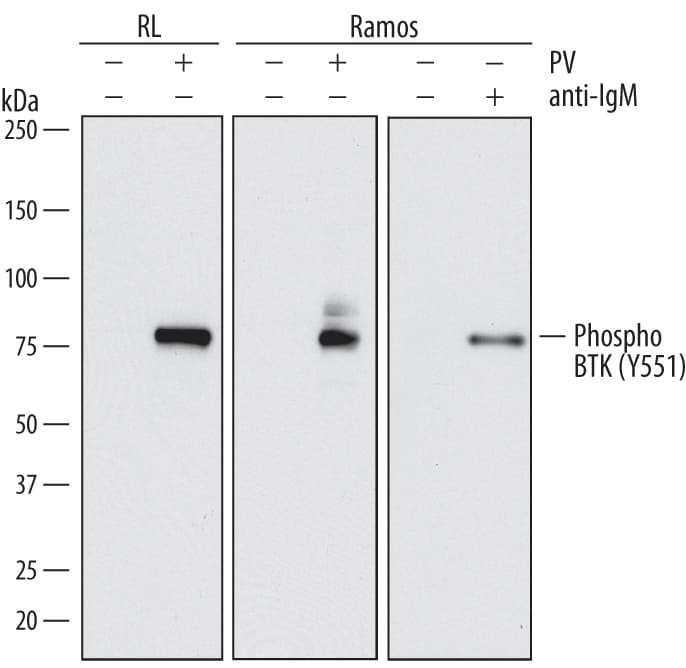
Detection of Human Phospho-BTK (Y551) by Western Blot.
Western blot shows lysates of RL human non-Hodgkin's lymphoma B cell line and Ramos human Burkitt's lymphoma cell line untreated (-) or treated (+) with 0.1 mM Pervanadate (PV) for 10 minutes and 12 µg/mL Goat Anti-Human IgM µ Chain Antigen Affinity-purified Polyclonal Antibody (Catalog # G-105-C) for 2 minutes. PVDF membrane was probed with 1 µg/mL of Mouse Anti-Human Phospho-BTK (Y551) Monoclonal Antibody (Catalog # MAB7659) followed by HRP-conjugated Anti-Mouse IgG Secondary Antibody (Catalog # HAF018). A specific band was detected for Phospho-BTK (Y551) at approximately 75 kDa (as indicated). This experiment was conducted under reducing conditions and using Immunoblot Buffer Group 1.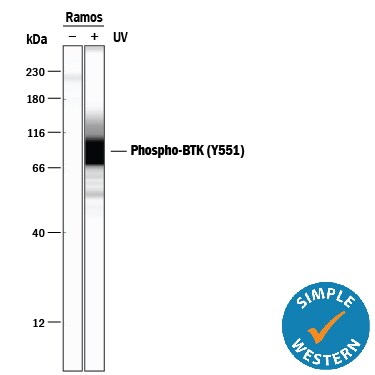
Detection of Human Phospho-BTK (Y551) by Simple WesternTM.
Simple Western lane view shows lysates of Ramos human Burkitt's lymphoma cell line untreated (-) or treated (+) with ultraviolet light (UV), loaded at 0.2 mg/mL. A specific band was detected for Phospho-BTK (Y551) at approximately 89 kDa (as indicated) using 20 µg/mL of Mouse Anti-Human Phospho-BTK (Y551) Monoclonal Antibody (Catalog # MAB7659). This experiment was conducted under reducing conditions and using the 12-230 kDa separation system.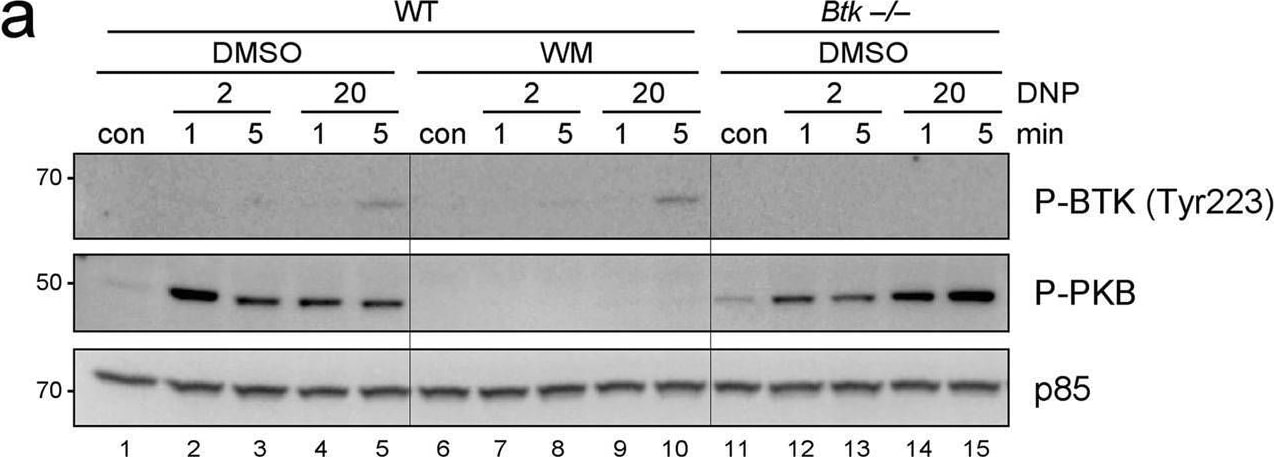
Detection of Phospho-BTK (Y551) by Western Blot
Antigen-triggered phosphorylation of BTK and PLC gamma in BMMCs is independent of PI3K. (a) WT BMMCs were pre-treated for 20 min with 100 nM Wortmannin (WM) or vehicle (DMSO) and were then left untreated (con) or stimulated with the indicated concentrations of Ag (DNP-HSA [DNP]) for 1 and 5 min. Btk−/− BMMCs were pre-treated with DMSO and stimulated accordingly. Whole-cell lysates were subjected to Western Blot analysis with antibodies against P-BTK (Tyr223), P-PKB (Ser473), and p85 (loading control). (b) WT BMMCs were pre-treated for 20 min with 100 nM WM or vehicle (DMSO) and were then left untreated (con) or stimulated with Ag (20 ng/ml DNP-HSA) for the indicated times. Btk−/− BMMCs were pre-treated with DMSO and stimulated accordingly. Whole-cell lysates were subjected to Western Blot analysis with antibodies against P-BTK (Tyr551), BTK, P-PKB (Ser473), and p85 (loading control). (c) WT and Btk−/− BMMCs were pre-treated for 20 min with 100 nM WM or vehicle (DMSO) and were then left untreated (con) or stimulated with the indicated concentrations of Ag for 1 and 5 min. Whole-cell lysates were analysed by immunoblotting against P-PLC gamma 1 (Tyr783), PLC gamma 1, P-PKB (Ser473), and p85 (loading control). Densitometry of P-PLC gamma 1 with reference to PLC gamma 1 was performed using ImageJ software (NIH, USA) and normalised to WT cells pretreated with DMSO and stimulated with 1 ng/ml Ag (1 min). Comparable results were obtained in at least three experiments with different BMMC cultures. Fine vertical lines were inserted to allow for better discrimination of cells/conditions. Image collected and cropped by CiteAb from the following open publication (https://pubmed.ncbi.nlm.nih.gov/30341350), licensed under a CC-BY license. Not internally tested by R&D Systems.Applications for Human phospho-BTK (Y551) Antibody (797837)
Simple Western
Sample: Ramos human Burkitt's lymphoma cell line treated with ultraviolet light (UV)
Western Blot
Sample: RL human non-Hodgkin's lymphoma B cell line and Ramos human Burkitt's lymphoma cell line treated (+) Pervanadate (PV) and Goat Anti-Human IgM μ Chain Antigen Affinity-purified Polyclonal Antibody (Catalog # G-105-C) for 2 minutes
Reviewed Applications
Read 1 review rated 5 using MAB7659 in the following applications:
Formulation, Preparation, and Storage
Purification
Reconstitution
Sterile PBS to a final concentration of 0.5 mg/mL. For liquid material, refer to CoA for concentration.
Formulation
Shipping
Stability & Storage
- 12 months from date of receipt, -20 to -70 °C as supplied.
- 1 month, 2 to 8 °C under sterile conditions after reconstitution.
- 6 months, -20 to -70 °C under sterile conditions after reconstitution.
Calculators
Background: BTK
Long Name
Alternate Names
Entrez Gene IDs
Gene Symbol
Additional BTK Products
Product Documents for Human phospho-BTK (Y551) Antibody (797837)
Certificate of Analysis
To download a Certificate of Analysis, please enter a lot or batch number in the search box below.
Note: Certificate of Analysis not available for kit components.
Product Specific Notices for Human phospho-BTK (Y551) Antibody (797837)
For research use only
Related Research Areas
Citations for Human phospho-BTK (Y551) Antibody (797837)
 Powered by Bioz
Customer Reviews for Human phospho-BTK (Y551) Antibody (797837) (1)
Have you used Human phospho-BTK (Y551) Antibody (797837)?
Submit a review and receive an Amazon gift card!
$25/€18/£15/$25CAN/¥2500 for a review with an image
$10/€7/£6/$10CAN/¥1110 for a review without an image
Submit a review
Customer Images
-
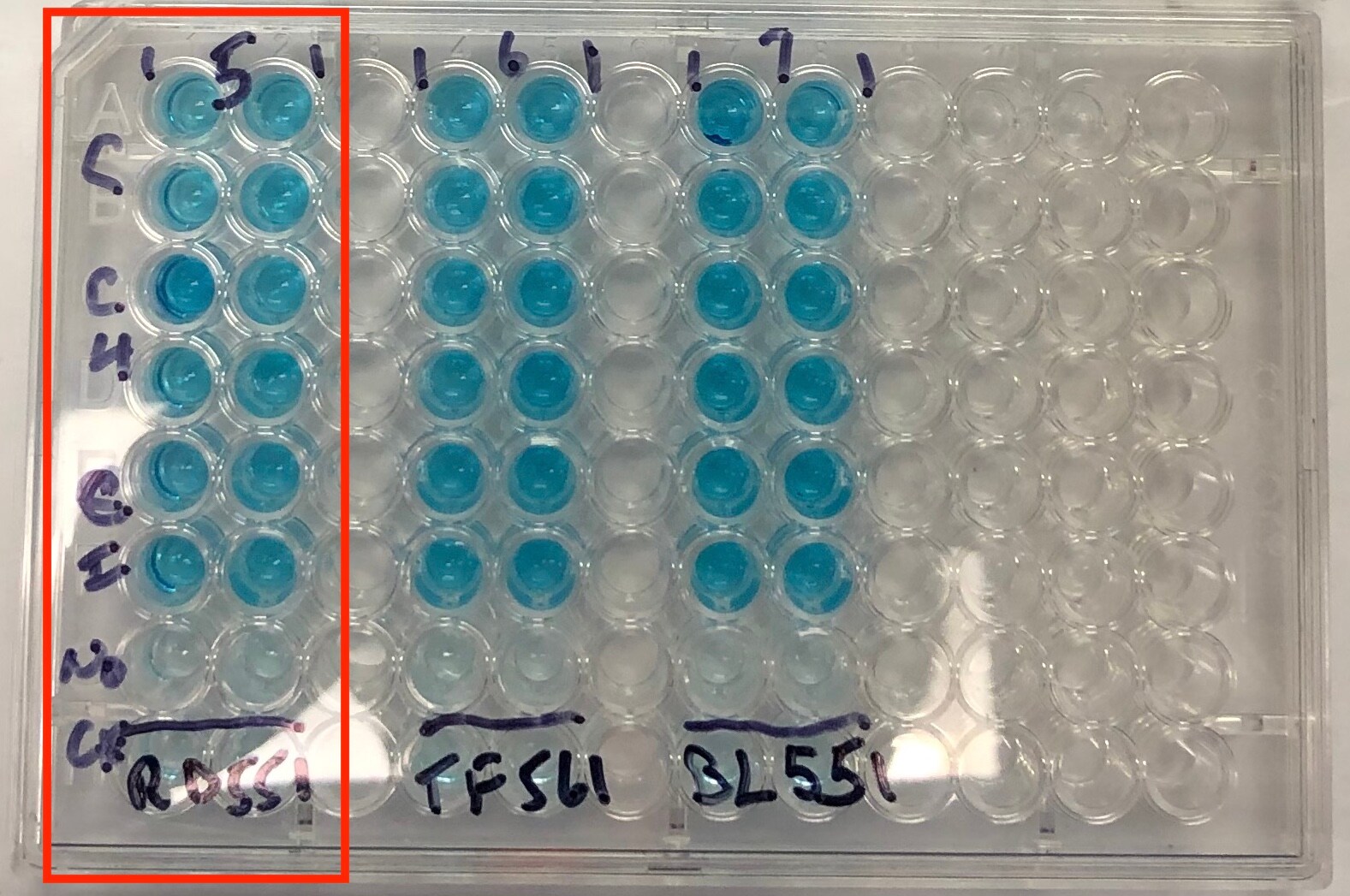
Application: ELISASample Tested: B cell lymphomaSpecies: HumanVerified Customer | Posted 01/08/2020This product was used as a capture antibody in an ELISA assay to test for BTK phosphorylation. Worked great!

There are no reviews that match your criteria.
Protocols
Find general support by application which include: protocols, troubleshooting, illustrated assays, videos and webinars.
- Cellular Response to Hypoxia Protocols
- R&D Systems Quality Control Western Blot Protocol
- Troubleshooting Guide: Western Blot Figures
- Western Blot Conditions
- Western Blot Protocol
- Western Blot Protocol for Cell Lysates
- Western Blot Troubleshooting
- Western Blot Troubleshooting Guide
- View all Protocols, Troubleshooting, Illustrated assays and Webinars
Associated Pathways
