
BAFF (also known as TALL-1, BLyS, THANK) is a type II transmembrane glycoprotein belonging to the TNF superfamily and has been designated as TNF superfamily member 13B (TNFSF13B). Mouse BAFF is a 309 aa protein consisting of a 248 amino acid (aa) extracellular domain, a 21 aa transmembrane region and a 45 aa cytoplasmic tail (1, 2). BAFF has the typical structural characteristics of the TNF superfamily ligands. It is a homotrimeric protein having the structurally conserved motif known as TNF homology domain (3, 4). A higher ordered structure composed of a cluster of trimeric units resembling the structure of a viral capsid has also been reported (4). Mouse BAFF may be shed from the cell surface by proteolytic cleavage between R126 and Ala 127 to yield a soluble form of the protein detectable in serum (1, 5). Within the TNF superfamily BAFF shares the highest homology (48%) with APRIL (1). BAFF shares with APRIL the ability to bind to BCMA and TACI and also binds specifically to BAFF receptor (BAFF R, also known as BR3 or TNFSFR13C), which is the principal BAFF receptor (6-8). All three receptors are type III transmembrane proteins that are expressed in B cells. BAFF and APRIL can form active heteromers that bind TACI (9). BAFF is expressed in peripheral blood mononuclear cells, in spleen and lymph nodes. Its expression in resting monocytes is upregulated by IFN-alpha, IFN-beta, LPS and IL-10. BAFF provides critical survival signals to a subset of B cells with intermediate maturation status (T2 B cells) during the immune response (10). BAFF also plays an important role in the development of lymphoid tissue and enhances the survival of activated memory B cells (7, 11). Human and mouse BAFF share 86% aa sequence identity (1).
Mouse BAFF/BLyS/TNFSF13B Antibody
R&D Systems | Catalog # AF2106


Scientific images may be resized, cropped, or adjusted for brightness or contrast for presentation purposes. These updates are limited to presentation and do not affect the underlying scientific interpretation of the data. Where available, additional source data may be provided upon request.
Key Product Details
Species Reactivity
Validated:
Cited:
Applications
Validated:
Cited:
Label
Antibody Source
Product Specifications
Immunogen
Ala127-Leu309
Accession # Q9WU72
Specificity
Clonality
Host
Isotype
Endotoxin Level
Scientific Data Images for Mouse BAFF/BLyS/TNFSF13B Antibody
Cell Proliferation Induced by BAFF/BLyS/TNFSF13B and Neutralization by Mouse BAFF/BLyS/TNFSF13B Antibody.
In the presence of Goat F(ab')2 Anti-mouse IgM, Recombinant Mouse BAFF/BLyS/ TNFSF13B (Catalog # 8876-BF) stimulates pro-liferation in mouse B cells in a dose-dependent manner (orange line). Under these conditions, proliferation elicited by Recombinant Goat Anti-Mouse BAFF/BLyS/TNFSF13B (3 ng/mL) is neutralized (green line) by increasing concentrations of Mouse BAFF/BLyS/TNFSF13B Antigen Affinity-purified Polyclonal Antibody (Catalog # AF2106). The ND50 is typically 0.01-0.04 µg/mL.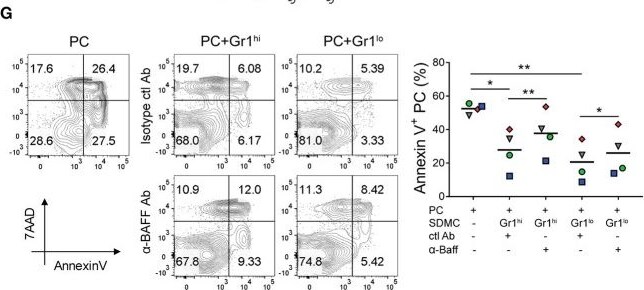
Detection of BAFF/BLyS/TNFSF13B by Flow Cytometry
BAFF-mediated effects of SDMCs on PC survival. (A) Spleen- and BM-derived CD11b+Gr-1hi and CD11b+Gr-1lo cells from sanroque mice and WT CD19+ B cells were assayed by RNA-seq. Differentially-expressed genes which encode known PC survival factors are displayed as a heatmap. The quantile-normalized (qnorm) TPM values were scaled in the logarithm with base 2 and are presented based on the color-code in the legend. (B) These cells were assayed by quantitative RT-PCR. (C) The SDMC subsets were analyzed by FACS to detect surface BAFF. Representative FACS profiles and mean fluorescence intensities (MFI) are displayed as means ± SDs with symbols representing values of individual mice. (D) The SDMC subsets were cultured in the presence of 1 μg/ml LPS for 48 h and supernatants were assayed by ELISA to detect soluble BAFF. (E) Sera were collected from WT and sanroque mice at the indicated ages and analyzed by ELISA. (F) Serum levels of BAFF and percentages of SDMCs in sanroque mice were analyzed by correlation analysis. (G) CD11b+Gr-1hi and Gr-1lo subsets of SDMCs were separately sorted and co-cultured with PCs in the presence of anti-BAFF or isotype-matched control mAb, and assayed by FACS after 48 h. FACS profiles gated on PCs and plots indicating the values of individual samples with means (horizontal lines) are shown. The data are representative of 2 (B) or 4 (C–G) independent experiments. Each symbol represents an individual experiment. *p < 0.05, **p < 0.01, and ***p < 0.001 by paired (G) and unpaired (C–E) Student's t-test. Image collected and cropped by CiteAb from the following open publication (https://pubmed.ncbi.nlm.nih.gov/33643317), licensed under a CC-BY license. Not internally tested by R&D Systems.Applications for Mouse BAFF/BLyS/TNFSF13B Antibody
Western Blot
Sample: Recombinant Mouse BAFF/BLyS/TNFSF13B (Catalog # 2106-BF)
Neutralization
Formulation, Preparation, and Storage
Purification
Reconstitution
Reconstitute at 0.2 mg/mL in sterile PBS. For liquid material, refer to CoA for concentration.
Formulation
Shipping
Stability & Storage
- 12 months from date of receipt, -20 to -70 °C as supplied.
- 1 month, 2 to 8 °C under sterile conditions after reconstitution.
- 6 months, -20 to -70 °C under sterile conditions after reconstitution.
Calculators
Background: BAFF/BLyS/TNFSF13B
References
- Schneider, P. et al. (1999) J. Exp. Med. 189:1747.
- Mukhopadhyay, A. et al. (1999) J. Biol. Chem. 274:15978.
- Karpusas, M. et al. (2002) J. Mol. Biol. 315:1145.
- Liu, Y. et al. (2002) Cell 108:383.
- Cheema, G.S. et al. (2001) Arthr. Rheum. 44:1313.
- Marsters, S.A. et al. (2000) Curr. Biol. 10:785.
- Thompson, J.S. et al. (2001) Science 293:2108.
- Ng, L. G. et al. (2004) J. Immunol. 173:807.
- Roschke, V. et al. (2002) J. Immunol. 169:4314.
- Batten, M. et al. (2000) J. Exp. Med. 192:1453.
- Avery, D.T. et al. (2003) J. Clin. Invest. 112:286.
Long Name
Alternate Names
Gene Symbol
UniProt
Additional BAFF/BLyS/TNFSF13B Products
Product Documents for Mouse BAFF/BLyS/TNFSF13B Antibody
Certificate of Analysis
To download a Certificate of Analysis, please enter a lot or batch number in the search box below.
Note: Certificate of Analysis not available for kit components.
Product Specific Notices for Mouse BAFF/BLyS/TNFSF13B Antibody
For research use only
Citations for Mouse BAFF/BLyS/TNFSF13B Antibody
 Powered by Bioz
Customer Reviews for Mouse BAFF/BLyS/TNFSF13B Antibody
There are currently no reviews for this product. Be the first to review Mouse BAFF/BLyS/TNFSF13B Antibody and earn rewards!
Have you used Mouse BAFF/BLyS/TNFSF13B Antibody?
Submit a review and receive an Amazon gift card!
$25/€18/£15/$25CAN/¥2500 for a review with an image
$10/€7/£6/$10CAN/¥1110 for a review without an image
Submit a review
Protocols
Find general support by application which include: protocols, troubleshooting, illustrated assays, videos and webinars.
- Cellular Response to Hypoxia Protocols
- R&D Systems Quality Control Western Blot Protocol
- Troubleshooting Guide: Western Blot Figures
- Western Blot Conditions
- Western Blot Protocol
- Western Blot Protocol for Cell Lysates
- Western Blot Troubleshooting
- Western Blot Troubleshooting Guide
- View all Protocols, Troubleshooting, Illustrated assays and Webinars
Associated Pathways
