
Cerberus 1, also called DAND4, is a member of the DAN domain family of BMP antagonists that includes DAN (DAND1), Gremlin/Drm (DAND2), PRDC (Protein Related to Dan and Cerberus; DAND3), and COCO/Dante (DAND5). DAN family members contain a cysteine-knot domain that is homologous to that found in other TGF-beta superfamily ligands (1, 2). Mature mouse Cerberus 1 shares 40%, 29%, and 66% amino acid (aa) sequence identity with chick, Xenopus, and human Cerberus 1, respectively. Within the cysteine-knot domain, it shares 24-37% aa sequence identity with mouse DAN, Gremlin, PRDC, and COCO. Cerberus 1 is a secreted 38 kDa glycoprotein that forms disulfide-linked homodimers (3). Cerberus-S, which is generated by proteolysis in Xenopus, is a short version of the molecule and includes the C-terminal cysteine-knot domain (4). At the onset of gastrulation, Cerberus 1 is transiently expressed in anterior endodermal structures in response to Nodal and Shh (3, 5-9). Cerberus 1 binds BMP-4 and Nodal and inhibits their activities. Xenopus Cerberus has also been shown to bind Xenopus Wnt8. These inhibitory functions of Cerberus favor mesodermal development in the anterior region of the gastrula and suppresses posterior mesodermal differentiation (3, 4, 6, 8, 10-12). In chick and Xenopus, Cerberus 1 also regulates, but is not required for embryonic left-right polarization, neurulation, and head and heart induction (4-8, 13).
Mouse Cerberus 1 Antibody (225807)
R&D Systems | Catalog # MAB1986

Scientific images may be resized, cropped, or adjusted for brightness or contrast for presentation purposes. These updates are limited to presentation and do not affect the underlying scientific interpretation of the data. Where available, additional source data may be provided upon request.
Key Product Details
Species Reactivity
Validated:
Cited:
Applications
Validated:
Cited:
Label
Antibody Source
Product Specifications
Immunogen
Asp18-Pro272
Accession # O55233
Specificity
Clonality
Host
Isotype
Scientific Data Images for Mouse Cerberus 1 Antibody (225807)
Detection of Cerberus 1 by Immunohistochemistry
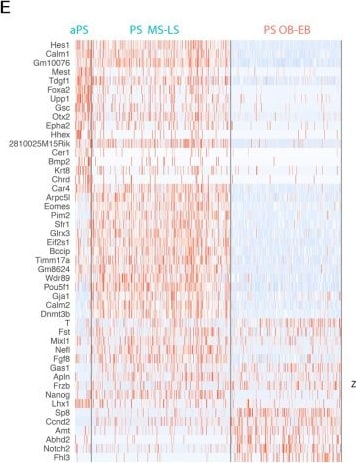
The molecular signature of the primitive streak cells contributing to the ventricles or outflow/atria are distinct.(A) Mid-late streak and OB/EB TnGPF-CreERT2/+; R26RtdTomato/tdTomato embryos analysed in the scRNA-seq. Embryos were selected at the mid-late streak stages (dissected at E6+21h and resulting from tamoxifen administration at E6+5h) and at the OB-EB stage (dissected at E7+3h and resulting from tamoxifen administration at E6+21h). (B, C) Expression heat map of marker genes. Scale indicates z-scored expression values. The data can be found in S7 Source Data. (D) UMAP plot showing the integrated data from the 2 scRNA-seq mid-late streak and OB/EB datasets (see also S11 Fig). Colour codes correspond to the embryonic stage of collection or population identity. The data underlying (D) can be found in S7 Source Data. (E) Expression heat map of marker genes comparing the aPS and primitive streak cells at the mid-late streak stages and primitive streak cells at the OB-EB stages (S7 Source Data). Scale indicates z-scored expression values. (F) UMAP plot of the aPS, MS-LS primitive streak, and OB-EB primitive streak cells colour coded. (G, H) Violin plots showing the normalised log2 expression value of Eomes and T (G) and Foxa2, Lhx1, Sp8 Hes1, Ccnd2, and Notch2 (H) in the aPS and primitive streak at MS-LS and OB-EB stages. The data underlying (G, H) can be found in S7 Source Data. aPS, anterior primitive streak; DE, definitive endoderm; EB, early bud; LPM/Ex-meso, lateral plate mesoderm and extraembryonic mesoderm, mesenchyme; LS, late streak; MS, mid-streak; Nascent meso, nascent mesoderm; OB, no bud; PGC, primordial germs cells; PS, primitive streak; scRNA-seq, single-cell RNA sequencing; UMAP, Uniform Manifold Approximation Projection. Image collected and cropped by CiteAb from the following open publication (https://pubmed.ncbi.nlm.nih.gov/33999917), licensed under a CC-BY license. Not internally tested by R&D Systems.Applications for Mouse Cerberus 1 Antibody (225807)
Western Blot
Sample: Recombinant Mouse Cerberus 1 (Catalog # 1986-CB)
Reviewed Applications
Read 1 review rated 5 using MAB1986 in the following applications:
Formulation, Preparation, and Storage
Purification
Reconstitution
Reconstitute at 0.5 mg/mL in sterile PBS. For liquid material, refer to CoA for concentration.
Formulation
Shipping
Stability & Storage
- 12 months from date of receipt, -20 to -70 °C as supplied.
- 1 month, 2 to 8 °C under sterile conditions after reconstitution.
- 6 months, -20 to -70 °C under sterile conditions after reconstitution.
Calculators
Background: Cerberus 1
References
- Avsian-Kretchmer, O. and A.J.W. Hsueh (2004) Mol. Endocrinol. 18:1.
- Kawano, Y. and R. Kypta (2003) J. Cell Sci. 116:2627.
- Biben, C. et al. (1998) Dev. Biol. 194:135.
- Piccolo, S. et al. (1999) Nature 397:707.
- Zhu, L. et al. (1999) Curr. Biol. 9:931.
- Tavares, A.T. et al. (2007) Development 134:2051.
- Foley, A.C. et al. (2007) Dev. Biol. 303:57.
- Bouwmeester, T. et al. (1996) Nature 382:595.
- Bertocchini, F. and C.D. Stern (2002) Dev. Cell 3:735.
- Glinka, A. et al. (1997) Nature 389:517.
- Perea-Gomez, A. et al. (2002) Dev. Cell 3:745.
- Takaoka, K. et al. (2007) Curr. Opin. Genet. Dev. 17:344
- Simpson, E.H. et al. (1999) Dev. Biol. 213:202.
Alternate Names
Gene Symbol
UniProt
Additional Cerberus 1 Products
Product Documents for Mouse Cerberus 1 Antibody (225807)
Certificate of Analysis
To download a Certificate of Analysis, please enter a lot or batch number in the search box below.
Note: Certificate of Analysis not available for kit components.
Product Specific Notices for Mouse Cerberus 1 Antibody (225807)
For research use only
Related Research Areas
Citations for Mouse Cerberus 1 Antibody (225807)
 Powered by Bioz
Customer Reviews for Mouse Cerberus 1 Antibody (225807) (1)
Have you used Mouse Cerberus 1 Antibody (225807)?
Submit a review and receive an Amazon gift card!
$25/€18/£15/$25CAN/¥2500 for a review with an image
$10/€7/£6/$10CAN/¥1110 for a review without an image
Submit a review
Customer Images

-
Application: Immunocytochemistry/ImmunofluorescenceSample Tested: E6.5 mouse embryo fixed in 4% PFASpecies: MouseVerified Customer | Posted 10/26/2015E6.5 mouse embryo fixed in 4% PFA was stained with this antibody. DAPI was used for nuclear counterstain. Cerberus1 positive cells were seen in the anterior visceral endoderm. <br />Specificity: Specific<br />Sensitivity: Reasonably sensitive<br />Buffer: PBS-T<br />Dilution: 1:100

There are no reviews that match your criteria.
Protocols
Find general support by application which include: protocols, troubleshooting, illustrated assays, videos and webinars.
- Cellular Response to Hypoxia Protocols
- R&D Systems Quality Control Western Blot Protocol
- Troubleshooting Guide: Western Blot Figures
- Western Blot Conditions
- Western Blot Protocol
- Western Blot Protocol for Cell Lysates
- Western Blot Troubleshooting
- Western Blot Troubleshooting Guide
- View all Protocols, Troubleshooting, Illustrated assays and Webinars