
Interleukin 22 binding protein (IL-22BP), also known as CRF2-10, CRF2-X, and IL-22 RA2, is a 35‑45 kDa secreted glycoprotein belonging to the type II cytokine receptor family (CRF). IL-22 signals through a receptor complex consisting of IL-22 R and IL-10 R beta. IL-10 R beta is also a component of the receptor complexes for IL‑10, IL-26, IL-28, and IL-29 (1‑4). IL‑10 R beta is widely expressed, and other cell types express either IL-10 R alpha or IL-22 R but not both (5). The mouse IL-22BP cDNA encodes a 230 amino acid (aa) precursor that includes a 20 aa signal sequence and two fibronectin type-III domains (6). Mouse IL-22BP shares 59% and 85% aa sequence identity with human and rat IL-22BP, respectively. Among type II cytokine receptors, IL-22BP is most closely related to the extracellular domain of IL-22 R, sharing 36% aa sequence identity. Splice variants of human IL-22BP exist but have not been detected for the mouse protein (6‑8). IL-22BP binds an epitope on IL-22 that is required for the interaction of IL-22 with the transmembrane IL-22 R (8‑10), thereby preventing the association of IL-22 R with IL-10 R beta (10). IL-22BP blocks IL‑22‑induced responses including induction of MHC class I expression, Stat1 and Stat3 activation, SOCS3 gene expression,the production of reactive oxygen species (6, 9) and the modulation of the proinflammatory effects of IL-22 (11). Mouse IL-22 BP neutralizes both mouse and human IL-22 (6). IL-22BP is secreted by epithelial cells, dendritic cells, activated B cells, and activated monocytes (6, 8, 12, 13).
Mouse IL-22BP Antibody
R&D Systems | Catalog # AF2376

Scientific images may be resized, cropped, or adjusted for brightness or contrast for presentation purposes. These updates are limited to presentation and do not affect the underlying scientific interpretation of the data. Where available, additional source data may be provided upon request.
Key Product Details
Species Reactivity
Validated:
Cited:
Applications
Validated:
Cited:
Label
Antibody Source
Product Specifications
Immunogen
Thr19-Pro230 (Asp149Glu)
Accession # Q80XF5
Specificity
Clonality
Host
Isotype
Scientific Data Images for Mouse IL-22BP Antibody
Detection of IL-22BP by Western Blot
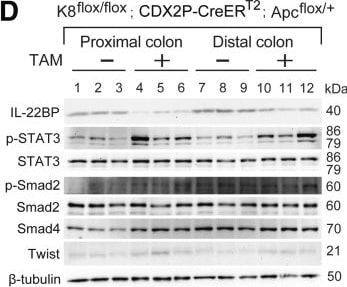
TAM-treated K8flox/flox; CDX2P-CreERT2; Apcflox/+ mice show downregulation of colonic keratins and minor changes in EMT-associated signaling in the colon. (A) Total proximal colon lysates from K8flox/flox; CDX2P-CreERT2; Apcflox/+ –TAM (Lanes 1–3), K8flox/flox; CDX2P-CreERT2; Apcflox/+ +TAM (Lanes 4–6) and (B) total distal colon lysates from K8flox/flox; CDX2P-CreERT2; Apcflox/+ –TAM (Lanes 1–3), K8flox/flox; CDX2P-CreERT2; Apcflox/+ +TAM (Lanes 4–6) on day 78 were immunoblotted for K8, K7, K18, K19, and K20. beta -actin was used as the loading control. (C) Western blots from (A and B) were quantified and normalized to beta -actin. The results are presented as mean (n = 3 mice per group, each data point represents an individual mouse) protein fold changes ± SD. (D) Total proximal colon lysates from K8flox/flox; CDX2P-CreERT2; Apcflox/+ –TAM (Lanes 1–3), K8flox/flox; CDX2P-CreERT2; Apcflox/+ +TAM (Lanes 4–6) and total distal colon lysates from K8flox/flox; CDX2P-CreERT2; Apcflox/+ –TAM (Lanes 7–9), K8flox/flox; CDX2P-CreERT2; Apcflox/+ +TAM (Lanes 10–12) on day 78 were immunoblotted for IL-22BP, p-STAT3, STAT3, p-Smad2, Smad2, Smad4, and Twist. beta -tubulin was used as the loading control. (E) Western blots from (D) were quantified and normalized to beta -tubulin. The results are presented as mean (n = 3 mice per group, each data point represents an individual mouse) protein fold changes ± SD. The statistical significance was determined after performing unpaired Student’s t-test for (C and E), shown as ∗P <.05; ∗∗P <.01; ∗∗∗P <.001; and ∗∗∗∗P <.0001. Image collected and cropped by CiteAb from the following open publication (https://linkinghub.elsevier.com/retrieve/pii/S2352345X25002589), licensed under a CC-BY license. Not internally tested by R&D Systems.Applications for Mouse IL-22BP Antibody
Western Blot
Sample: Recombinant Mouse IL‑22BP Fc Chimera (Catalog # 2376-BP)
Formulation, Preparation, and Storage
Purification
Reconstitution
Reconstitute at 0.2 mg/mL in sterile PBS. For liquid material, refer to CoA for concentration.
Formulation
Shipping
Stability & Storage
- 12 months from date of receipt, -20 to -70 °C as supplied.
- 1 month, 2 to 8 °C under sterile conditions after reconstitution.
- 6 months, -20 to -70 °C under sterile conditions after reconstitution.
Calculators
Background: IL-22BP
References
- Donnelly, R.P. et al. (2004) J. Leukoc. Biol. 76:314.
- Pestka, S. et al. (2004) Annu. Rev. Immunol. 22:929.
- Langer, J.A. et al. (2004) Cytokine Growth Factor Rev. 15:33.
- Kotenko, S.V. (2002) Cytokine Growth Factor Rev. 13:223.
- Wolk, K. et al. (2005) Genes Immun. 6:8.
- Wei, C.-C. et al. (2003) Genes Immun. 4:204.
- Dumoutier, L. et al. (2001) J. Immunol. 166:7090.
- Xu, W. et al. (2001) Proc. Natl. Acad. Sci. USA 98:9511.
- Kotenko, S.V. et al. (2001) J. Immunol. 166:7096.
- Li, J. et al. (2004) Int. Immunopharmacol. 4:693.
- Whittington, H.A. et al. (2004) Am. J. Respir. Cell Mol. Biol. 31:220.
- Lecart, S. et al. (2002) Int. Immunol. 14:1351.
- Nagalakshmi, M.L. et al. (2004) Int. Immunopharmacol. 4:577.
Long Name
Alternate Names
Gene Symbol
UniProt
Additional IL-22BP Products
Product Documents for Mouse IL-22BP Antibody
Certificate of Analysis
To download a Certificate of Analysis, please enter a lot or batch number in the search box below.
Note: Certificate of Analysis not available for kit components.
Product Specific Notices for Mouse IL-22BP Antibody
For research use only
Related Research Areas
Citations for Mouse IL-22BP Antibody
 Powered by Bioz
Customer Reviews for Mouse IL-22BP Antibody
There are currently no reviews for this product. Be the first to review Mouse IL-22BP Antibody and earn rewards!
Have you used Mouse IL-22BP Antibody?
Submit a review and receive an Amazon gift card!
$25/€18/£15/$25CAN/¥2500 for a review with an image
$10/€7/£6/$10CAN/¥1110 for a review without an image
Submit a review
Protocols
Find general support by application which include: protocols, troubleshooting, illustrated assays, videos and webinars.
- Cellular Response to Hypoxia Protocols
- R&D Systems Quality Control Western Blot Protocol
- Troubleshooting Guide: Western Blot Figures
- Western Blot Conditions
- Western Blot Protocol
- Western Blot Protocol for Cell Lysates
- Western Blot Troubleshooting
- Western Blot Troubleshooting Guide
- View all Protocols, Troubleshooting, Illustrated assays and Webinars