
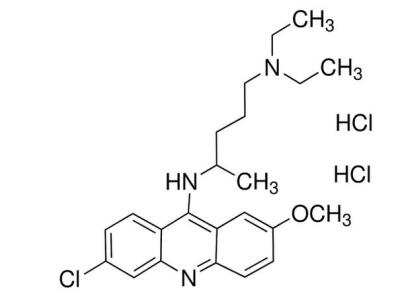
Quinacrine Inhibitor
Novus Biologicals | Catalog # NBP2-29385

Loading...
Loading...
Product Specifications
Details of Functionality
Endosomal toll-like receptor inhibitor (antagonist); Inhibitor of endosomal acidification on which functional activity of endosomal TLRs (particularly TLR9 and TLR3) is dependent.
Application Notes
Assay>=90%
Scientific Data Images for Quinacrine Inhibitor
Quinacrine Inhibitor [NBP2-29385]
![Other: Quinacrine Inhibitor [NBP2-29385]](https://resources.rndsystems.com/images/products/Quinacrine-Inhibitor-NBP2-29385-img0002.jpg "Other: Quinacrine Inhibitor [NBP2-29385]")
Other: Quinacrine Inhibitor [NBP2-29385]
Quinacrine Inhibitor [NBP2-29385] - Evaluation of inhibitory activity of quinacrine. TLR9/NF-kB/SEAPorter™ HEK 293 and TLR2/NF-kB/SEAPorter™ HEK 293 cells were plated in 96-well plates at 5x10^4 cells/well for 16 h. Cells were preincubated with different concentrations of quinacrine (0.05, 0.1, 0.5, 1, 5 and 10 uM) for 30 min. Cell were then stimulated with 10 ug/ml CpG [A] or 20 ng/ml MALP-2 [B] for 24 h. Secreted alkaline phosphatase (SEAP) was analyzed using SEAPorter™ Assay Kit![Other: Quinacrine Inhibitor [NBP2-29385]](https://resources.rndsystems.com/images/products/Quinacrine-Inhibitor-NBP2-29385-img0003.jpg "Other: Quinacrine Inhibitor [NBP2-29385]")
Other: Quinacrine Inhibitor [NBP2-29385]
Quinacrine Inhibitor [NBP2-29385] - TLR9/NF-kB/SEAPorter™ HEK 293 cells were plated in 96-well plates at 5x10^4 cells/well for 16 h. Cells were preincubated with various concentrations of quinacrine for 30 min, followed by stimulation with 10 ug/ml CpG for 24 h. SEAP was analyzed using SEAPorter™ Assay Kit. Dose-responsive percent inhibition of each sample well was calculated to yield the quinacrine IC50 value.Formulation, Preparation, and Storage
Formulation
Form : Yellow Solid (Powder)
Solubility:Deionized water
Solubility:Deionized water
Concentration
Concentration is not relevant for this product. Please see the protocols for proper use of this product.
Shipping
The product is shipped with polar packs. Upon receipt, store it immediately at the temperature recommended below.
Storage
Store at 4C. Do not freeze.
Background: Quinacrine
Alternate Names
1-2-bromophenyl-5-3-methylphenyl triazole-4-carboxylic acid, 6-Chloro-9-4-diethylamino-1-methylbutylamino-2-methoxyacridine dihydrochloride, Atebrin dihydrochloride, C23H30ClN3O-2HCl, Mepacrine dihydrochloride, Quinacrine dihydrochloride
Additional Quinacrine Products
Product Documents for Quinacrine Inhibitor
Certificate of Analysis
To download a Certificate of Analysis, please enter a lot or batch number in the search box below.
Product Specific Notices for Quinacrine Inhibitor
This product is for research use only and is not approved for use in humans or in clinical diagnosis. Inhibitors are guaranteed for 1 year from date of receipt.
Citations for Quinacrine Inhibitor
 Powered by Bioz
Customer Reviews for Quinacrine Inhibitor
There are currently no reviews for this product. Be the first to review Quinacrine Inhibitor and earn rewards!
Have you used Quinacrine Inhibitor?
Submit a review and receive an Amazon gift card!
$25/€18/£15/$25CAN/¥2500 for a review with an image
$10/€7/£6/$10CAN/¥1110 for a review without an image
Submit a review
Protocols
View specific protocols for Quinacrine Inhibitor (NBP2-29385):
Product Handling Protocol (NBP2-29385):
1. To make 100 mM stock solution, dissolve 200 mg quinacrine in 4.2 ml water by gentle vortex.
2. Filter sterilize through a 0.22 um filter.
3. Store at 4oC (Note: Quinacrine solution is light sensitive.).
4. For TLR signaling inhibition study, perform a pilot inhibitory test with the different concentrations of quinacrine ranging from 1 to 10 mM to optimize your experiments.
1. To make 100 mM stock solution, dissolve 200 mg quinacrine in 4.2 ml water by gentle vortex.
2. Filter sterilize through a 0.22 um filter.
3. Store at 4oC (Note: Quinacrine solution is light sensitive.).
4. For TLR signaling inhibition study, perform a pilot inhibitory test with the different concentrations of quinacrine ranging from 1 to 10 mM to optimize your experiments.
Loading...