
Mcl-1 (Myeloid Cell Leukemia 1) is a member of the Bcl-2 family of proteins. Alternative splicing results in two distinct isoforms: Mcl-1L (long) enhances cell survival by inhibiting apoptosis, while Mcl-1S (short) promotes apoptosis. The elimination of Mcl-1L is an early and required step for DNA damage-induced apoptosis. Degradation of Mcl-1L is regulated by polyubiquitination, which targets Mcl-1L to the proteasome pathway.
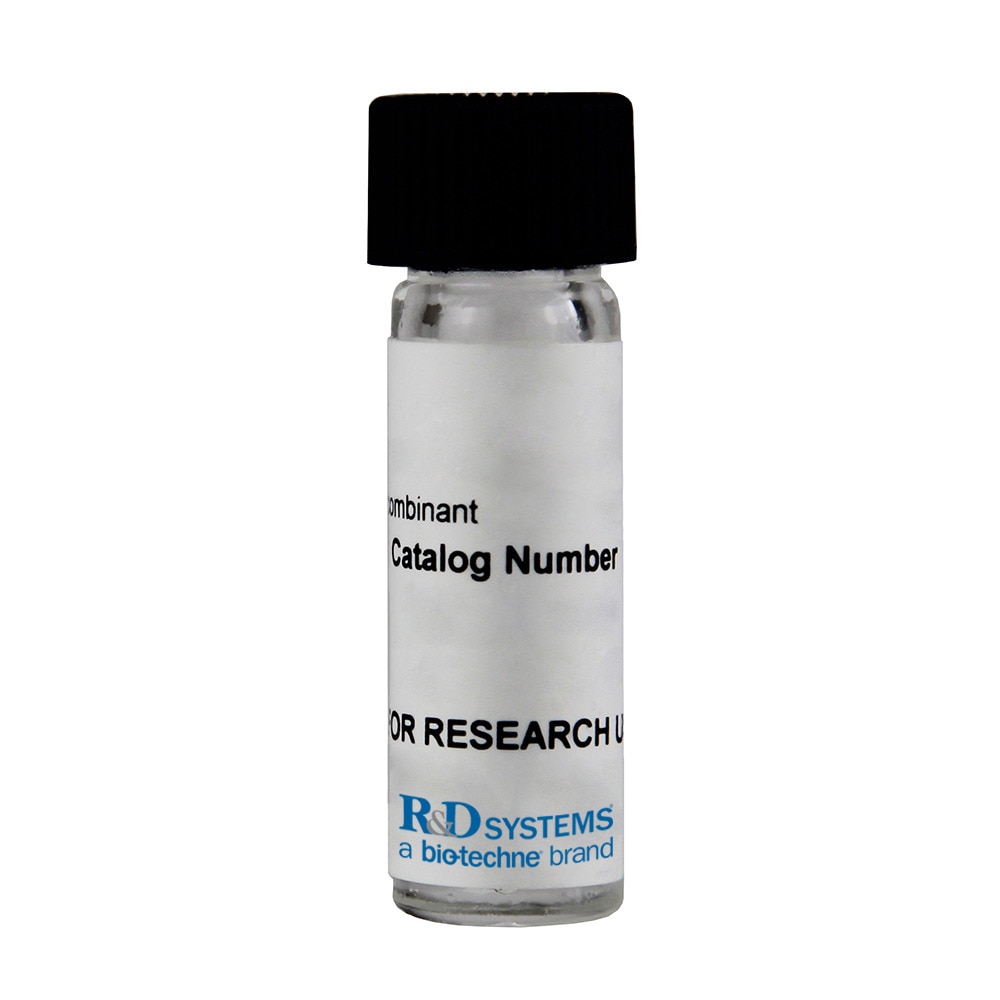
Recombinant Human Mcl-1 Western Blot Standard Protein
R&D Systems | Catalog # WBC003

Loading...
Key Product Details
- R&D Systems E. coli-derived Recombinant Human Mcl-1 Western Blot Standard Protein (WBC003)
- Quality control testing to verify active proteins with lot specific assays by in-house scientists
- All R&D Systems proteins are covered with a 100% guarantee
Source
Sf 21 (baculovirus)
Applications
Western Blot
Loading...
Formulation, Preparation, and Storage
WBC003
Background: Mcl-1
Long Name
Myeloid Cell Leukemia Sequence 1
Alternate Names
BCL2L3, Mcl1
Gene Symbol
MCL1
Additional Mcl-1 Products
Product Documents for Recombinant Human Mcl-1 Western Blot Standard Protein
Certificate of Analysis
To download a Certificate of Analysis, please enter a lot or batch number in the search box below.
Note: Certificate of Analysis not available for kit components.
Product Specific Notices for Recombinant Human Mcl-1 Western Blot Standard Protein
For research use only
Related Research Areas
Customer Reviews for Recombinant Human Mcl-1 Western Blot Standard Protein
There are currently no reviews for this product. Be the first to review Recombinant Human Mcl-1 Western Blot Standard Protein and earn rewards!
Have you used Recombinant Human Mcl-1 Western Blot Standard Protein?
Submit a review and receive an Amazon gift card!
$25/€18/£15/$25CAN/¥2500 for a review with an image
$10/€7/£6/$10CAN/¥1110 for a review without an image
Submit a review
Protocols
Find general support by application which include: protocols, troubleshooting, illustrated assays, videos and webinars.
- Cellular Response to Hypoxia Protocols
- R&D Systems Quality Control Western Blot Protocol
- Troubleshooting Guide: Western Blot Figures
- Western Blot Conditions
- Western Blot Protocol
- Western Blot Protocol for Cell Lysates
- Western Blot Troubleshooting
- Western Blot Troubleshooting Guide
- View all Protocols, Troubleshooting, Illustrated assays and Webinars
Loading...
Associated Pathways
