
PAR/pADPr Antibody
R&D Systems | Catalog # 4336-APC-050

Scientific images may be resized, cropped, or adjusted for brightness or contrast for presentation purposes. These updates are limited to presentation and do not affect the underlying scientific interpretation of the data. Where available, additional source data may be provided upon request.
Discontinued Product
4336-APC-050 has been discontinued.
An alternative/replacement product is available:
4335-MC-100. View all PAR/pADPr products.
Key Product Details
Species Reactivity
Validated:
Multi-Species
Cited:
Human, Mouse
Applications
Validated:
Western Blot
Cited:
Western Blot
Label
Unconjugated
Antibody Source
Polyclonal Rabbit IgG
Loading...
Product Specifications
Immunogen
Poly(ADP-ribose) polymer
Specificity
This polyclonal antibody detects free PAR and poly-ribosylated proteins.
Clonality
Polyclonal
Host
Rabbit
Isotype
IgG
Scientific Data Images for PAR/pADPr Antibody
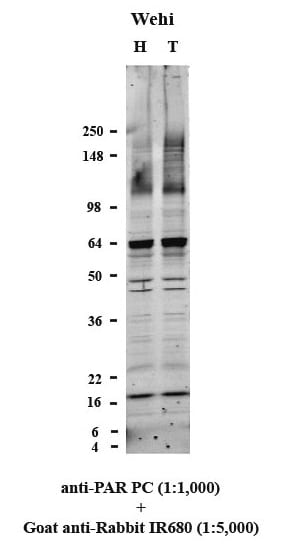
Detection of PAR/pADPr by Western Blot.
Western blot analysis of Wehi cells untreated (H) and treated (T) with 25 μM Etoposide for 4 hours at 37 °C. Cells were lysed in Tris-Glycine SDS sample buffer at the concentration of 1 x 10⁷cells/ml, and 10 μl of clarified lysate were loaded per well of 4-20% Tris-Glycine gel. Proteins were transferred onto an Immobilon FL membrane and ribosylated proteins were detected using Trevigen's polyclonal anti-PAR antibody (cat# 4336-APC-050) followed by an IR680-conjugated secondary antibody (Licor). The membrane was scanned using an Odyssey Infrared Imaging System (Licor).Applications for PAR/pADPr Antibody
Application
Recommended Usage
Western Blot
1:1000 dilution
Sample: Wehi cells treated with Etoposide
Sample: Wehi cells treated with Etoposide
Formulation, Preparation, and Storage
Purification
Antigen Affinity-purified
Formulation
This antibody is an affinity purified IgG fraction in 1X PBS, containing 50%
glycerol.
Shipping
The product is shipped with polar packs. Upon receipt, store it immediately at the temperature recommended below.
Stability & Storage
-20 °C (manual defrost freezer)
Background: PAR/pADPr
Blotting buffer: 12 mM Tris base, 96 mM Glycine, and 15% MeOH.
Blocking solution: 5% (w/v) nonfat dry milk in TBS-0.1% Tween.
Antibody solution: 5% (w/v) nonfat dry milk, in TBS-0.1% Tween.
Transfer the electrophoresed proteins to a PVDF membrane and incubate the membrane for 1 hour at room temperature in blocking solution.
Incubate the membrane overnight at 4°C in antibody solution containing a 1:1000 dilution of anti-PAR rabbit polyclonal antibody. Empirical determination of primary antibody concentration will be required for optimal results.
Wash the membrane at room temperature for 5 minutes with 3 changes of TBS-0.1% Tween. Changing the membrane containers often reduces background.
Incubate the membrane at room temperature for 1 hour in antibody solution containing antirabbit conjugated to horseradish peroxidase.
Empirical determination of secondary antibody concentration will be required for optimal results.
Wash the membrane for 5 minutes with 4 changes of TBS-0.1% Tween.
Develop peroxidase reaction using chemiluminescence.
References
- Affar, E.B., et al. 1998. Immunodot blot method for the detection of poly(ADP-ribose) synthesized in vitro and in vivo. Anal Biochem 259:280-3.
- Shah, G.M., et al. 1995. Methods for biochemical study of poly(ADP-ribose) metabolism in vitro and in vivo. Anal Biochem 227:1-13.
- Gagné, J-P., et al. 2008. Proteome-wide identification of poly(ADP-ribose) binding proteins and poly(ADP-ribose)-associated protein complexes. Nucleic Acids Res 36:6959-76.
Long Name
Poly [ADP-ribose] Polymer
Alternate Names
PAR
Additional PAR/pADPr Products
Product Documents for PAR/pADPr Antibody
Certificate of Analysis
To download a Certificate of Analysis, please enter a lot or batch number in the search box below.
Note: Certificate of Analysis not available for kit components.
Product Specific Notices for PAR/pADPr Antibody
For research use only
Related Research Areas
Citations for PAR/pADPr Antibody
 Powered by Bioz
Customer Reviews for PAR/pADPr Antibody
There are currently no reviews for this product. Be the first to review PAR/pADPr Antibody and earn rewards!
Have you used PAR/pADPr Antibody?
Submit a review and receive an Amazon gift card!
$25/€18/£15/$25CAN/¥2500 for a review with an image
$10/€7/£6/$10CAN/¥1110 for a review without an image
Submit a review
Protocols
Find general support by application which include: protocols, troubleshooting, illustrated assays, videos and webinars.
- Cellular Response to Hypoxia Protocols
- R&D Systems Quality Control Western Blot Protocol
- Troubleshooting Guide: Western Blot Figures
- Western Blot Conditions
- Western Blot Protocol
- Western Blot Protocol for Cell Lysates
- Western Blot Troubleshooting
- Western Blot Troubleshooting Guide
- View all Protocols, Troubleshooting, Illustrated assays and Webinars
Loading...