
Smart-seq3xpress Protocol with SEQURNA
In Brief
SEQURNA (Catalog # 9028) is a synthetic thermostable RNase inhibitor for single-cell RNA-sequencing (scRNAseq), yielding single-cell libraries of equal or superior quality compared to ubiquitously used protein-based recombinant RNase inhibitors (RRIs).
SEQURNA provides additional unique improvements in reproducibility and throughput, enables new experimental workflows including retained RNase inhibition throughout heat cycles, and can reduce the need for dry-ice transports.
Important Information
• Using more RNase inhibitor than recommended does not improve results and may reduce cDNA library yield and quality.
• This protocol requires a liquid handler capable of dispensing nanolitre volumes.
Oligonucleotide Sequences (5’ to 3’)
SS3 oligo dT: 5’-/5Biosg/ACGAGCATCAGCAGCATACGAT30VN-3’
Smart-seq3xpress TSO: 5’- /5BiosG/AGAGACAGATTGCGCAATGNNNNNNNNWWrGrGrG-3’
SS3 Fwd Primer: 5’-TCGTCGGCAGCGTCAGATGTGTATAAGAGACAGATTGCGCAA*T*G-3’
SS3 Rev Primer: 5’-ACGAGCATCAGCAGCATAC*G*A-3’
* Phosphorothioate bonds
Considerations
• This protocol requires a liquid handler capable of performing nanoliter dispenses (Formulatrix Mantis, Dispendix I.Dot & Dispendix I.Dot Mini). Other (non-contact) liquid dispensers should work as well, as long as they can dispense the required volumes accurately.
• All volumes have been scaled to nanoliter volumes, as such the volume your cell is dispensed in matters. This protocol works with an array of FACS machines and cell printers including BD FACSMelody, BD Fusion, BD Influx, Sony SH800S, Cellenion CellenOne, Cytena F.SIGHT Omics, which all typically dispenses the cell in ~5-10 nl or less. If your instrument dispenses in higher volumes (> 50 nl), the protocol may either not work or not be as efficient.
• Consider what buffer you use to dispense / sort your single cells in. Since the relative difference between sorted cell volume and lysis volume has overall decreased, common additives like FBS, BSA, EDTA can potentially interfere and affect downstream molecular reaction if present in high enough amounts. As such we recommend if possible, to sort in PBS alone, or as recommended by 10x Genomics a solution of PBS + 0.04% BSA at most. Refrain also from using buffers with Mg2+ and Ca2+ or other metal ions for sorting. If EDTA is an absolute must, try and keep the amounts low. Avoid other additives like DNAseI, and Sodium Azide.
1. Preparation of Overlay Plates
1.1 Use Vapor-Lock, Silicone Oil 25 cSt, or Silicone Oil 100 cSt (the higher viscosity is preferred for shipping plates). Caution: Do not dispense these silicone oils/overlays using non-contact liquid handlers, as the solutions may spread uncontrollably. Instead, use manual multichannel pipettes or semi-manual/automated systems with tips (e.g., Integra ViaFlow, Agilent Bravo, Tecan Fluent). Prepare and store in bulk. Add 3 µl of overlay to each well of a 384 well plate. The amount of overlay can be increased if desired.
1.2 Briefly centrifuge at 1000 × g to collect all content at the bottom of the wells.
1.3 Seal the plate and store at room temperature until use.
2. Preparation of Lysis Plates
2.1 Prepare the lysis buffer mix according to Table 1. Optimal concentration of SEQURNA in the Smart-seq3xpress protocol is 0.2 mass units/µl in the lysis buffer, resulting in 0.15 mass units/µl in the RT reaction.
| Reagent | Conc. in lysis buffer | µl per reaction | 384-well plate (500 rxns) |
|---|---|---|---|
| Poly-ethylene glycol 8000 (40% solution) | 6.7% | 0.05 | 25 |
| Triton X-100 (10% solution) | 0.1% | 0.003 | 1.5 |
| SEQURNA (50 mass units/µl) | 0.2 mass units/µl | 0.0012 | 0.6 |
| SS3 oligo dT (10 µM) | 0.167 µM | 0.005 | 2.5 |
| dNTPs (10mM/each) | 0.66 mM/each | 0.02 | 10 |
| Nuclease-free water | - | 0.221 | 110.5 |
| ERCC spike-ins (Optional) | - | - | - |
| Total | - | 0.3 µl | 150µl |
Table 1: Reagent preparation for Smart-seq3xpress lysis buffer: Volumes for 384-well plates
2.2 Add 0.3 µl lysis buffer to each well of a 384-well plate containing overlay, and centrifuge briefly to collect lysis buffer.
3. Sample Collection
3.1 Sort single cells into 0.3 μl of lysis buffer with overlay in 384-well plates.
3.2 Seal the plate with appropriate cover seals (tolerating -80 °C to +110 °C) and centrifuge the finished sorted plate immediately after. Transfer the plate to a -80 °C freezer if not processing the cells into cDNA libraries within one day (or keep plates in ~4 °C for up to one day). Prompt processing is beneficial for retained RNA integrity.
4. Cell Lysis
4.1 Remove the plate of sorted cells from the -80 °C freezer and incubate in a thermocycler with heated lid at 72 °C for 10 min., followed by a 4 °C hold.
5. Reverse Transcription
5.1 While the plate is incubating at the cell lysis step, prepare the reverse transcription master mix as described in Table 2. Do not add additional inhibitor in the RT reaction. The SEQURNA from the lysis buffer stays effective throughout lysis and the following RT.
| Reagent | Conc. in RT | µl per reaction | 384-well plate (500 rxns) |
|---|---|---|---|
| Tris-HCl pH 8.3 (1 M) | 25 mM | 0.01 | 5 |
| NaCl (2.5M) | 30 mM | 0.0048 | 2.4 |
| MgCl2 (100 mM) | 2.5 mM | 0.01 | 5 |
| GTP (100 mM) | 1 mM | 0.004 | 2 |
| DTT (100 mM) | 8 mM | 0.032 | 16 |
| Smart-seq3xpress TSO (100 µM) | 0.75 µM | 0.003 | 1.5 |
| Maxima H-minus RT enzyme (200 units/µl) | 2 units | 0.004 | 2 |
| Nuclease-free water | - | 0.0325 | 16.25 |
| Total | - | 0.1 µl | 50µl |
Table 2. Reagent preparation for reverse transcription reaction: Volumes for 384-well plates
5.2 Add 0.1 µl RT mix to each well of a 384-well plate.
5.3 Replace the storage seal with a PCR seal. Ensure that the plate is properly sealed to avoid evaporation (use thermal pads, depending on thermocycler model).
5.4 Briefly centrifuge to collect reaction at the bottom.
5.5 Incubate the plate in a thermocycler at the conditions listed in Table 3.
| Temperature | Time | Cycles |
|---|---|---|
| 42 °C | 90 min | 1× |
50 °C 42 °C | 2 min 2 min | 10× |
| 85 °C | 5 min | 1× |
| 4 °C | Hold | Hold |
Table 3. Thermocycling conditions for reverse transcription
6. Pre-amplification PCR
6.1 Start preparing the PCR mix when the incubation of the reverse transcription reaction is near completion, by combining the reagents listed in Table 4.
| Reagent | Reaction conc. | µl per reaction | 384-well plate (500 rxns) |
|---|---|---|---|
| SeqAmp PCR buffer (2×) | 1x | 0.5 | 250 |
| Fwd Primer(100 µM) | 0.5 µM | 0.005 | 2.5 |
| Rev Primer(100 µM) | 0.5 µM | 0.005 | 2.5 |
| SeqAmp DNA polymerase (1.25 units/ul) | 0.025 units/µl | 0.02 | 10 |
| Nuclease-free water | – | 0.07 | 35 |
| Total | – | 0.6 µl | 300 µl |
Table 4. Reagent preparation for PCR amplification: Volumes for 384-well plates
6.2 Add 0.6 µl PCR mix to each well of a 384-well plate.
6.3 Briefly centrifuge to collect reaction at the bottom.
6.4 Incubate the plate in a thermocycler at the conditions listed in Table 5.
| Step | Temperature | Time | Cycles |
|---|---|---|---|
| Initial denaturation | 98 °C | 1 min | 1× |
Denaturation Annealing Elongation | 98 °C 65 °C 72 °C | 10 s 30 s 4 min |
12-16×* |
| Final Elongation | 72 °C | 10 min | 1× |
| Hold | 4 °C | Hold |
* Depending on cell type (reflecting RNA content per cell)
Table 5. Thermocycling conditions for PCR amplification
7. Quality Control
Check the final library concentration and size distribution after tagmentation, PCR, and clean-up, by capillary electrophoresis such as an Agilent Bioanalyzer High Sensitivity DNA Analysis chip.
A representative Bioanalyzer image of successfully tagmented and pooled library using SEQURNA is shown in Figure 1.
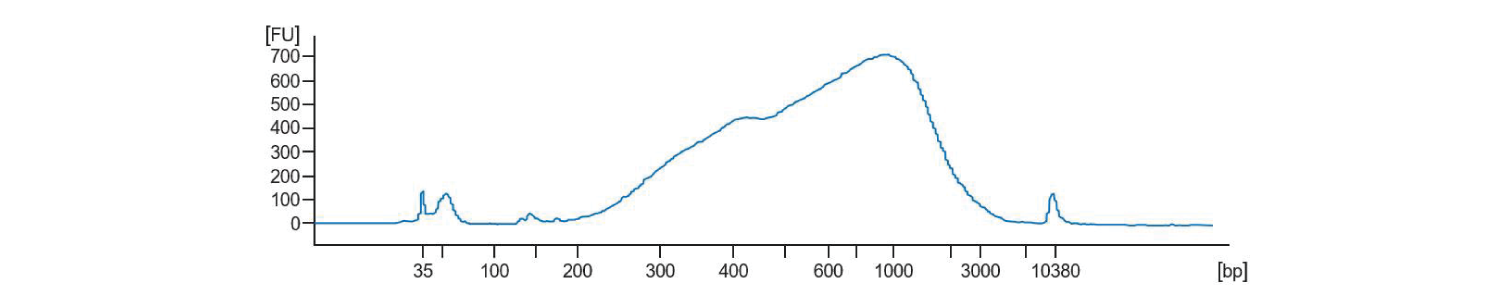
Figure 1. Trace of Smart-seq3express pooled library (after tagmentation and PCR amplification) from sorted HEK cells, using an Agilent Bioanalyzer High Sensitivity DNA Analysis chip.
8. Additional Literature
For detailed instructions on preparing indexed sequencing libraries from Smart-seq3express cDNA using tagmentation and PCR, as well as the subsequent sequencing library generation steps, please refer to the online protocol:
• Hagemann-Jensen et al., Protocols.io – Smart-seq3xpress Protocol
For further details on the developme onft Smart-seq3xpress:
• Hagemann-Jensen et al. (2022) Scalable single-cell RNA sequencing from full transcripts with Smartseq3xpress. Nature Biotechnology 40, 1452
For more information on SEQURNA:
• Noble et al. (2024) Introducing synthetic thermostable RNase inhibitors to single-cell RNA-seq. Nature Communications 15, 8373
9. Abbreviations
- dNTP: Deoxynucleotide triphosphate
- DTT: Dithiothreitol
- ERCC: External RNA Controls Consortium
- HEK cell: Human embryonic kidney cell
- PCR: Polymerase chain reaction
- RT: Reverse transcription
- SS3: Smart-seq3
- TSO: Template-switching oligo
10. Frequently Asked Questions about SEQURNA
- What is SEQURNA?
SEQURNA is a synthetic thermostable RNase inhibitor made from a mixture of non-toxic organic molecules.
- What is SEQURNA used for?
It helps protect RNA from degradation during the preparation of single-cell libraries, leading to higher quality RNA-seq data. By improving the stability and integrity of RNA throughout the protocol, SEQURNA enhances reproducibility and throughput in single-cell transcriptomic studies.
- What are the advantages of using SEQURNA?
- It produces single-cell libraries of equal or superior quality compared to protein-based recombinant RNase inhibitors (RRIs).
- It shows robustness to various harsh treatments, such as pH changes, heating, freeze-thaw and vortexing.
- It does not require toxic reducing agents (like DTT or beta-mercaptoethanol)