Recombinant Human Flt-3 Ligand/FLT3L GMP Protein, CF
R&D Systems | Catalog # 308E-GMP

Key Product Details
Source
Accession Number
Applications
Product Specifications
Source
Thr27-Ala181
Produced in an animal-free laboratory. Manufactured and tested under cGMP guidelines
Purity
Endotoxin Level
N-terminal Sequence Analysis
Met-Thr27-Gln-Asp-(Cys)-Ser-Phe-Gln-His-Ser and
Thr27-Gln-Asp-(Cys)-Ser-Phe-Gln-His-Ser-Pro
Predicted Molecular Mass
SDS-PAGE
Activity
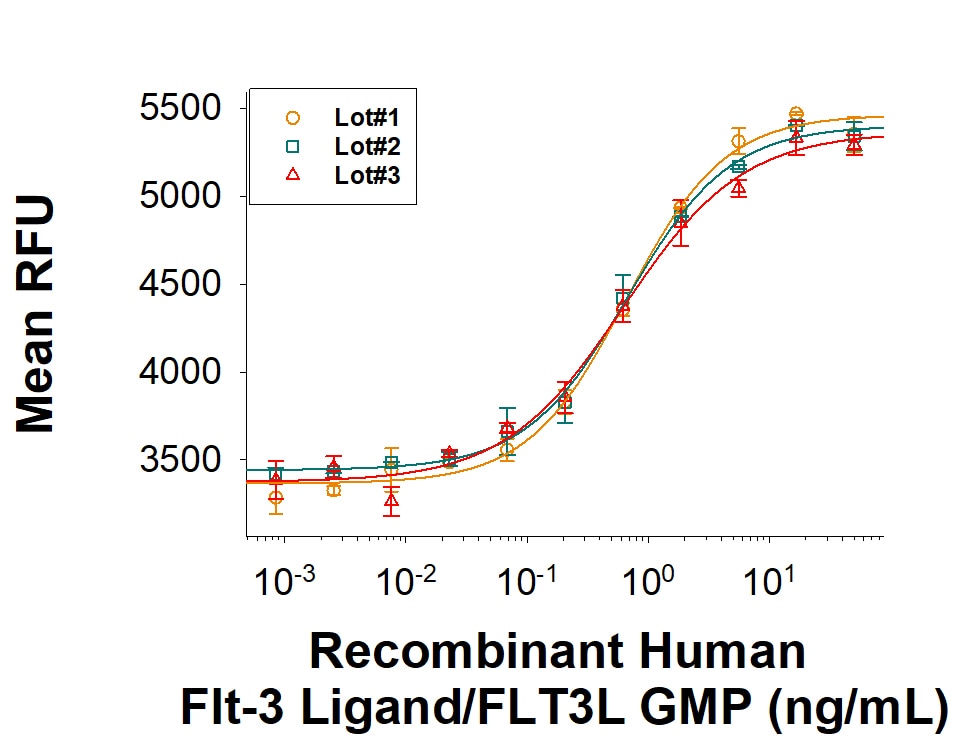
The ED50 for this effect is 0.2-1 ng/mL.
The specific activity of Recombinant Human Flt-3 Ligand/FLT3L is >5.0 x 10⁵ units/mg, which is calibrated against the human Flt-3 Ligand WHO Standard (NIBSC code: 96/532).
Host Cell Protein
Mycoplasma
Host Cell DNA
Scientific Data Images for Recombinant Human Flt-3 Ligand/FLT3L GMP Protein, CF
Recombinant Human Flt-3 Ligand/FLT3L GMP Protein Bioactivity
GMP-grade Recombinant Human Flt-3 Ligand/FLT3L (Catalog # 308E-GMP) stimulates cell proliferation in the BaF3 mouse pro-B cell line transfected with mouse Flt-3. The ED50 for this effect is 0.2-1 ng/mL. Three independent lots were tested for activity and plotted on the same graph to show lot-to-lot consistency of GMP Flt‑3 Ligand/FLT3L.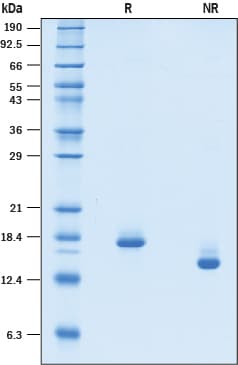
Recombinant Human Flt-3 Ligand/FLT3L GMP Protein SDS-PAGE
2 μg/lane of GMP-grade Recombinant Human Flt-3 Ligand/FLT3L (Catalog # 308E-GMP) was resolved with SDS-PAGE under reducing (R) and non-reducing (NR) conditions and visualized by Coomassie® blue staining, showing bands at 15-17 kDa and 12-14 kDa, respectively.Formulation, Preparation, and Storage
308E-GMP
| Formulation | Lyophilized from a 0.2 μm filtered solution in PBS. |
| Reconstitution | Reconstitute at 100-500 μg/mL in PBS. |
| Shipping | The product is shipped with polar packs. Upon receipt, store it immediately at the temperature recommended below. |
| Stability & Storage | Use a manual defrost freezer and avoid repeated freeze-thaw cycles.
|
Calculators
Background: Flt-3 Ligand/FLT3L
References
- Wodnar-Filipowicz, A. (2003) News Physiol. Sci. 18:247.
- Dong, J. et al. (2002) Cancer Biol. Ther. 1:486.
- Gilliland, D.G. and J.D. Griffin (2002) Blood 100:1532.
- Hannum, C. et al. (1994) Nature 368:643.
- Lyman, S.D. et al. (1994) Blood 83:2795.
- Lyman, S.D. et al. (1993) Cell 75:1157.
- Savvides, S.N. et al. (2000) Nat. Struct. Biol. 7:486.
- McClanahan, T. et al. (1996) Blood 88:3371.
- Diener, K.R. et al. (2008) Exp. Hematol. 36:51.
- Farag, S.S. and M.A. Caligiuri (2006) Blood Rev. 20:123.
- Edwan, J.H. et al. (2004) J. Immunol. 172:5016.
Long Name
Alternate Names
Gene Symbol
UniProt
Additional Flt-3 Ligand/FLT3L Products
Product Documents for Recombinant Human Flt-3 Ligand/FLT3L GMP Protein, CF
Certificate of Analysis
To download a Certificate of Analysis, please enter a lot or batch number in the search box below.
Note: Certificate of Analysis not available for kit components.
Manufacturing Specifications
GMP ProteinsR&D Systems, a Bio-Techne Brand's GMP proteins are produced according to relevant sections of the following documents: USP Chapter 1043, Ancillary Materials for Cell, Gene and Tissue-Engineered Products and Eu. Ph. 5.2.12, Raw Materials of Biological Origin for the Production of Cell-based and Gene Therapy Medicinal Products.
R&D Systems' quality focus includes:
- Designed, manufactured and tested under an ISO 9001:2015 and ISO 13485:2016 certified quality system
- Documented and controlled manufacturing process
- Control of documentation and process changes by QA
- Personnel training programs
- Raw material inspection and vendor qualification/monitoring program
- Validated equipment, processes and test methods
- Equipment calibration and maintenance schedules using a Regulatory Asset Manager
- Facility/Utilities maintenance, contamination controls, safety and pest control programs
- Material review process for variances
- Robust product stability program following relevant ICH guidelines
- N-terminal amino acid analysis
- SDS-PAGE purity analysis
- Molecular weight analysis via mass spectrometry
- Endotoxin assessment per USP <85> and Ph. Eur. 2.6.14 guidelines
- Bioassay analysis
- Microbial testing per USP <71> and Ph. Eur. 2.6.1 guidelines
- Host cell protein assessment
- Host cell DNA assessment
- Mycoplasma assessment
Production records and facilities are available for examination by appropriate personnel on-site at R&D Systems in Minneapolis and St. Paul, Minnesota USA.
R&D Systems sells GMP grade products for preclinical or clinical ex vivo use. They are not for in vivo use. Please read the following End User Terms prior to using this product.
Animal-Free Manufacturing Conditions
Our dedicated controlled-access animal-free laboratories ensure that at no point in production are the products exposed to potential contamination by animal components or byproducts. Every stage of manufacturing is conducted in compliance with R&D Systems' stringent Standard Operating Procedures (SOPs). Production and purification procedures use equipment and media that are confirmed animal-free.
Production
- All molecular biology procedures use animal-free media and dedicated labware.
- Dedicated fermentors are utilized in committed animal-free areas.
- Protein purification columns are animal-free.
- Bulk proteins are filtered using animal-free filters.
- Purified proteins are stored in animal-free containers.
Product Specific Notices for Recombinant Human Flt-3 Ligand/FLT3L GMP Protein, CF
Full terms and conditions of sale can be found online in the Protein Sciences Segment T&Cs at: Terms & Conditions.
For preclinical, or clinical ex vivo use
Related Research Areas
Citations for Recombinant Human Flt-3 Ligand/FLT3L GMP Protein, CF
 Powered by Bioz
Customer Reviews for Recombinant Human Flt-3 Ligand/FLT3L GMP Protein, CF
There are currently no reviews for this product. Be the first to review Recombinant Human Flt-3 Ligand/FLT3L GMP Protein, CF and earn rewards!
Have you used Recombinant Human Flt-3 Ligand/FLT3L GMP Protein, CF?
Submit a review and receive an Amazon gift card!
$25/€18/£15/$25CAN/¥2500 for a review with an image
$10/€7/£6/$10CAN/¥1110 for a review without an image
Submit a review