
Cochlin (COCH/coagulation factor C homology; also Coch-5B2) is a 63-70 kDa, secreted member of the Cochlin-related glycoprotein family. It is expressed by type I and III fibrocytes of the auditory spiral limbus and constitutes the major noncollagenous component of inner ear ECM. Mature human Cochlin is 526 amino acids (aa) in length. It contains one LCCL (or FCH/factor C homologous) segment (aa 28-121) and two VWF-A domains (aa 165-346 and 367-537). Single aa changes at positions 66, 88 and 109 are detrimental to Cochlin deposition. Multiple splice variants exist. There are two potential alternate start sites at Met113 and Met194, an Ala-Lys substitution for aa 493 - 550, a 44 aa insertion after Thr244 and an 13 aa substitution for aa 343 - 550. Over aa 25-550, human Cochlin shares 96% aa identity with mouse Cochlin.

Discontinued Product
AF5249 has been discontinued.
View all Cochlin products.
Key Product Details
Species Reactivity
Human
Applications
Western Blot
Label
Unconjugated
Antibody Source
Polyclonal Sheep IgG
Loading...
Product Specifications
Immunogen
Mouse myeloma cell line NS0-derived recombinant human Cochlin
Glu25-Gln550
Accession # O43405
Glu25-Gln550
Accession # O43405
Specificity
Detects human Cochlin in direct ELISAs and Western blots.
Clonality
Polyclonal
Host
Sheep
Isotype
IgG
Scientific Data Images for Human Cochlin Antibody
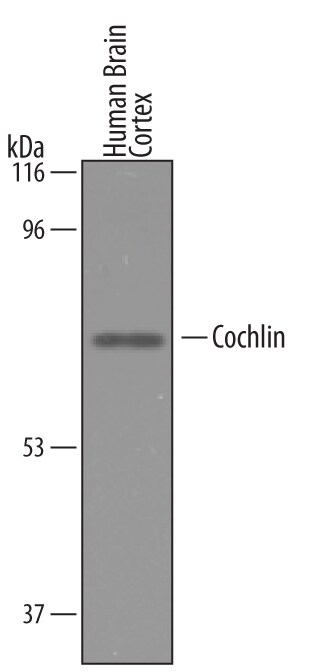
Detection of Human Cochlin by Western Blot.
Western blot shows lysates of human brain cortex tissue. PVDF membrane was probed with 1 µg/mL of Sheep Anti-Human Cochlin Antigen Affinity-purified Polyclonal Antibody (Catalog # AF5249) followed by HRP-conjugated Anti-Sheep IgG Secondary Antibody (Catalog # HAF016). A specific band was detected for Cochlin at approximately 65 kDa (as indicated). This experiment was conducted under reducing conditions and using Immunoblot Buffer Group 8.Applications for Human Cochlin Antibody
Application
Recommended Usage
Western Blot
1 µg/mL
Sample: Human brain cortex tissue
Sample: Human brain cortex tissue
Formulation, Preparation, and Storage
Purification
Antigen Affinity-purified
Reconstitution
Reconstitute at 0.2 mg/mL in sterile PBS. For liquid material, refer to CoA for concentration.
Formulation
Lyophilized from a 0.2 μm filtered solution in PBS with Trehalose. *Small pack size (SP) is supplied either lyophilized or as a 0.2 µm filtered solution in PBS.
Shipping
Lyophilized product is shipped at ambient temperature. Liquid small pack size (-SP) is shipped with polar packs. Upon receipt, store immediately at the temperature recommended below.
Stability & Storage
Use a manual defrost freezer and avoid repeated freeze-thaw cycles.
- 12 months from date of receipt, -20 to -70 °C as supplied.
- 1 month, 2 to 8 °C under sterile conditions after reconstitution.
- 6 months, -20 to -70 °C under sterile conditions after reconstitution.
Calculators
Background: Cochlin
Alternate Names
COCH, COCH5B2, DFNA31, DFNA9
Gene Symbol
COCH
UniProt
Additional Cochlin Products
Product Documents for Human Cochlin Antibody
Certificate of Analysis
To download a Certificate of Analysis, please enter a lot or batch number in the search box below.
Note: Certificate of Analysis not available for kit components.
Product Specific Notices for Human Cochlin Antibody
For research use only
Related Research Areas
Customer Reviews for Human Cochlin Antibody
There are currently no reviews for this product. Be the first to review Human Cochlin Antibody and earn rewards!
Have you used Human Cochlin Antibody?
Submit a review and receive an Amazon gift card!
$25/€18/£15/$25CAN/¥2500 Yen for a review with an image
$10/€7/£6/$10CAN/¥1110 Yen for a review without an image
Submit a review
Protocols
Find general support by application which include: protocols, troubleshooting, illustrated assays, videos and webinars.
- Cellular Response to Hypoxia Protocols
- R&D Systems Quality Control Western Blot Protocol
- Troubleshooting Guide: Western Blot Figures
- Western Blot Conditions
- Western Blot Protocol
- Western Blot Protocol for Cell Lysates
- Western Blot Troubleshooting
- Western Blot Troubleshooting Guide
- View all Protocols, Troubleshooting, Illustrated assays and Webinars
Loading...