Recombinant Human u-Plasminogen Activator/Urokinase Avi, CF
R&D Systems | Catalog # AVI1310
His-tag Avi-tag

Loading...
Key Product Details
- R&D Systems HEK293-derived Recombinant Human u-Plasminogen Activator/Urokinase Avi (AVI1310)
- Quality control testing to verify active proteins with lot specific assays by in-house scientists
- All R&D Systems proteins are covered with a 100% guarantee
Source
HEK293
Accession Number
Conjugate
Biotin
Applications
Binding Activity, Enzyme Activity
Loading...
Product Specifications
Source
Human embryonic kidney cell, HEK293-derived human u-Plasminogen Activator (uPA)/Urokinase protein
Met1-Leu431 with C-terminal 6-His and Avi-tag
Met1-Leu431 with C-terminal 6-His and Avi-tag
Purity
>90%, by SDS-PAGE visualized with Silver Staining and quantitative densitometry by Coomassie® Blue Staining.
Endotoxin Level
<0.10 EU per 1 μg of the protein by the LAL method.
N-terminal Sequence Analysis
Lys156 & Phe177
Predicted Molecular Mass
18 kDa (long A chain), 3 kDa (short A chain), 31 kDa (B chain)
SDS-PAGE
19-20 kDa & 32-38 kDa, under reducing conditions.
Activity
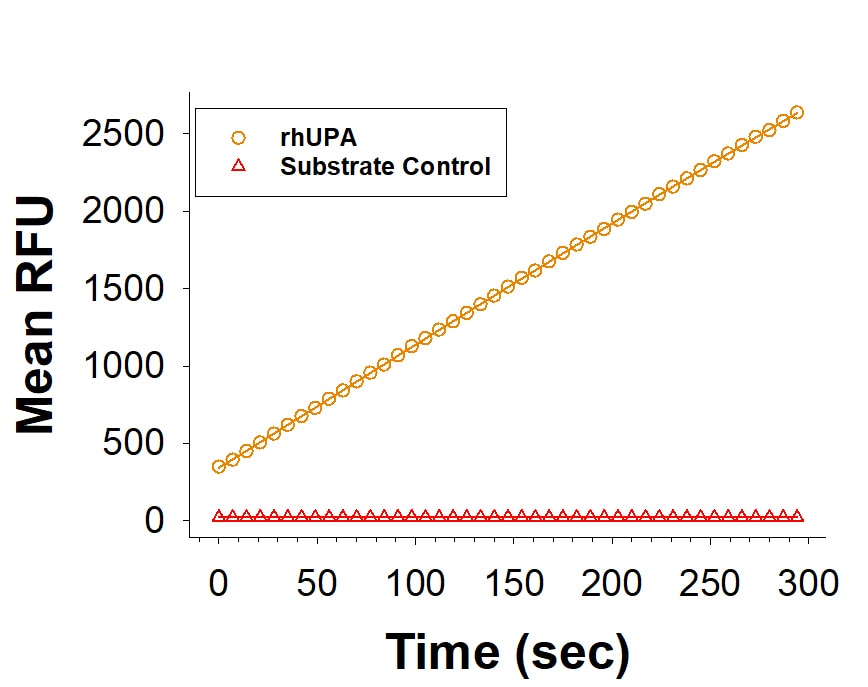
Measured by its ability to cleave a peptide substrate, N-carbobenzyloxy-Gly-Gly-Arg-7-amido-4-methylcoumarin (Z-GGR-AMC).
The specific activity is >2000 pmol/min/μg, as measured under the described conditions.
Measured by its binding ability in a functional ELISA.
Biotinylated Recombinant Human u-Plasminogen Activator (uPA)/Urokinase His-tag Avi-tag (Catalog # AVI1310) binds to Human u-Plasminogen Activator (uPA) Antibody (Catalog # MAB1310) with an ED50 of 0.300-4.50 ng/mL.
The specific activity is >2000 pmol/min/μg, as measured under the described conditions.
Measured by its binding ability in a functional ELISA.
Biotinylated Recombinant Human u-Plasminogen Activator (uPA)/Urokinase His-tag Avi-tag (Catalog # AVI1310) binds to Human u-Plasminogen Activator (uPA) Antibody (Catalog # MAB1310) with an ED50 of 0.300-4.50 ng/mL.
Scientific Data Images for Recombinant Human u-Plasminogen Activator/Urokinase Avi, CF
Biotinylated Recombinant Human u‑Plasminogen Activator (uPA)/Urokinase His-tag Avi-tag Protein Enzyme Activity.
Recombinant Human u-Plasminogen Activator (uPA)/Urokinase His-tag Avi-tag (Catalog # AVI1310) is measured by its ability to cleave a peptide substrate, N-carbobenzyloxy-Gly-Gly-Arg-7-amido-4-methylcoumarin (Z-GGR-AMC).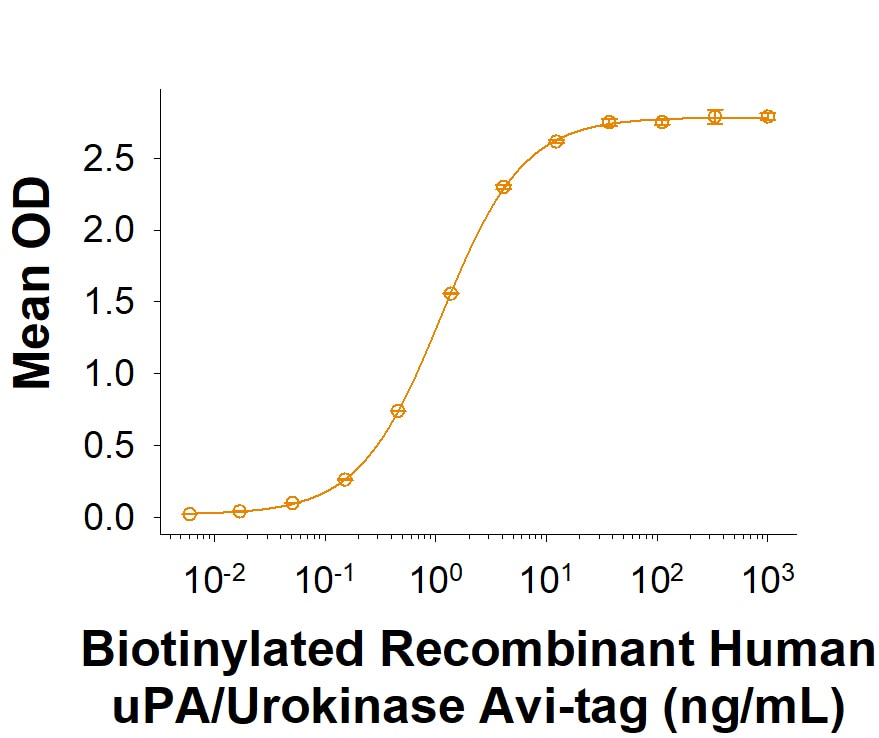
Biotinylated Recombinant Human u‑Plasminogen Activator (uPA)/Urokinase His-tag Avi-tag Protein Binding Activity.
In a functional ELISA, Biotinylated Recombinant Human u-Plasminogen Activator (uPA)/Urokinase His-tag Avi-tag Protein (Catalog # AVI1310) binds to Human u-Plasminogen Activator (uPA) Antibody (MAB1310) with an ED50 of 0.300-4.50 ng/mLFormulation, Preparation, and Storage
AVI1310
| Formulation | Supplied as a 0.2 μm filtered solution in HEPES, NaCl and CaCl2. |
| Shipping | The product is shipped with polar packs. Upon receipt, store it immediately at the temperature recommended below. |
| Stability & Storage | Use a manual defrost freezer and avoid repeated freeze-thaw cycles.
|
Background: u-Plasminogen Activator (uPA)/Urokinase
References
- Ellis, V. (2004) in Handbook of Proteolytic Enzymes. Barrett, A.J. et. al. eds., Academic Press, San Diego, pp.1677.
- Mahmood, N. et. al. (2018) Front Oncol. 8:24.
- Nagamine, Y. et. al. (2005) Thromb. Haemost. 93:661.
- Duffy, M. and C. Duggan. (2004) Clin. Biochem. 37:541.
- Pappot, H. et. al. (2006) Lung Cancer 51:193.
- Taubert, H. et. al. (2010) Br. J. Cancer 102:731.
- Masucci, M.T. et. al. (2022) Cancers. 14:498.
- Riccio, A. et. al. (1985) Nucleic Acids Res. 13:2759.
- Nagai, M. et. al. (1985) Gene 36:183.
- Jacobs, P. et. al. (1985) DNA 4:139.
Long Name
Urokinase-type Plasminogen Activator
Alternate Names
PLAU, uPA, uPlasminogen Activator, Urokinase
Gene Symbol
PLAU
UniProt
Additional u-Plasminogen Activator (uPA)/Urokinase Products
- All Products for u-Plasminogen Activator (uPA)/Urokinase
- u-Plasminogen Activator (uPA)/Urokinase Activity Assays
- u-Plasminogen Activator (uPA)/Urokinase cDNA Clones
- u-Plasminogen Activator (uPA)/Urokinase ELISA Kits
- u-Plasminogen Activator (uPA)/Urokinase Lysates
- u-Plasminogen Activator (uPA)/Urokinase Primary Antibodies
- u-Plasminogen Activator (uPA)/Urokinase Proteins and Enzymes
- u-Plasminogen Activator (uPA)/Urokinase Simple Plex
Product Documents for Recombinant Human u-Plasminogen Activator/Urokinase Avi, CF
Certificate of Analysis
To download a Certificate of Analysis, please enter a lot or batch number in the search box below.
Note: Certificate of Analysis not available for kit components.
Product Specific Notices for Recombinant Human u-Plasminogen Activator/Urokinase Avi, CF
For research use only
Customer Reviews for Recombinant Human u-Plasminogen Activator/Urokinase Avi, CF
There are currently no reviews for this product. Be the first to review Recombinant Human u-Plasminogen Activator/Urokinase Avi, CF and earn rewards!
Have you used Recombinant Human u-Plasminogen Activator/Urokinase Avi, CF?
Submit a review and receive an Amazon gift card!
$25/€18/£15/$25CAN/¥2500 for a review with an image
$10/€7/£6/$10CAN/¥1110 for a review without an image
Submit a review
Protocols
View specific protocols for Recombinant Human u-Plasminogen Activator/Urokinase Avi, CF (AVI1310):
Materials
- Assay Buffer: 50 mM Tris, 0.01% (v/v) Tween® 20, pH 8.5
- Biotinylated Recombinant Human u-Plasminogen Activator/Urokinase His-tag Avi-tag (rhuPA) (Catalog # AVI1310)
- Substrate: Z-GGR-AMC, 10 mM stock in DMSO
- Black 96-Well Plate
- Plate Reader with Fluorescence Read Capability
- Dilute rhuPA to 0.5 µg/mL in Assay Buffer.
- Dilute Substrate to 400 µM in Assay Buffer.
- Load 50 µL of the 0.5 µg/mL rhuPA into a black well plate and start the reaction by adding 50 µL of 400 µM Substrate. Include a Substrate Blank containing 50 µL Assay Buffer and 50 µL of 400 µM Substrate.
- Read at excitation and emission wavelengths of 380 nm and 460 nm (top read), respectively, in kinetic mode for 5 minutes.
- Calculate specific activity:
Specific Activity (pmol/min/µg) = | Adjusted Vmax* (RFU/min) x Conversion Factor** (pmol/RFU) |
| amount of enzyme (µg) |
*Adjusted for Substrate Blank
**Derived using calibration standard 7-amino, 4-Methyl Coumarin (AMC)
Per Well:
- rhuPA His Avi: 0.025 µg
- Substrate: 200 µM
Loading...
Associated Pathways