Recombinant Human TGF-beta 3 GMP Protein, CF
Recombinant Human TGF-beta 3 GMP Protein, CF Summary
Product Specifications
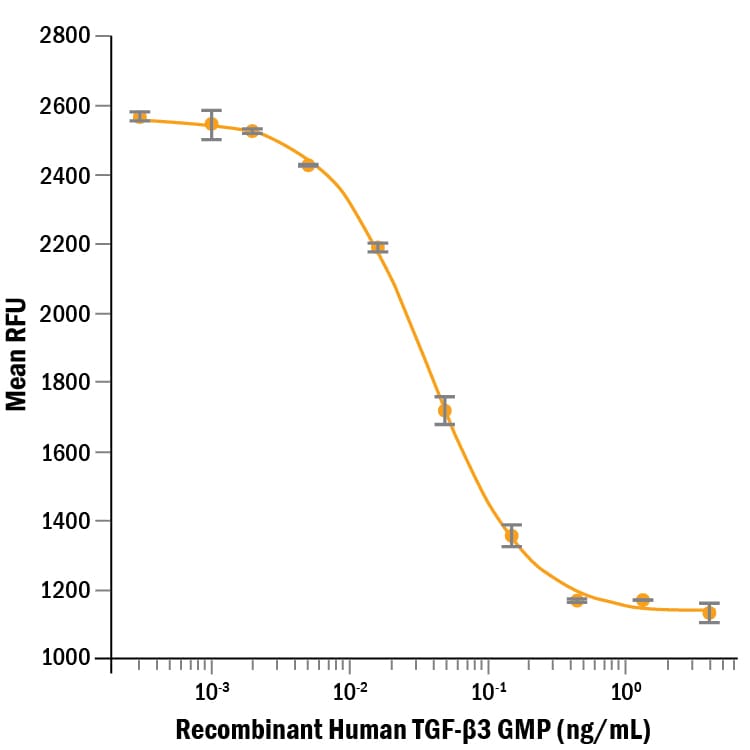
The specific activity of Recombinant Human TGF-beta 3 is >1.9 x 10⁷ IU/mg, which is calibrated against the Human TGF-beta 3 WHO International Standard (NIBSC code: 09/234).
Ala301-Ser412
Produced in an animal component free process (ACFP).
Manufactured and tested under current Good Manufacturing Practice (GMP) guidelines.
Analysis
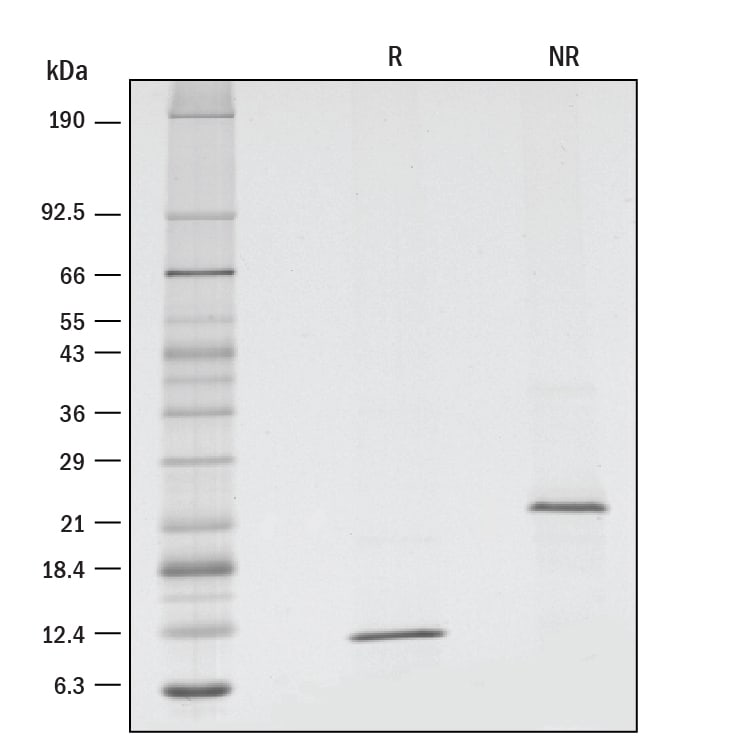
12 kDa, reducing conditions
24 kDa, non-reducing conditions
Product Datasheets
Carrier Free
CF stands for Carrier Free (CF). We typically add Bovine Serum Albumin (BSA) as a carrier protein to our recombinant proteins. Adding a carrier protein enhances protein stability, increases shelf-life, and allows the recombinant protein to be stored at a more dilute concentration. The carrier free version does not contain BSA.
In general, we advise purchasing the recombinant protein with BSA for use in cell or tissue culture, or as an ELISA standard. In contrast, the carrier free protein is recommended for applications, in which the presence of BSA could interfere.
243-GMP
| Formulation | Lyophilized from a 0.2 μm filtered solution in Acetonitrile and TFA. |
| Reconstitution | Reconstitute at 50-200 μg/mL in sterile 4 mM HCl. |
| Shipping | The product is shipped with polar packs. Upon receipt, store it immediately at the temperature recommended below. |
| Stability & Storage: | Use a manual defrost freezer and avoid repeated freeze-thaw cycles.
|
Scientific Data
View Larger
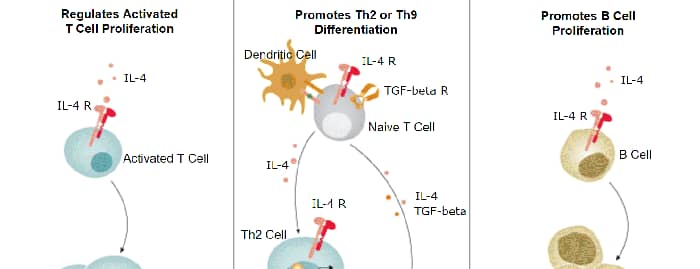
GMP-grade Recombinant Human TGF-beta 3 (Catalog # 243-GMP) inhibits Recombinant Mouse IL-4 (Catalog # 404-ML) induced proliferation in the HT-2 mouse T cell line. The ED50 for this effect is 0.01-0.04 ng/mL.
View Larger
1 μg/lane of GMP-grade Recombinant Human TGF-beta 3 (Catalog # 243-GMP) was resolved with SDS-PAGE under reducing (R) and non-reducing (NR) conditions and visualized by silver staining, showing bands at 12 kDa and 23 kDa, respectively.
Reconstitution Calculator
Background: TGF-beta 3
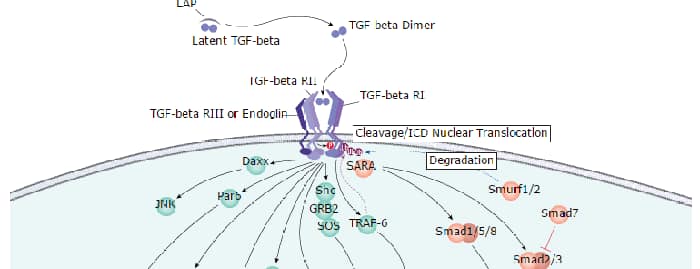
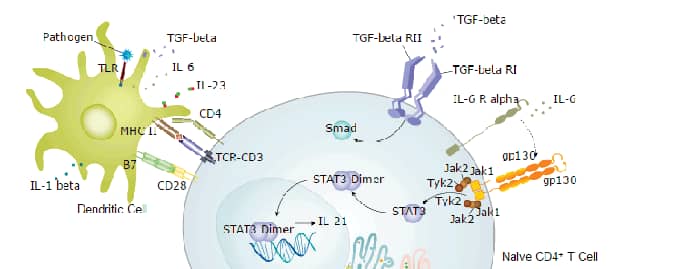
TGF-beta 3 (transforming growth factor-beta 3) is a member of a TGF-beta superfamily subgroup that is defined by their structural and functional similarities (1-5). TGF-beta 3 and its closely related proteins, TGF-beta 1 and -beta 2, act as cellular switches to regulate immune function, cell proliferation, and epithelial-mesenchymal transition (4, 6, 7). The non-redundant biological effects of TGF-beta 3 include involvement in palatogenesis, chondrogenesis, and pulmonary development (1, 2, 7-9). Human TGF-beta 3 cDNA encodes a 412 amino acid (aa) precursor that contains a 20 aa signal peptide and a 392 aa proprotein. The proprotein is processed by a furin-like convertase to generate a 220 aa latency associated peptide (LAP) and a 112 aa mature TGF-beta 3 (10, 11). Mature human TGF-beta 3 shows 100%, 99%, and 98% aa identity with mouse/dog/horse, rat, and pig TGF-beta 3, respectively. TGF-beta 3 is secreted as a complex with LAP. This latent form of TGF-beta 3 becomes active upon cleavage by plasmin, matrix metalloproteases, thrombospondin-1, and a subset of integrins (12). TGF-beta 3 binds with high affinity to TGF-beta RII, a type II serine/threonine kinase receptor. This receptor then phosphorylates and activates type I serine/threonine kinase receptors, TGF-beta RI or ALK-1, to modulate transcription through Smad phosphorylation (13-15). The divergent biological effects exerted by individual TGF-beta isoforms is dependent upon the recruitment of co-receptors (TGF-beta RIII and endoglin) and the subsequent initiation of Smad-dependent or -independent signaling pathways (14, 16, 17).
- Barrio, M.C. et al. (2014) Cells Tissues Organs. [Epub ahead of print; PMID 24861080].
- Doetschman, T. et al. (2012) Genesis 50:59.
- Mittl, P.R. et al. (1996) Protein Sci. 5:1261.
- Sporn, M.B. (2006) Cytokine Growth Factor Rev. 17:3.
- Wahl, S.M. et al. (2006) Immunol. Rev. 213:213.
- Chang, H. et al. (2002) Endocr. Rev. 23:787.
- Dunker, N. and K. Krieglstein (2000) Eur. J. Biochem. 267:6982.
- Jin, J.Z. et al. (2014) Dev. Dyn. [Epub ahead of print; PMID 25104574].
- Tang, Q.O. et al. (2009) Expert Opin. Biol Ther. 9:689.
- Derynck, R. et al. (1988) EMBO J. 7:3737.
- Miyazono, K. et al. (1988) J. Biol. Chem. 263:6407.
- Oklu, R. and R. Hesketh (2000) Biochem. J. 352 Pt 3:601.
- Cui, X.M. and C.F. Shuler (2000) Int. J. Dev. Biol. 44:397.
- de Caestecker, M. (2004) Cytokine Growth Factor Rev. 15:1.
- Nakajima, A. et al. (2007) Dev. Dyn. 236:791.
- Iwata, J. et al. (2012) J. Clin. Invest. 122:873.
- Gatza, C.E. et al. (2010) Cell. Signal. 22:1163.
Manufacturing Specifications
GMP ProteinsR&D Systems, a Bio-Techne Brand's GMP proteins are produced according to relevant sections of the following documents: USP Chapter 1043, Ancillary Materials for Cell, Gene and Tissue-Engineered Products and Eu. Ph. 5.2.12, Raw Materials of Biological Origin for the Production of Cell-based and Gene Therapy Medicinal Products.
R&D Systems' quality focus includes:
- Manufactured and tested under an ISO 9001:2015 and ISO 13485:2016 certified quality system
- Documented processes and QA control of documentation and process changes
- Personnel training programs
- Raw material testing and vendor qualification/monitoring
- Fully validated equipment, processes and test methods
- Equipment calibration schedules using a computerized calibration program
- Facility maintenance, safety programs and pest control
- Material review process for variances
- Monitoring of stability over product shelf-life
- N-terminal amino acid analysis, SDS-PAGE analysis, and endotoxin level (as determined by LAL assay) performed on each bulk QC lot, not on individual bottlings of each QC lot
- Post-bottling lot-specific bioassay results (compliance with an established range) and results of microbial testing according to USP
- Mycoplasma testing by ribosomal RNA hybridization assay
Production records and facilities are available for examination by appropriate personnel on-site at R&D Systems in Minneapolis, Minnesota USA.
R&D Systems sells GMP grade products for preclinical or clinical ex vivo use. They are not for in vivo use. Please read the following End User Terms prior to using this product.
Animal Component-Free Process (ACFP) Manufacturing Conditions
R&D Systems Animal Component-Free Process (ACFP) recombinant proteins are expressed in an animal-free certified Sf 9 insect cell line using dedicated animal-free raw materials and labware. Production and purification procedures use equipment and media that are confirmed animal-free but performed outside our dedicated animal-free laboratories. Every stage of the manufacturing process follows R&D Systems' stringent Standard Operating Procedures (SOPs). The certified Sf 9 insect cell bank has undergone extensive testing to certify the lack of cytopathogens by screening for various viruses, Mycoplasma, and Spiroplasmas using both in vitro and in vivo testing methods.
Please read our complete ACFP Statement
Product Specific Notices
END USER TERMS OF USE OF PRODUCT
The following terms are offered to you upon your acceptance of these End User Terms of Use of Product. By using this product, you indicate your acknowledgment and agreement to these End User Terms of Use of Product. If you do not agree to be bound by and comply with all of the provisions of these End User Terms of Use of Product, you should contact your supplier of the product and make arrangements to return the product.
We suggest you print and retain a copy of these End User Terms of Use of Product for your records.
The End User is aware that R&D Systems, Inc. sells GMP products for preclinical or clinical ex vivo use and not for in vivo use. The End User further agrees, as a condition of the sale of R&D Systems' GMP products that: a) the End User will not use this GMP Product in any procedure wherein the product may be directly or indirectly administered to humans, unless the End User has obtained, or prior to their use will have obtained, an Investigational New Drug (IND) exemption from the FDA and will use the product only in accordance with the protocols of such IND and of the Institutional Review Board overseeing the proposed research, or b) the End User will use the products outside of the United States in accordance with the protocols of research approved by the Institutional Review Board or authorized ethics committee and regulatory agencies to which the End User is subject to in their territory.
R&D Systems, Inc. has the right, at its sole discretion, to modify, add or remove any terms or conditions of these End User Terms of Use without notice or liability to you. Any changes to these End User Terms of Use are effective immediately following the printing of such changes on this product insert. The most recent version of these End User Terms of Use of Product may be found at: RnDSystems.com/Legal.
You agree to review these End User Terms of Use of Product to ensure any subsequent use by you of R&D Systems' GMP Products following changes to these End User Terms of Use of Product constitutes your acceptance of all such changes.
TERMS AND CONDITIONS
The following limitation applies to R&D Systems' warranty and liability for damages: All products are warranted to meet R&D Systems' published specifications when used under normal laboratory conditions.
R&D SYSTEMS DOES NOT MAKE ANY OTHER WARRANTY OR REPRESENTATION WHATSOEVER, WHETHER EXPRESS OR IMPLIED, WITH RESPECT TO ITS PRODUCTS. IN PARTICULAR, R&D SYSTEMS DOES NOT MAKE ANY WARRANTY OF SUITABILITY, NONINFRINGEMENT, MERCHANTABILITY OR FITNESS FOR ANY PARTICULAR PURPOSE.
NOTWITHSTANDING ANY OTHER PROVISIONS OF THESE TERMS AND/OR ANY OTHER AGREEMENT BETWEEN R&D SYSTEMS AND PURCHASER FOR THE PURCHASE OF THE PRODUCTS, R&D SYSTEMS' TOTAL LIABILITY TO PURCHASER ARISING FROM OR IN RELATION TO THESE TERMS, AN AGREEMENT BETWEEN THE PARTIES OR THE PRODUCTS, WHETHER ARISING IN CONTRACT, TORT OR OTHERWISE SHALL BE LIMITED TO THE TOTAL AMOUNT PAID BY PURCHASER TO R&D SYSTEMS FOR THE APPLICABLE PRODUCTS. IN NO EVENT WILL R&D SYSTEMS BE LIABLE FOR THE COST OF PROCUREMENT OF SUBSTITUTE GOODS.
Full details of R&D Systems' Terms and Conditions of Sale can be found online at: RnDSystems.com/Legal.
Citation for Recombinant Human TGF-beta 3 GMP Protein, CF
R&D Systems personnel manually curate a database that contains references using R&D Systems products. The data collected includes not only links to publications in PubMed, but also provides information about sample types, species, and experimental conditions.
1 Citation: Showing 1 - 1
-
Preclinical Efficacy and Safety of a Human Embryonic Stem Cell-Derived Midbrain Dopamine Progenitor Product, MSK-DA01
Authors: J Piao, S Zabierowsk, BN Dubose, EJ Hill, M Navare, N Claros, S Rosen, K Ramnarine, C Horn, C Fredrickso, K Wong, B Safford, S Kriks, A El Maarouf, U Rutishause, C Henchcliff, Y Wang, I Riviere, S Mann, V Bermudez, S Irion, L Studer, M Tomishima, V Tabar
Cell Stem Cell, 2021-02-04;28(2):217-229.e7.
Species: Human
Sample Types: Whole Cells
Applications: Bioassay
FAQs
No product specific FAQs exist for this product, however you may
View all Proteins and Enzyme FAQsReviews for Recombinant Human TGF-beta 3 GMP Protein, CF
There are currently no reviews for this product. Be the first to review Recombinant Human TGF-beta 3 GMP Protein, CF and earn rewards!
Have you used Recombinant Human TGF-beta 3 GMP Protein, CF?
Submit a review and receive an Amazon gift card.
$25/€18/£15/$25CAN/¥75 Yuan/¥2500 Yen for a review with an image
$10/€7/£6/$10 CAD/¥70 Yuan/¥1110 Yen for a review without an image