
Pancreatic Duct-Like Organoids
Accurate and reproducible pancreatic disease models.
PDLO Models | Workflow | Resources | FAQ | Contact Us
Why PDLOs are Becoming Essential Models
Pancreatic duct–like organoids (PDLOs) are gaining rapid adoption as models for pancreatic cancer, exocrine cell disease, and drug screening. When cultured correctly, pancreatic organoids can more accurately mimic human pancreatic duct biology and provide more physiologically relevant models than traditional 2D cultures or animal models. R&D Systems solutions support the generation and analysis of highly reproducible iPSC-derived PDLOs.
Pancreatic organoid technology provides versatile models for studying pancreatic development, disease progression, and therapeutic response. Organoids can also be used to study disease-associated alterations in genes such as KRAS, CDKN2A, SMAD4, BRCA1, and BRCA2, and evaluate responses to targeted therapies.
Benefits of Using PDLO Models
- PDLOs mimic the cellular architecture, polarity, and lumenized ductal structures found in pancreatic cells in vivo, enabling more physiologically relevant modeling of pancreatic cancer progression and more reliable drug screening, which will inform future clinical trials.
- For chronic pancreatitis and inflammatory signaling research, allow controlled interrogation of cytokine, immune, and stress‑response pathways within ductal epithelium.
- PDLOs support high‑resolution study of tumor–stromal interactions, drug‑response mechanisms, and chemoresistance pathways central to pancreatic ductal adenocarcinoma (PDAC).
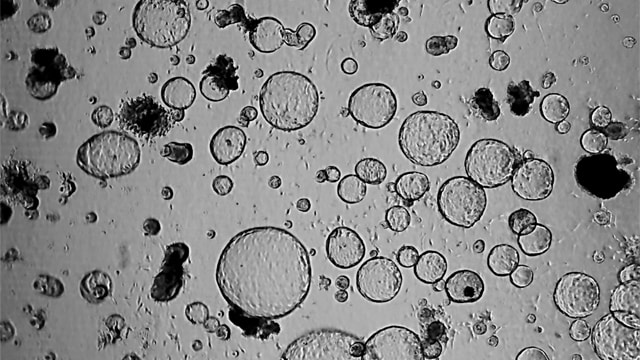

Overcome the Challenges of PDLO Models
- Culturing stable duct‑like structures with consistent basal–apical polarity and lumen formation can be sensitive to matrix variations. Minimize your culture variability with consistent, high-quality R&D Systems extracellular matrices, cytokines, media, and supplements.
- Partial maturation and incomplete differentiation can impact organoid functionality. Fine tune your cell differentiation with our proven small molecules and growth factors, and verify proper cell phenotypes with our reliable, validated flow cytometry panels at multiple intermediate steps (i.e., definitive endoderm and pancreatic progenitor stages).
- Scalability for high‑throughput drug screening can be constrained by culture time, cost, and reproducibility. Control time and costs by partnering with an experienced organoid reagent supplier like R&D Systems.
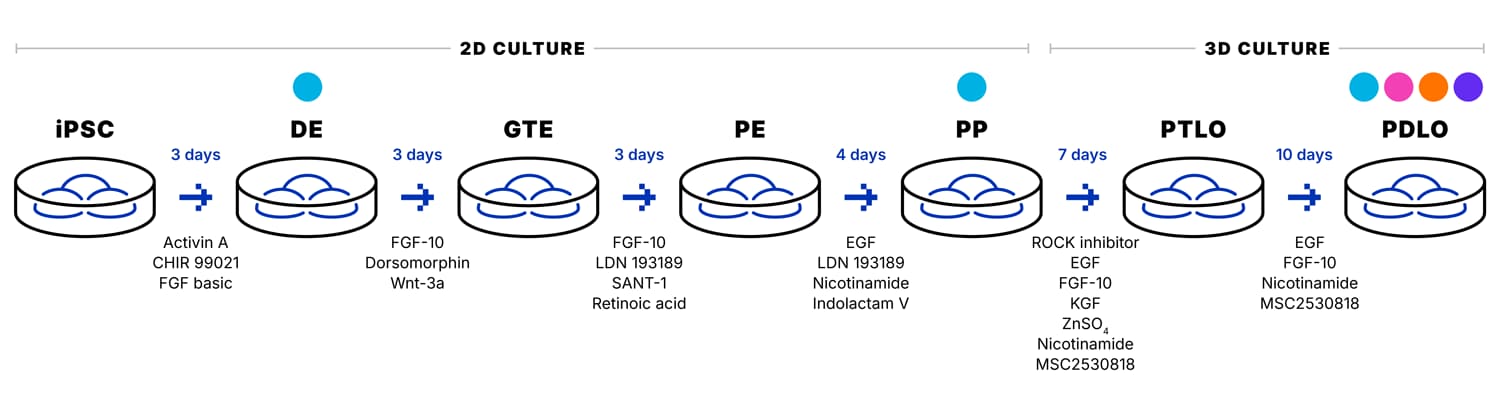
iPSC Maintenance & Expansion
Reagents supporting robust expansion and pluripotency support
- ExCellerate™ iPSC Expansion Medium
- CEPT Cocktail Kit
- ROCK Inhibitors (ROCKi)
- rhFGF basic (Heat Stable)
- Cultrex UltiMatrix BME
Endoderm Differentiation
- Small molecules: CHIR 99021, Dorsomorphin, LDN 193189, SANT-1, Retinoic acid
- Growth factors: Activin A, FGF basic, FGF-10, Wnt-3a
- Cultrex UltiMatrix BME
- Antibodies for phenotype marker analysis
Pancreatic Progenitor Generation
- Small molecules: LDN 193189, Nicotinamide, Indolactam V
- Growth factors: EGF
- Cultrex UltiMatrix BME
- Antibodies for phenotype marker analysis
3D Culture of PDLOs and Functional Analysis
- Small molecules: Y-27632 (ROCKi), ZnSO4, Nicotinamide, MSC2530818
- Growth factors: EGF, FGF-10, KGF
- Cultrex UltiMatrix BME
- Simple Western
- Antibodies for phenotype marker analysis
- Functional assays: Forskolin, GlyH 101, CTFRinh 172
PDLO Workflow Application Note
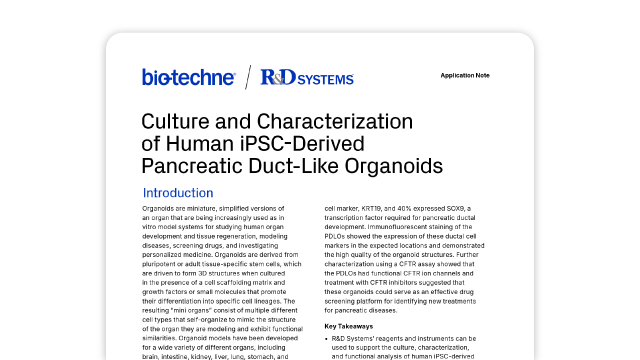
See the workflow in action! Learn how to culture and analyze functional iPSC-derived PDLOs, with practical steps for reducing variability and maximizing results.
Pancreatic Disease Solutions
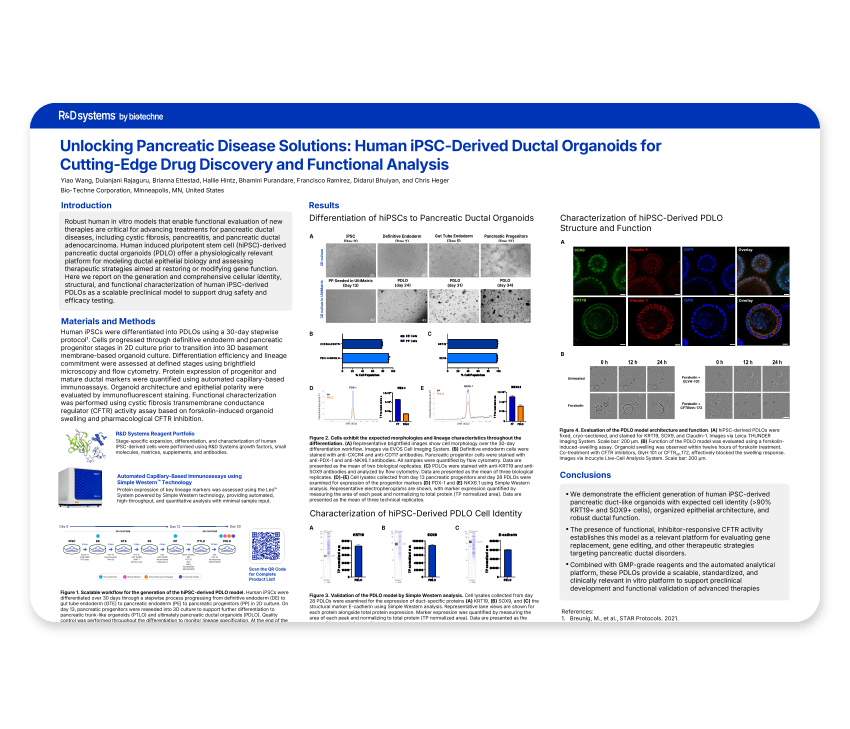
Generate and characterize PDLOs with high ductal marker expression and function, for a scalable and standardized clinically relevant workflow.
The Organoid Culture Handbook

Your guide for consistent organoid culture! Find tissue-specific protocols, troubleshooting tips, and key reagents for organoid and 3D cell culture.
Featured PDLO Publications
What is a pancreatic duct-like organoid (PDLO)?
A pancreatic duct-like organoid (PDLO) is a 3D in vitro organoid model that mimics the structure, cell types, and functional characteristics of the human pancreatic duct.
What are PDLOs most often used for?
PDLOs are widely used for pancreatic disease modeling, drug screening, cancer progression research, and precision medicine applications. Applications include modeling pancreatic ductal adenocarcinoma, pancreatic intraepithelial neoplasia (PanIN), intraductal papillary mucinous neoplasms (IPMNs), and pancreatic neuroendocrine tumors. Pancreatic organoid models can also be used to study different pancreatic cell lineages, including ductal, exocrine, and endocrine cells. PDLOs specifically model characteristics of the pancreatic ductal epithelium.
What are the major differences between iPSC-derived and patient-derived organoids?
iPSC-derived PDLOs originate from induced pluripotent stem cells and allow controlled genetic manipulation, while patient-derived PDLOs retain patient-specific tumor characteristics useful for personalized medicine.
What challenges exist in organoid culture?
Challenges include variability in differentiation efficiency, matrix sensitivity, scalability limitations, and difficulty replicating full pancreatic complexity.
How can I improve reproducibility in PDLO culture?
Use high-quality reagents, standardized differentiation protocols, micro-well-based culture systems, and functional marker validation to ensure consistency.
What tools support PDLO analysis?
Tools include immunofluorescence staining, single-cell RNA sequencing, in situ hybridization, CFTR functional assays, co-culture systems, and polarity-switching methods.