
Recombinant Proteins
Recombinant Proteins for Reliable, Reproducible Results
Your work deserves recombinant proteins that make experiments reproducible, scalable, and cost-effective across protein expression systems used for recombinant protein production. For 50 years, R&D Systems scientists have delivered high-quality reagents that support cell culture, protein purification, and downstream assays in biotechnology and molecular biology.
Our portfolio includes 5,000+ bioactive cytokines, growth factors, interferons, enzymes, and target proteins, widely cited in the scientific literature and optimized for consistency. Expressed across E. coli, insect cells, mammalian hosts such as HEK293 and CHO, and animal-free systems, R&D Systems recombinant proteins provide reliable formats designed for consistent in vitro performance and seamless downstream biochemical or diagnostic workflows.
Move from discovery to GMP manufacturing with continuity and confidence. Every lot undergoes stringent quality control, including testing for bioactivity, endotoxin, solubility, and sequence accuracy, helping you generate reliable and reproducible data at any scale.
Key Product Lines






Immune Checkpoint Targets eBook

Learn about the latest research on current and emerging immune checkpoint targets for cancer immunotherapy.
Optimizing Organoid Culture Conditions
Learn the importance of growth factor bioactivity and reagent consistency for achieving robust, reproducible organoid growth.
SEC-MALS for Protein Characterization
Discover how our scientists prioritize your success through cutting-edge techniques such as SEC-MALS for protein characterization.
Flow Cytometry-Based Assay for CAR Expression
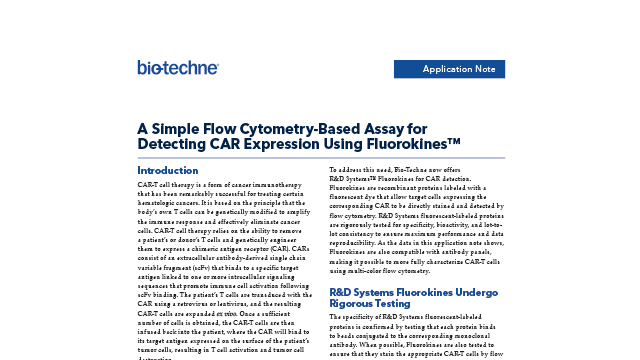
Learn about the advantages of using fluorescent-labeled proteins to directly stain and detect CAR+ cells by flow cytometry.
Achieve Optimal Stem Cell Culture Conditions
Discover how R&D Systems proteins can help improve the expansion, differentiation, and consistency of your stem cell cultures.
Organoid Wall Poster
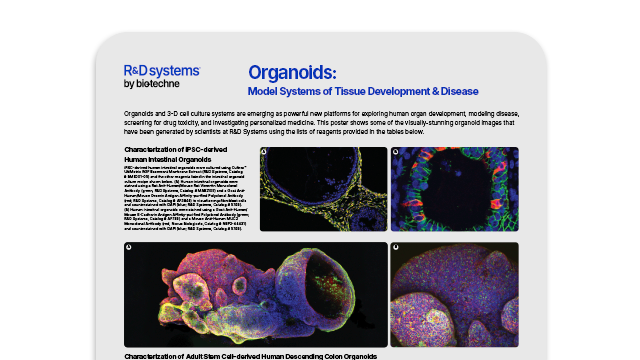
Decorate your lab with some visually stunning organoid images generated by our 3-D cell culture specialists.
Immune Checkpoint Targets Wall Poster
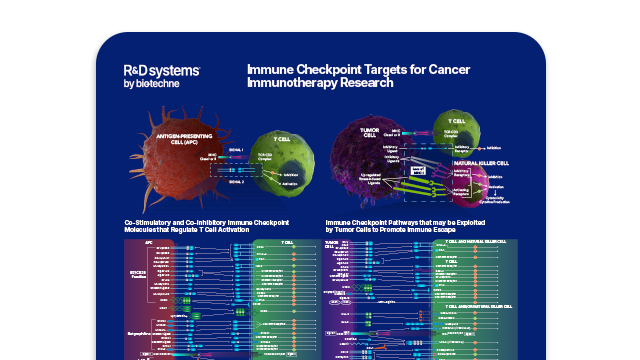
Use our new wall poster to explore the current and emerging immune checkpoint molecules being targeted for cancer immunotherapy.
Core Recombinant Protein Product Lines
R&D Systems recombinant proteins support applications in drug discovery, cell biology, genetic engineering, and recombinant DNA technology. The collection includes cytokines, growth factors, immune checkpoint proteins, enzymes, and labeled proteins designed for assays, antibody development, protein synthesis studies, and recombinant protein expression optimization. Multiple expression systems, tag formats, and species options support workflows from early discovery to translational and clinical research.
Cytokines & Growth Factors
Researchers rely on cytokines and growth factors with consistent biological activity and low endotoxin levels to regulate cell signaling, differentiation, activation, and growth. R&D Systems cytokines and growth factors are produced in expression systems that support correct folding and post-translational modifications, including glycosylation in mammalian cells. Each protein is verified by SDS PAGE, ELISA, and functional assays. These reagents support stem cell and immune cell culture, as well as a wide range of in vitro applications in drug discovery and biochemical research.
Animal-Free RUO to GMP
R&D Systems animal-free recombinant proteins support chemically defined and xeno-free cell culture and organoid workflows. For clinical transitions, R&D Systems GMP cytokines and growth factors provide continuity with matching sequences and expression systems. This alignment simplifies recombinant protein expression at a larger scale and supports consistent quality control and documentation.
Immune Checkpoint Proteins
R&D Systems immune checkpoint proteins include purified receptors, ligands, Fc fusion proteins, and related antigens that support monoclonal antibody development, recombinant antibody screening, inhibitor evaluation, and assay design. Each protein is qualified for bioactivity using in vitro methods and validated by Western blot, ELISA, and flow cytometry. To support immune checkpoint receptor research, our portfolio includes purified checkpoint proteins for:
- Defining immunotherapy targets
- Developing antibodies
- Screening drugs
- Designing quality control assays
Labeled Proteins for Assays & Detection
R&D Systems labeled proteins include Avi tag biotinylated proteins, chemically biotinylated proteins, and fluorescent proteins designed for antigen detection, receptor ligand studies, and high-throughput assay development. Each protein is validated by SDS PAGE, ELISA, and biological activity assays to ensure reliable immunoassay performance and consistent chromatography workflows.
Enzymes
R&D Systems recombinant enzymes support immunotherapy research, metabolic pathway analysis, ubiquitin signaling, glycan editing, nucleic acid modification, and other molecular biology applications. Each enzyme is produced with attention to solubility and stability and is tested using in vitro biochemical assays.
Continued Recombinant Protein Science Innovation
R&D Systems recombinant proteins are developed using advances in recombinant DNA technology, expression vector engineering, and analytical characterization. By aligning expression systems and purification strategies with target proteins, these reagents support reliable performance across life science and biotechnology applications.
Redefining Industry Standards with NextGen Proteins
NextGen Proteins reflect modernized manufacturing approaches designed to improve supply continuity, reproducibility, and protein performance. These reagents use optimized expression technologies, refined purification processes, and advanced analytical methods to achieve dependable activity and stability across biological pathways.
AI-Engineered Designer Proteins
R&D Systems AI-Engineered Designer recombinant proteins incorporate machine-learning-guided sequence optimization and protein library evolution to improve bioactivity, solubility, and overall performance. These proteins help address challenges that limit the behavior of the protein of interest in cell culture and in vitro screening.
Bulk Supply & Custom Recombinant Protein Services
R&D Systems recombinant proteins are available in large quantities to support long-term studies and process development. Flexible programs provide cost-effective access to high-yield production, with pricing structures aligned with project needs. Custom services include cloning, expression vector design, transfection strategies, recombinant protein production optimization, and chromatography-based purification development.
Engineered for Bioactivity, Built for Results
R&D Systems recombinant proteins undergo more than 900 assays to confirm bioactivity and meet quality control criteria. Manufacturing processes preserve the correct tertiary structure and post-translational modifications, supporting consistent biological activity and reducing troubleshooting.
Maximizing Bioactivity
During development, each protein is evaluated for sequence design, expression system suitability, and formulation to achieve optimal activity. R&D Systems scientists use proprietary methods to improve folding and solubility during recombinant protein expression and protein purification. Verification includes in vitro bioassays that reflect expected biological function.
During production, we consider several factors to optimize protein bioactivity, including:
- Processing
- Multiple host expression systems
- Secretion
- Tertiary structure
- Post-translational modifications (i.e., glycosylation)
To evaluate our proteins, our scientists use biological activity assays described in the scientific literature. We use over 900 different in-house assays to measure recombinant protein bioactivity and meet strict quality control (QC) parameters before releasing them to the market.
Researchers can also access R&D Systems bioassays for their unique protein targets through our Bioactivity Testing Services. Through this service, researchers can reduce their development burden of custom protein projects by harnessing our bioassays and expertise.
Consistent Performance Through Scalable Manufacturing and Stringent QC
During development, each protein is evaluated for sequence design, expression system suitability, and formulation to achieve optimal activity. R&D Systems scientists use proprietary methods to improve folding and solubility during recombinant protein expression and protein purification. Verification includes in vitro bioassays that reflect expected biological function.
We reinforce this manufacturing approach with rigorous quality control. Each lot is evaluated for purity, identity, biological activity, protein integrity, and microbial contamination, ensuring that the protein you receive performs as expected from one vial to the next.
We are so confident in our promise to provide superior recombinant proteins that we back our products with a 100% guarantee.
Lot-to-Lot Equivalency
Stable manufacturing systems and optimized processes support lot-to-lot consistency. Each lot is analyzed for bioactivity, amino acid sequence accuracy, purity, and microbial quality.
Microbial QC: Endotoxin and Bioburden Testing
Endotoxin levels are measured using the LAL assay with a specification of less than 0.1 EU per microgram. Bioburden testing follows USP guidelines to ensure preparations are free of contaminating microorganisms.
Protein Sequence Accuracy
Each protein is verified by N-terminal amino acid sequence analysis or equivalent methods to confirm the accuracy and identity of the DNA sequence.
Formulation & Long-Term Stability
Proteins are formulated to support solubility, structural integrity, and long-term stability. Most proteins are provided as lyophilized powders with clear instructions for reconstitution. Recombinant enzymes are supplied as ready-to-use solutions for biochemical and analytical applications.
Literature & Tools
Access application notes, pathway summaries, wall posters, and technical guides that highlight how R&D Systems recombinant proteins are used across cell biology, immunology, stem cell research, and biochemical analysis. These resources offer support for both new and experienced researchers as they design experiments and evaluate data.
Related Products and Services
Review detailed information on how R&D Systems proteins support applications such as cell signaling studies, immunoassays, protein interaction analyses, and drug discovery. Each resource provides context on how protein quality, bioactivity, and the selection of expression systems influence experimental outcomes.
Proteins: Frequently Asked Questions
This section addresses common questions about expression systems, bioactivity validation, purification methods, stability, storage, and application suitability. These FAQs help researchers select the right R&D Systems recombinant proteins and apply them correctly in their workflows.
What is a recombinant protein?
A recombinant protein is generated by introducing a gene of interest into an expression system such as bacteria, yeast, insect cells, or mammalian cells, often integrating into the host cell's genome. The host cell produces the target protein in a controlled manner, allowing researchers to obtain consistent quantities with defined purity and biological activity. Recombinant proteins support applications in cell biology, biochemistry, immunology, and therapeutic development.
How are recombinant proteins made?
Recombinant proteins are produced by inserting a gene into an expression vector, often a plasmid, introducing the vector into a host cell, and scaling up expression in appropriate cell lines. This process can also be adapted for peptides. The protein is then isolated using protein purification methods such as affinity chromatography and verified by SDS-PAGE, Western blot, and ELISA.
What are the advantages of using recombinant proteins in research?
Recombinant proteins offer controlled purity levels, predictable performance, and reduced variability compared with proteins isolated from natural sources. They support reproducible assays, allow specific tag or format choices, and can be produced at a large scale for high-throughput or long-term studies. They are widely used in drug discovery, diagnostics, molecular biology, cell signaling studies, and structural analysis.
What expression systems are commonly used to produce recombinant proteins?
Common expression systems include Escherichia coli, yeast, insect cells that use baculovirus expression, and mammalian hosts such as HEK293 or CHO. Each system offers distinct benefits in terms of folding requirements, glycosylation patterns, yield, and production scale. The choice depends on the type of protein and the application it supports.
What is the difference between animal-free and traditional recombinant proteins?
Animal-free recombinant proteins are produced in expression and purification systems that avoid all animal-derived components. This reduces variability and supports chemically defined and xeno-free workflows that are important for stem cell research, organoid systems, immunology studies, and cell and gene therapy applications.
How do I choose the right recombinant protein for my application?
Selection depends on several factors, including required bioactivity, purity, expression system, species compatibility, the presence or absence of tags, and grade requirements such as RUO, Animal-Free RUO, or GMP. Application-specific considerations include target receptor interactions, sensitivity to post-translational modifications, and compatibility with cell culture or in vitro assays.
How is the bioactivity of recombinant proteins validated?
Bioactivity is verified using functional assays that reflect the expected biological response. These may include cell proliferation, signaling pathway activation, ligand receptor binding, enzymatic activity, or other quantitative in vitro methods. These tests ensure that each protein meets defined activity specifications.
What quality control tests are performed on recombinant proteins?
Quality control typically includes SDS-PAGE, Western blotting, mass spectrometry, purity assessment, endotoxin testing, concentration measurements, and functional bioassays. These assays confirm the identity, stability, consistency, and biological activity of each lot.
What storage conditions are required for recombinant proteins?
Most recombinant proteins should be stored at –20°C or –80°C in small aliquots to avoid repeated freeze-thaw cycles. Some proteins may require stabilizers or specific buffer conditions depending on sensitivity to oxidation, aggregation, degradation, or proteases.
Why is the endotoxin level important in recombinant proteins?
Low endotoxin levels are essential for applications that involve immune cells, stem cells, sensitive cell culture systems, or in vivo studies. Endotoxins can activate immune responses or alter cell behavior, potentially compromising data quality. Many R&D Systems recombinant proteins meet an industry-leading specification of less than 0.1 EU per microgram.
What applications use recombinant proteins?
Recombinant proteins support research in drug discovery, cell signaling, structural biology, immunoassays, stem cell differentiation, organoid development, and cell and gene therapy. They are also used in assay development and quality control methods for translational research.
What formats or tags are available for recombinant proteins?
Proteins may be available as His-tagged, Fc-tagged, GST-tagged, or tag-free formats. These options support purification, immobilization, detection, and assay design. Labeled formats, such as biotinylated or fluorescent proteins, enable direct use in ELISA, flow cytometry, and other assay platforms.