
Best Seller
Recombinant Human Activin A (CHO derived) Protein, CF
R&D Systems | Catalog # 11348-AC

See our NEW hyperactive version of Human Recombinant Activin A (BT-ACTAH). Same R&D Systems quality with higher bioactivity.
Loading...
Key Product Details
- R&D Systems CHO-derived Recombinant Human Activin A (CHO derived) Protein (11348-AC)
- Quality control testing to verify active proteins with lot specific assays by in-house scientists
- All R&D Systems proteins are covered with a 100% guarantee
Source
CHO
Accession Number
Structure / Form
Disulfide-linked homodimer
Applications
Bioactivity
Loading...
Product Specifications
Source
Chinese Hamster Ovary cell line, CHO-derived human Activin A protein
Gly311-Ser426
Gly311-Ser426
Purity
>95%, by SDS-PAGE visualized with Silver Staining and quantitative densitometry by Coomassie® Blue Staining.
Endotoxin Level
<0.01 EU per 1 μg of the protein by the LAL method.
N-terminal Sequence Analysis
Gly311
Predicted Molecular Mass
13 kDa
SDS-PAGE
13 kDa under reducing conditions and 24 kDa under non-reducing conditions.
Activity
Measured by its ability to induce hemoglobin expression in K562 human chronic myelogenous leukemia cells. Schwall, R.H. et al. (1991) Method Enzymol. 198:340.
The ED50 for this effect is 0.200-1.60 ng/mL.
The ED50 for this effect is 0.200-1.60 ng/mL.
Scientific Data Images for Recombinant Human Activin A (CHO derived) Protein, CF
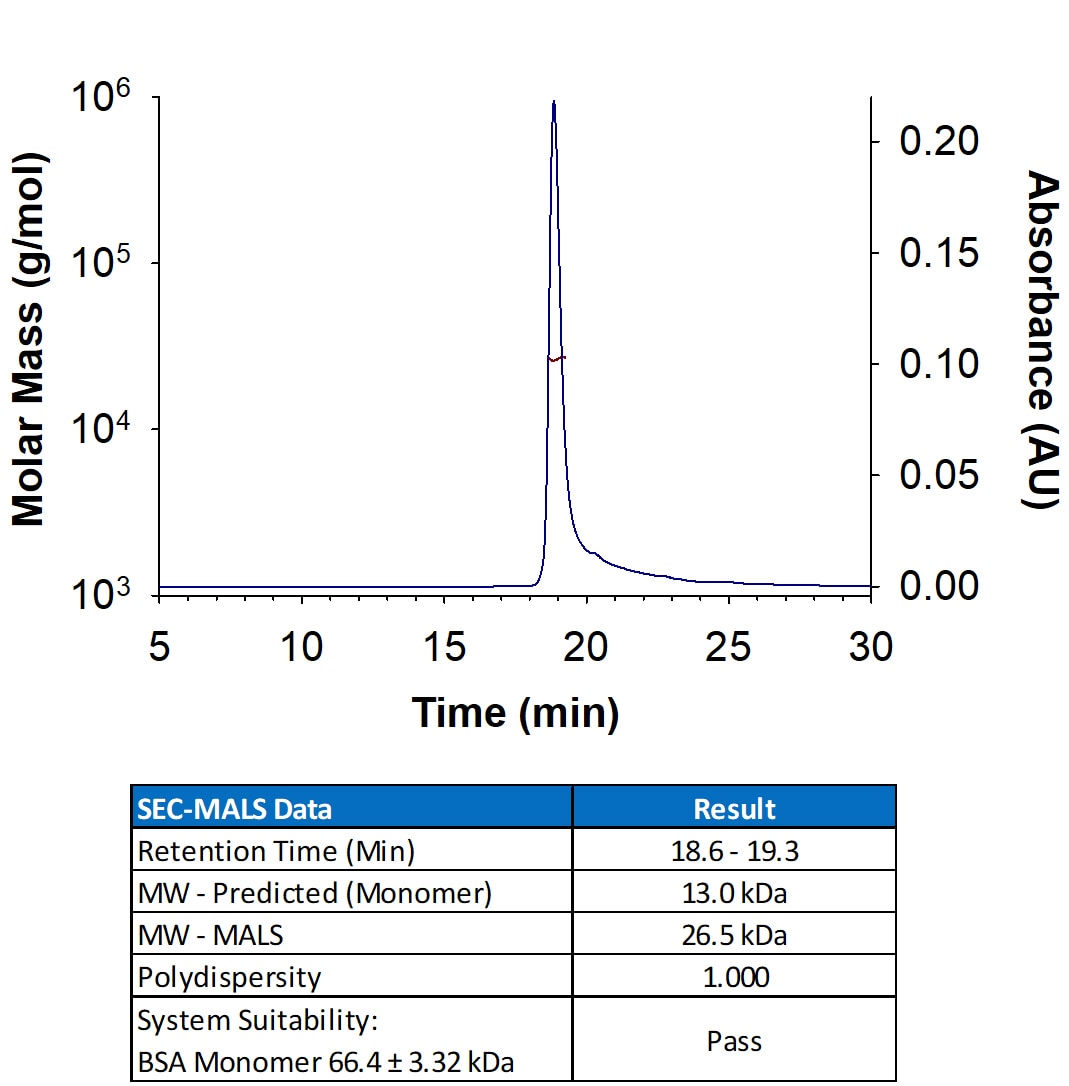
Recombinant Human Activin A (CHO derived) Protein SEC-MALS.
Recombinant Human Activin A (CHO derived) (Catalog # 11348-AC) has a molecular weight (MW) of 26.5 kDa as analyzed by SEC-MALS, suggesting that this protein is a homodimer.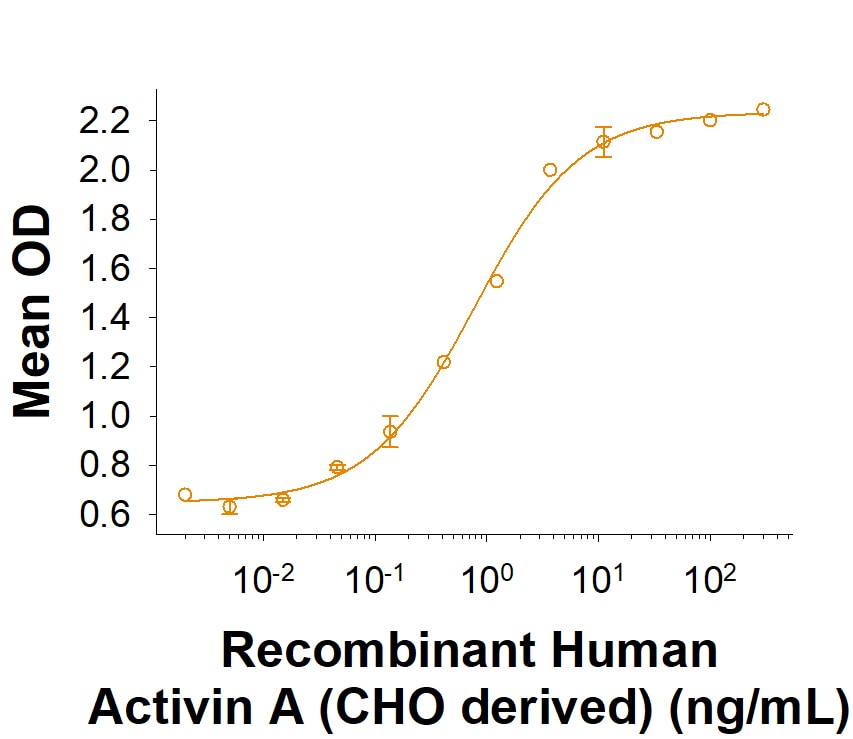
Recombinant Human Activin A (CHO derived) Protein Bioactivity.
Recombinant Human Activin A Protein (CHO derived) induces hemoglobin expression in K562 human chronic myelogenous leukemia cells. The ED50 for this effect is 0.200-1.60 ng/mL.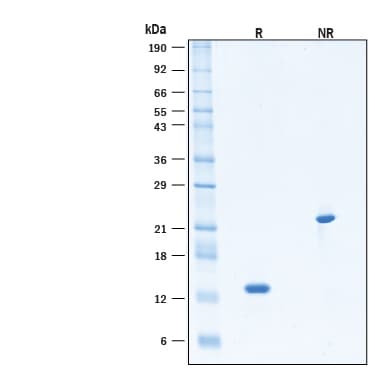
Recombinant Human Activin A (CHO derived) Protein SDS-PAGE.
2 μg/lane of Recombinant Human Activin A (CHO derived) Protein (Catalog # 11348-AC) was resolved with SDS-PAGE under reducing (R) and non-reducing (NR) conditions and visualized by Coomassie® Blue staining, showing bands at 13 and 24 kDa respectively.Formulation, Preparation, and Storage
11348-AC
| Formulation | Lyophilized from a 0.2 μm filtered solution in Acetonitrile and TFA with Trehalose. |
| Reconstitution | Reconstitute 20 μg size at 100 μg/mL in sterile 4 mM HCl. Reconstitute all the other sizes at 500 μg/mL in sterile 4 mM HCl. |
| Shipping | The product is shipped with polar packs. Upon receipt, store it immediately at the temperature recommended below. |
| Stability & Storage | Use a manual defrost freezer and avoid repeated freeze-thaw cycles.
|
Calculators
Background: Activin A
References
- Kumanov, P. et al. (2005) Reprod. Biomed. Online 10:786.
- Maeshima, A. et al. (2008) Endocr. J. 55:1.
- Rodgarkia-Dara, C. et al. (2006) Mutat. Res. 613:123.
- Werner, S. and C. Alzheimer (2006) Cytokine Growth Factor Rev. 17:157.
- Xu, P. and A.K. Hall (2006) Dev. Biol. 299:303.
- Shav-Tal, Y. and D. Zipori (2002) Stem Cells 20:493.
- Chen, Y.G. et al. (2006) Exp. Biol. Med. 231:534.
- Gray, A.M. and A.J. Mason (1990) Science 247:1328.
- Mason, A.J. et al. (1996) Mol. Endocrinol. 10:1055.
- Thompson, T.B. et al. (2004) Mol. Cell. Endocrinol. 225:9.
- Harrison, C.A. et al. (2005) Trends Endocrinol. Metab. 16:73.
- Onichtchouk, D. et al. (1999) Nature 401:480.
- Gray, P.C. et al. (2002) Mol. Cell. Endocrinol. 188:254.
- Kelber, J.A. et al. (2008) J. Biol. Chem. 283:4490.
- Phillips, D.J. et al. (1997) J. Endocrinol. 155:65.
- Schneyer, A. et al. (2003) Endocrinology 144:1671.
- Ghorbani-Dalini, S. et al. (2020) 3 Biotech. 10:215.
- Mennen, R.H. et al. (2022) Reprod Toxicol. 107:44.
- Mishra, S. et al. (2021) Stem Cells. 39:551.
- Tanigawa, S. et al. (2019) Stem Cell Reports 13:322.
- Cangkrama, M. et al. (2020) Trends Mol. Med. 26:1107.
- Ries, A. et al. (2020) Expert Opin. Ther. Targets. 24:985.
- Pinjusic, K. et al. (2022) J. Immunother. Cancer. 10:e004533.
- Dadheech, N. et al. (2020) Stem Cell Res. Ther. 11:327.
Alternate Names
activin AB alpha polypeptide, Activin beta-A chain, erythroid differentiation factor, Erythroid differentiation protein, follicle-stimulating hormone-releasing protein, FSH-releasing protein, inhibin beta A chain, inhibin beta A subunit, Inhibin, beta-1
Gene Symbol
INHBA
UniProt
Additional Activin A Products
Product Documents for Recombinant Human Activin A (CHO derived) Protein, CF
Certificate of Analysis
To download a Certificate of Analysis, please enter a lot or batch number in the search box below.
Note: Certificate of Analysis not available for kit components.
Product Specific Notices for Recombinant Human Activin A (CHO derived) Protein, CF
For research use only
Citations for Recombinant Human Activin A (CHO derived) Protein, CF
 Powered by Bioz
Customer Reviews for Recombinant Human Activin A (CHO derived) Protein, CF
There are currently no reviews for this product. Be the first to review Recombinant Human Activin A (CHO derived) Protein, CF and earn rewards!
Have you used Recombinant Human Activin A (CHO derived) Protein, CF?
Submit a review and receive an Amazon gift card!
$25/€18/£15/$25CAN/¥2500 for a review with an image
$10/€7/£6/$10CAN/¥1110 for a review without an image
Submit a review
Loading...
Associated Pathways
