Mouse IL-6 PE-conjugated Antibody
Mouse IL-6 PE-conjugated Antibody Summary
Applications
Please Note: Optimal dilutions should be determined by each laboratory for each application. General Protocols are available in the Technical Information section on our website.
Scientific Data
 View Larger
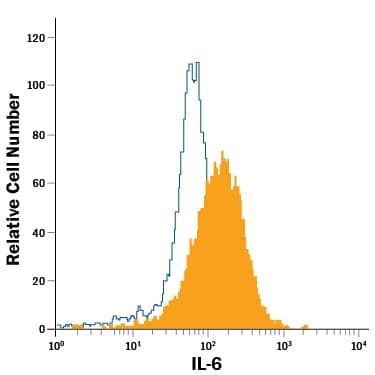
Detection of IL‑6 in J774A.1 Mouse Cell Line by Flow Cytometry. LPS stimulated J774A.1 mouse reticulum cell sarcoma macrophage cell line was stained with Rat Anti-Mouse IL-6 PE-conjugated Monoclonal Antibody (Catalog # IC406P, filled histogram) or isotype control antibody (Catalog # IC005P, open histogram). To facilitate intracellular staining, cells were fixed with Flow Cytometry Fixation Buffer (Catalog # FC004) and permeabilized with Flow Cytometry Permeabilization/Wash Buffer I (Catalog # FC005). View our protocol for Staining Intracellular Molecules.
Reconstitution Calculator
Preparation and Storage
Background: IL-6
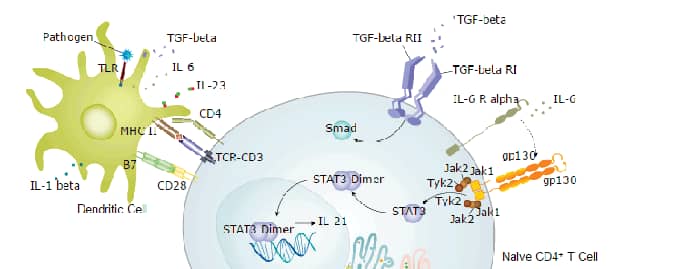
IL-6 (Interleukin-6), also known as Interferon beta 2, is a secreted, 24-30 kDa member of the IL-6 family of proteins. In mouse, mature IL-6 is a highly glycosylated, monomeric polypeptide that is 187 amino acids (aa) in length, and shares 85% and 40% aa identity with rat and human IL-6, respectively. IL-6 expression is induced in a highly diverse group of cells including vascular and visceral smooth muscle cells, T helper cells, fibroblasts, astrocytes, endothelial cells, neurons, monocytes, microglia, pancreatic islet alpha -cells, osteoblasts, keratinocytes and white adipocytes. The receptor for IL-6 is composed of two distinct type I transmembrane glycoproteins, an 80-85 kDa ligand-binding IL-6R alpha subunit, and two signal-transducing 130-135 kDa gp130 subunits. Notably, the IL-6 system seems to exist as one of two states; there is a "classic signaling" state where IL-6 interacts with the transmembrane forms of both IL-6R alpha and gp130 in a signaling complex, and an IL-6 "trans-signaling" state, where IL-6 is bound to soluble IL-6R alpha in a circulating complex that subsequently interacts with transmembrane gp130. The "classic signaling" complex occurs on select cells such as hepatocytes, neutrophils and monocytes. The outcome of "classic signaling" is typically anti-inflammatory, promoting hepatocyte and pancreatic proliferation and regeneration, plus hepatic acute phase protein production. "Trans-signaling", by contrast, is very widespread, as a soluble IL-6R alpha :IL-6 complex can go almost everywhere and interact with the ubiquitously-expressed gp130. Relative to "classic signaling" however, this type of signaling is typically pro-inflammatory, and results in endothelial and smooth muscle cell activation, an inhibition of Treg differentiation, and a mononuclear cell infiltration into inflammatory environments.
Product Datasheets
FAQs
No product specific FAQs exist for this product, however you may
View all Antibody FAQsReviews for Mouse IL-6 PE-conjugated Antibody
There are currently no reviews for this product. Be the first to review Mouse IL-6 PE-conjugated Antibody and earn rewards!
Have you used Mouse IL-6 PE-conjugated Antibody?
Submit a review and receive an Amazon gift card.
$25/€18/£15/$25CAN/¥75 Yuan/¥2500 Yen for a review with an image
$10/€7/£6/$10 CAD/¥70 Yuan/¥1110 Yen for a review without an image