
Snail Antibody - BSA Free
Novus Biologicals | Catalog # NBP2-29626

![Western Blot: Snail AntibodyBSA Free [NBP2-29626]](https://resources.rndsystems.com/images/products/SNAIL-Antibody-Western-Blot-NBP2-29626-img0001.jpg "Western Blot: Snail AntibodyBSA Free [NBP2-29626]")
Scientific images may be resized, cropped, or adjusted for brightness or contrast for presentation purposes. These updates are limited to presentation and do not affect the underlying scientific interpretation of the data. Where available, additional source data may be provided upon request.
Key Product Details
Species Reactivity
Validated:
Human, Mouse, Primate
Cited:
Mouse
Predicted:
Feline (100%), Hamster (100%), Mustelid (100%), Rat (100%). Backed by our 100% Guarantee.
Applications
Validated:
Western Blot
Cited:
Western Blot
Label
Unconjugated
Antibody Source
Polyclonal Rabbit IgG
Format
BSA Free
Loading...
Product Specifications
Immunogen
Synthetic peptide made to an internal portion of human SNAIL protein (between residues 200-300) [UniProt O95863]
Reactivity Notes
Predicted to react with rat, mink, feline and hamster based on 100% sequence homology.
Localization
Nuclear
Clonality
Polyclonal
Host
Rabbit
Isotype
IgG
Scientific Data Images for Snail Antibody - BSA Free
Western Blot: Snail AntibodyBSA Free [NBP2-29626]
Western Blot: SNAIL Antibody [NBP2-29626] - Western blot analysis of SNAIL in HeLa whole cell extract.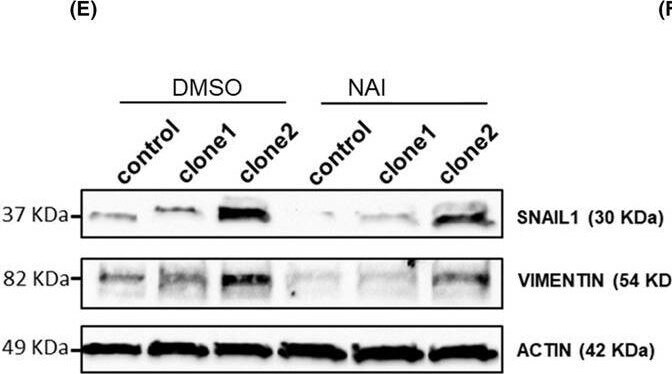
Western Blot: Snail Antibody - BSA Free [NBP2-29626] -
microRNA‐196a (miR‐196a) effects are mediated by the NF kappa B signaling pathway. (A) Pathway enrichment meta‐analysis of miRTarBase predicted targets for miR‐196a. (B) Gene expression of the miR‐196a validated target NFKBIA in control and OE33 miR‐196a overexpressing clones. (C) Activity of the NF kappa B pathway in control and OE33 miR‐196a clones. Cells were transfected with a plasmid containing 4xNF kappa B response elements controlling the expression of the downstream luciferase gene. After 48 h, protein extract was obtained and luciferase activity was quantified using the Dual‐Glo Luciferase Assay System. (D) Reversion of the mesenchymal phenotype of control and OE33 miR‐196a overexpressing clones after inhibition of NF kappa B. Cells were treated with 10 μm of NAI or DMSO as control for 18 h. Scale bar, 100 μm. (E) Western Blot images showing the inhibition of the increase in both SNAIL1 and VIMENTIN protein levels, and in cell motility (F) of control and OE33 miR‐196a overexpressing clones after inhibition of NF kappa B signaling using 10 μm of NAI or DMSO as control for 18 h. Data are mean + standard error of the mean of three independent experiments. **P < 0.01 and ***P < 0.001 for analysis of variance (ANOVA), plus Bonferroni post‐test. ns, not significant. Image collected and cropped by CiteAb from the following open publication (https://pubmed.ncbi.nlm.nih.gov/40955778), licensed under a CC-BY license. Not internally tested by Novus Biologicals.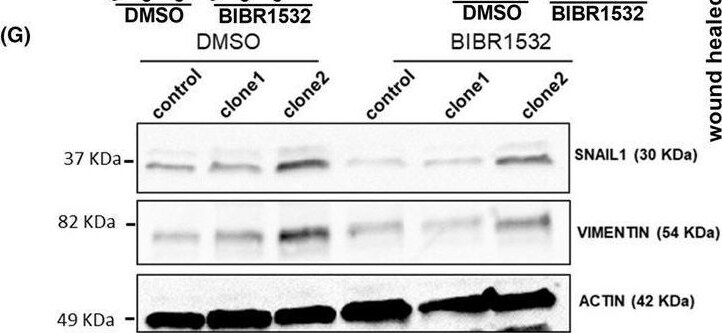
Western Blot: Snail Antibody - BSA Free [NBP2-29626] -
microRNA‐196a (miR‐196a) effects are mediated by TERT. (A–D) TERT siRNA interference reduces the expression of epithelial‐to‐mesenchymal transition markers (EMT) in miR‐196a overexpressing OE33 clones both at mRNA and protein levels. Cells were transfected using Lipofectamine 2000 with TERT siRNA or control siRNA (ctrl siRNA) and gene expression was analyzed after 48 h by qPCR (A–C). Protein expression in these cells was analyzed by western blot (D). (E–G) Reduction of miR‐196a‐mediated increase in the expression of EMT markers, both at mRNA and protein levels, upon TERT inhibition. Control cells and OE33 clones overexpressing miR‐196a were treated with 20 μm of BIBR1532 or DMSO as control for 18 h, and gene and protein expression were analyzed. (H) Reduction of miR‐196a‐mediated increase in cell motility upon TERT inhibition. Control cells and OE33 clones overexpressing miR‐196a were treated with 20 μm of BIBR1532 or DMSO as control for 18 h, and cell motility was analyzed by wound‐healing assay. Data are mean + standard error of the mean of three independent experiments. **P < 0.01 and ***P < 0.001 for analysis of variance (ANOVA), plus Bonferroni post‐test. ns, not significant. Image collected and cropped by CiteAb from the following open publication (https://pubmed.ncbi.nlm.nih.gov/40955778), licensed under a CC-BY license. Not internally tested by Novus Biologicals.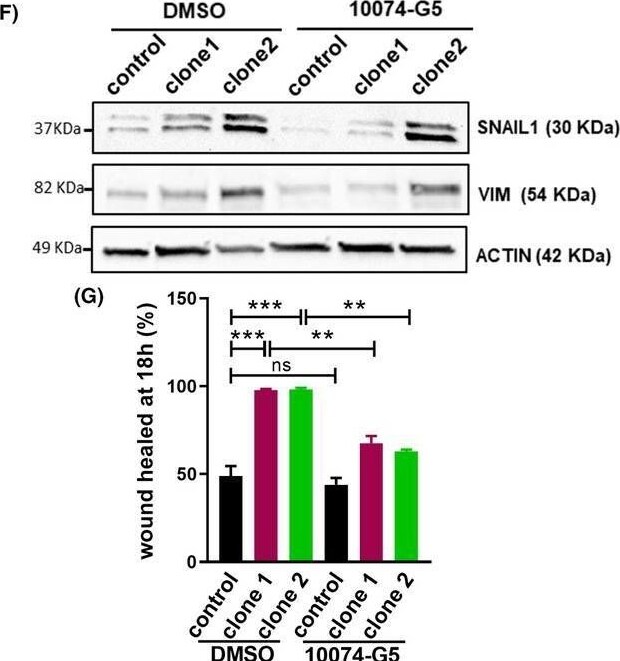
Western Blot: Snail Antibody - BSA Free [NBP2-29626] -
microRNA‐196a (miR‐196a) induces epithelial‐to‐mesenchymal transition (EMT) and cell motility via c‐MYC protein accumulation. (A) c‐MYC mRNA levels in control cells and OE33 miR‐196a overexpressing clones. (B) Western blot of c‐MYC protein in control cells and OE33 miR‐196a overexpressing clones. (C) VCP mRNA levels in control cells and OE33 miR‐196a overexpressing clones. (D) Luciferase reporter assay in control and miR‐196a overexpressing OE33 clones. Wild type (wt) 3′ untranslated region of VCP mRNA (vcp mRNA 3′ UTR) or deletion of putative mir‐196a binding sequences ( delta 196a) were cloned downstream of the luciferase (luc) gene. Luciferase constructs were then transfected in control cells or OE33 miR‐196a overexpressing clones, and luciferase activity was quantified using the Dual‐Glo Luciferase Assay System after 48 h. (E) Reversal of the mesenchymal phenotype of OE33 miR‐196a overexpressing clones after inhibition of c‐MYC activity. Cells were plated in six well plates and treated with 50 μm of 10 074‐G5 or DMSO as control for 18 h. Scale bar, 100 μm. (F) Western blot of SNAIL1 and VIMENTIN protein levels in control cells or OE33 miR‐196a overexpressing clones, and TERT mRNA levels in control cells and OE33 miR‐196a overexpressing clones upon c‐MYC inhibition (H). Cells were plated in six well plates and treated with 50 μm of 10 074‐G5 or DMSO as control for 18 h. Data are mean + standard error of the mean of three independent experiments. **P < 0.01 and ***P < 0.001 for analysis of variance (ANOVA), plus Bonferroni post‐test. ns, not significant. Image collected and cropped by CiteAb from the following open publication (https://pubmed.ncbi.nlm.nih.gov/40955778), licensed under a CC-BY license. Not internally tested by Novus Biologicals.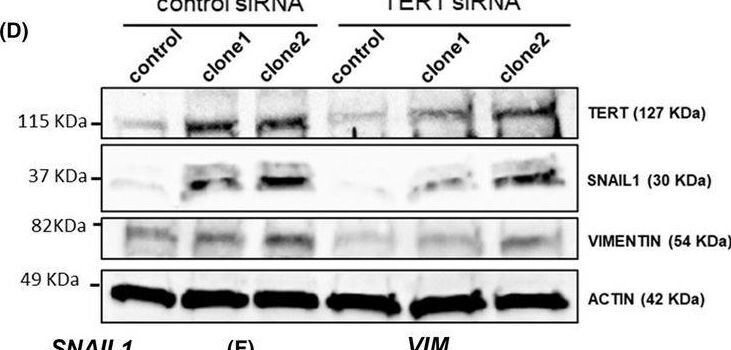
Western Blot: Snail Antibody - BSA Free [NBP2-29626] -
microRNA‐196a (miR‐196a) effects are mediated by TERT. (A–D) TERT siRNA interference reduces the expression of epithelial‐to‐mesenchymal transition markers (EMT) in miR‐196a overexpressing OE33 clones both at mRNA and protein levels. Cells were transfected using Lipofectamine 2000 with TERT siRNA or control siRNA (ctrl siRNA) and gene expression was analyzed after 48 h by qPCR (A–C). Protein expression in these cells was analyzed by western blot (D). (E–G) Reduction of miR‐196a‐mediated increase in the expression of EMT markers, both at mRNA and protein levels, upon TERT inhibition. Control cells and OE33 clones overexpressing miR‐196a were treated with 20 μm of BIBR1532 or DMSO as control for 18 h, and gene and protein expression were analyzed. (H) Reduction of miR‐196a‐mediated increase in cell motility upon TERT inhibition. Control cells and OE33 clones overexpressing miR‐196a were treated with 20 μm of BIBR1532 or DMSO as control for 18 h, and cell motility was analyzed by wound‐healing assay. Data are mean + standard error of the mean of three independent experiments. **P < 0.01 and ***P < 0.001 for analysis of variance (ANOVA), plus Bonferroni post‐test. ns, not significant. Image collected and cropped by CiteAb from the following open publication (https://pubmed.ncbi.nlm.nih.gov/40955778), licensed under a CC-BY license. Not internally tested by Novus Biologicals.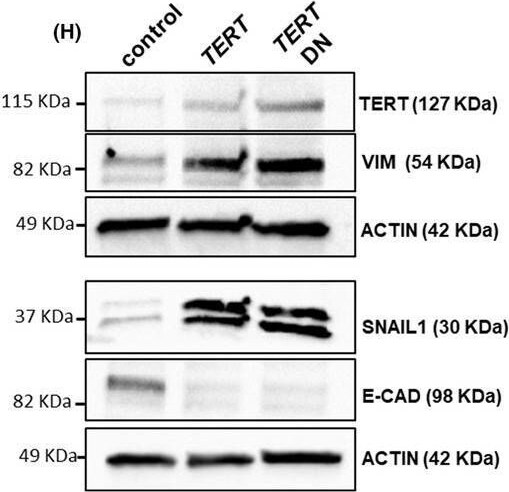
Western Blot: Snail Antibody - BSA Free [NBP2-29626] -
microRNA‐196a (miR‐196a) up‐regulates TERT expression, and TERT increases NF kappa B activity and produces epithelial‐to‐mesenchymal transition (EMT) in Esophageal Adenocarcinoma cells in a telomere lengthening‐independent manner. (A) Expression of TERT, the main component of the telomerase complex, by qPCR in control and OE33 mir196a overexpressing cells. (B) TERT expression in OE33 control and OE33 clones stably overexpressing TERT or a dominant negative form of TERT (TERT DN). (C) Phenotype switch in OE33 TERT and TER‐DN overexpressing clones. (D) TERT overexpression increases NF kappa B signaling activity. Control or OE33 clones stably overexpressing TERT or TERT DN were transfected with a plasmid containing 4xNF kappa B response elements controlling the expression of downstream luciferase gene. After 48 h, protein extract was obtained, and luciferase activity was quantified using the Dual‐Glo Luciferase Assay System. (E–H) qPCR and western blots of control and OE33 TERT and TER‐DN overexpressing clones showing the expression of EMT markers at both mRNA and protein levels. Scale bar, 100 μm. Data are mean + standard error of the mean of three independent experiments. **P < 0.01 and ***P < 0.001 for analysis of variance (ANOVA), plus Bonferroni post‐test. Image collected and cropped by CiteAb from the following open publication (https://pubmed.ncbi.nlm.nih.gov/40955778), licensed under a CC-BY license. Not internally tested by Novus Biologicals.Applications for Snail Antibody - BSA Free
Application
Recommended Usage
Western Blot
1.0 ug/ml
Formulation, Preparation, and Storage
Purification
Immunogen affinity purified
Formulation
PBS
Format
BSA Free
Preservative
0.02% Sodium Azide
Concentration
1.0 mg/ml
Shipping
The product is shipped with polar packs. Upon receipt, store it immediately at the temperature recommended below.
Stability & Storage
Store at 4C short term. Aliquot and store at -20C long term. Avoid freeze-thaw cycles.
Background: Snail
In addition to its role in embryonic development, Snail-induced EMT is also associated with cancer metastasis (1-5). Snail is expressed in a variety of cancer lines including breast cancer, cervical carcinoma, and colorectal carcinoma, and typically results in increased migration, invasion, and metastasis (1). Accordingly, Snail expression is also correlated with drug resistance and tumor recurrence (1-5). Chemical inhibitors that target Snail have shown some promise in reducing or eliminating Snail-induced EMT, increasing E-cadherin expression, and increasing tumor regression (1).
1. Kaufhold, S., & Bonavida, B. (2014). Central role of Snail1 in the regulation of EMT and resistance in cancer: a target for therapeutic intervention. Journal of Experimental & Clinical Cancer Research. https://doi.org/10.1186/s13046-014-0062-0
2. Wang, Y., Shi, J., Chai, K., Ying, X., & Zhou, B. P. (2013). The Role of Snail in EMT and Tumorigenesis. Current Cancer Drug Targets. https://doi.org/10.2174/15680096113136660102
3. Kang, E., Seo, J., Yoon, H., & Cho, S. (2021). The Post-Translational Regulation of Epithelial-Mesenchymal Transition-Inducing Transcription Factors in Cancer Metastasis. International Journal of Molecular Sciences. https://doi.org/10.3390/ijms22073591
4. Seo, J., Ha, J., Kang, E., & Cho, S. (2021). The role of epithelial-mesenchymal transition-regulating transcription factors in anti-cancer drug resistance. Archives of Pharmacal Research. https://doi.org/10.1007/s12272-021-01321-x
5. Baulida, J., Diaz, V. M., & Herreros, A. G. (2019). Snail1: A Transcriptional Factor Controlled at Multiple Levels. Journal of Clinical Medicine. https://doi.org/10.3390/jcm8060757
Additional Snail Products
Product Documents for Snail Antibody - BSA Free
Certificate of Analysis
To download a Certificate of Analysis, please enter a lot or batch number in the search box below.
Product Specific Notices for Snail Antibody - BSA Free
This product is for research use only and is not approved for use in humans or in clinical diagnosis. Primary Antibodies are guaranteed for 1 year from date of receipt.
Citations for Snail Antibody - BSA Free
 Powered by Bioz
Customer Reviews for Snail Antibody - BSA Free
There are currently no reviews for this product. Be the first to review Snail Antibody - BSA Free and earn rewards!
Have you used Snail Antibody - BSA Free?
Submit a review and receive an Amazon gift card!
$25/€18/£15/$25CAN/¥2500 for a review with an image
$10/€7/£6/$10CAN/¥1110 for a review without an image
Submit a review
Protocols
View specific protocols for Snail Antibody - BSA Free (NBP2-29626):
Snail Antibody:
Western Blot Protocol
1. Perform SDS-PAGE on samples to be analyzed, loading 40 ug of total protein per lane.
2. Transfer proteins to membrane according to the instructions provided by the manufacturer of the membrane and transfer apparatus.
3. Stain according to standard Ponceau S procedure (or similar product) to assess transfer success, and mark molecular weight standards where appropriate.
4. Rinse the blot.
5. Block the membrane using standard blocking buffer for at least 1 hour.
6. Wash the membrane in wash buffer three times for 10 minutes each.
7. Dilute primary antibody in blocking buffer and incubate 1 hour at room temperature.
8. Wash the membrane in wash buffer three times for 10 minutes each.
9. Apply the diluted HRP conjugated secondary antibody in blocking buffer (as per manufacturers instructions) and incubate 1 hour at room temperature.
10. Wash the blot in wash buffer three times for 10 minutes each (this step can be repeated as required to reduce background).
11. Apply the detection reagent of choice in accordance with the manufacturers instructions.
*Note: Tween-20 can be added to the blocking or antibody dilution buffer at a final concentration of 0.05-0.2%.
Western Blot Protocol
1. Perform SDS-PAGE on samples to be analyzed, loading 40 ug of total protein per lane.
2. Transfer proteins to membrane according to the instructions provided by the manufacturer of the membrane and transfer apparatus.
3. Stain according to standard Ponceau S procedure (or similar product) to assess transfer success, and mark molecular weight standards where appropriate.
4. Rinse the blot.
5. Block the membrane using standard blocking buffer for at least 1 hour.
6. Wash the membrane in wash buffer three times for 10 minutes each.
7. Dilute primary antibody in blocking buffer and incubate 1 hour at room temperature.
8. Wash the membrane in wash buffer three times for 10 minutes each.
9. Apply the diluted HRP conjugated secondary antibody in blocking buffer (as per manufacturers instructions) and incubate 1 hour at room temperature.
10. Wash the blot in wash buffer three times for 10 minutes each (this step can be repeated as required to reduce background).
11. Apply the detection reagent of choice in accordance with the manufacturers instructions.
*Note: Tween-20 can be added to the blocking or antibody dilution buffer at a final concentration of 0.05-0.2%.
Find general support by application which include: protocols, troubleshooting, illustrated assays, videos and webinars.
- Cellular Response to Hypoxia Protocols
- R&D Systems Quality Control Western Blot Protocol
- Troubleshooting Guide: Western Blot Figures
- Western Blot Conditions
- Western Blot Protocol
- Western Blot Protocol for Cell Lysates
- Western Blot Troubleshooting
- Western Blot Troubleshooting Guide
- View all Protocols, Troubleshooting, Illustrated assays and Webinars
FAQs for Snail Antibody - BSA Free
Showing
1
-
1 的
1 FAQ
Showing All
-
Q: There are many kinds of antibodies you supply against SNAIL. Could you give me your recommendation? Which is the best for the IHC-P experiments the species of my samples to be tested is human.
A:
Our SNAIL antibody with catalog # NBP1-19529 has been successfully validated for IHC-P in paraffin-embedded human lung carcinoma tissue and I would highly recommend you to use the same for your samples too. The working dilutions of this antibody for IHC-P ranges from 1:50 - 1:200 and beside IHC, you can use this antibody for Western Blot and Immunofluorescence also.
Loading...
Associated Pathways
