GAG-specific Endoglycosidase Assay using 35S-Labeled Proteoglycans
by Cheryl M. Ethen, Miranda Machacek, Brittany Prather, & Zhengliang L. Wu.
Scientific Meeting PostersABSTRACT
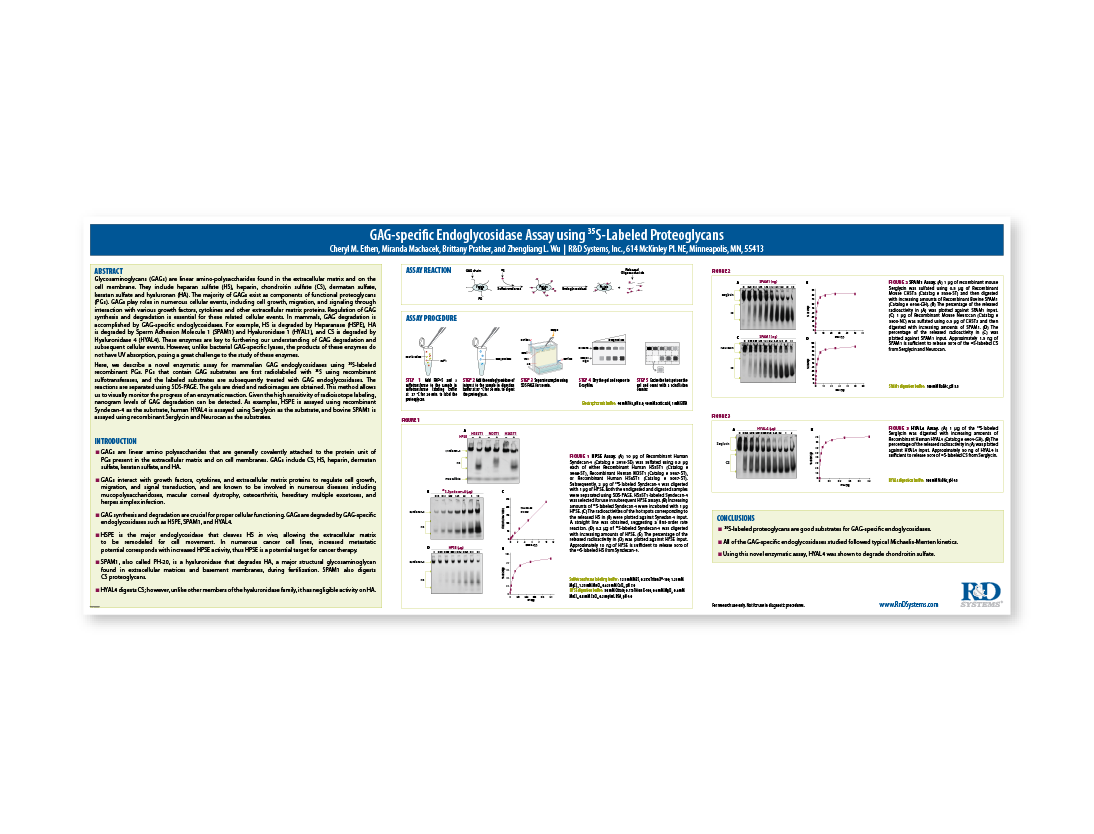
Glycosaminoglycans (GAGs) are linear amino-polysaccharides found in the extracellular matrix and on the cell membrane. They include heparan sulfate (HS), heparin, chondroitin sulfate (CS), dermatan sulfate, keratan sulfate, and hyaluronan (HA). The majority of GAGs exist as components of functional proteoglycans (PGs). GAGs play roles in numerous cellular events, including cell growth, migration, and signaling through interaction with various growth factors, cytokines, and other extracellular matrix proteins. Regulation of GAG synthesis and degradation is essential for these related cellular events. In mammals, GAG degradation is accomplished by GAG-specific endoglycosidases. For example, HS is degraded by Heparanase (HSPE), HA is degraded by Sperm Adhesion Molecule 1 (SPAM1) and Hyaluronidase 1 (HYAL1), and CS is degraded by Hyaluronidase 4 (HYAL4). These enzymes are key to furthering our understanding of GAG degradation and subsequent cellular events. However, unlike bacterial GAG-specific lyases, the products of these enzymes do not have UV absorption, posing a great challenge to the study of these enzymes.
Here, we describe a novel enzymatic assay for mammalian GAG endoglycosidases using 35S-labeled recombinant PGs. PGs that contain GAG substrates are first radio-labeled with 35S using recombinant sulfotransferases, and the labeled substrates are subsequently treated with GAG endoglycosidases. The reactions are separated using SDS-PAGE. The gels are dried and radio images are obtained. This method allows us to visually monitor the progress of an enzymatic reaction. Given the high sensitivity of radioisotope labeling, nanogram levels of GAG degradation can be detected. As examples, HSPE is assayed using recombinant Syndecan-4 as the substrate, human HYAL4 is assayed using Serglycin as the substrate, and bovine SPAM1 is assayed using recombinant Serglycin and Neurocan as the substrates.
Related Information
- Extracellular Matrix and Related Molecules
- Glycobiology Assay Kits
- Glycobiology-related Enzymes
- Proteoglycans
- Sulfation Regulators