Recombinant Human Collagens and Associated Reagents
by Wei-Man Wang, Sara J. Larson, Hyun Park, Gary D. Johnson, & Weiping Jiang.
Scientific Meeting PostersABSTRACT
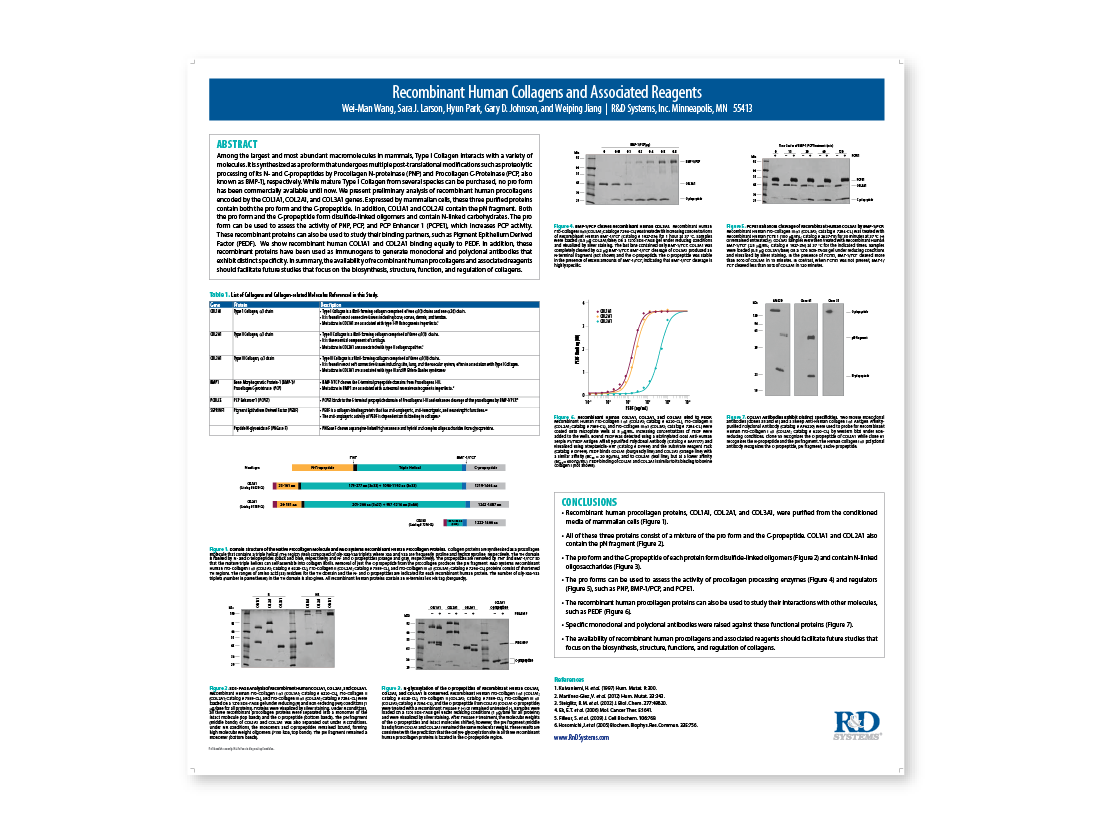
Among the largest and most abundant macromolecules in mammals, Type I Collagen interacts with a variety of molecules. It is synthesized as a pro form that undergoes multiple post-translational modifications such as proteolytic processing of its N- and C-propeptides by Procollagen N-proteinase (PNP) and Procollagen C-Proteinase (PCP, also known as BMP-1), respectively. While mature Type I Collagen from several species can be purchased, no pro form has been commercially available until now. We present preliminary analysis of recombinant human procollagens encoded by the COL1A1, COL2A1, and COL3A1 genes. Expressed by mammalian cells, these three purified proteins contain both the pro form and the C-propeptide. In addition, COL1A1 and COL2A1 contain the pN fragment. Both the pro form and the C-propeptide form disulfide-linked oligomers and contain N-linked carbohydrates. The pro form can be used to assess the activity of PNP, PCP, and PCP Enhancer 1 (PCPE1), which increases PCP activity. These recombinant proteins can also be used to study their binding partners, such as Pigment Epithelium Derived Factor (PEDF). We show recombinant human COL1A1 and COL2A1 binding equally to PEDF. In addition, these recombinant proteins have been used as immunogens to generate monoclonal and polyclonal antibodies that exhibit distinct specificity. In summary, the availability of recombinant human procollagens and associated reagents should facilitate future studies that focus on the biosynthesis, structure, function, and regulation of collagens.
Related Information
Extracellular Matrix and Related Molecules
Extracellular Matrix Molecules
Download PDF