Western Blot

Western blot is a fundamental analytical technique that is used to detect protein expression levels in cell or tissue lysates. When coupled with immunoprecipitation, Western blotting can also reveal subcellular localization, post-translational modifications, protein processing and protein-protein interactions. Bio-Techne offers an unmatched selection of antibodies, controls, support products, imaging systems, and analysis software for both traditional and automated Western blotting.

Traditional Western Blot

Primary Antibodies 

The success of a Western blot experiment depends on having reliable antibodies validated for Western blot. Bio-Techne's Western blot antibody portfolio includes top-cited monoclonal and recombinant primary antibodies backed by our 100% guarantee

Western Blot Primary Antibodies by Species

Anti-Human Anti-Mouse Anti-RatAnti-Bovine 

Secondary Antibodies & Detection

Bio-Techne offers enzyme- and fluorochrome-conjugated secondary antibodies for use in Western blot experiments. Although enzyme-conjugated secondary antibodies, such as HRP conjugates, are often used in conjunction with chemiluminescence detection and allow for the sensitive detection (low picogram) of antigens, fluorescence-based detection methods have improved signal stability and allow for simultaneous detection of multiple proteins. In fluorescence detection a fluorophore-conjugated antibody directly emits a detectable single, whereas in both chemiluminescent or chromogenic detection the process relies on an enzyme-conjugated antibody plus the addition of a substrate or detection reagent.

Protocols for Traditional Western Blot

Western Blot Controls  

Controls are vital for Western blot analysis to validate the specificity of protein bands and/or to uncover the root cause of any issues. Bio-Techne provides a range of controls to ensure Western blot success.

Control LysatesOver-expression LysatesTissue LysatesBlocking Peptides and Proteins
Loading Controls    

Request Bio-Techne's Western Blot eHandbook

Explore our step-by-step guide along with helpful troubleshooting tips to achieve reliable and reproducible results.

Western Blot Handbook Thumbnail

Other Western Blotting Support Products 

In addition to antibodies and lysate controls, Bio-Techne also offers an assortment of other support products to aid Western blot success, including an HRP stabilizer, sub-cellular fractionation kits, protein ladders, and Western blot membranes.

Western Blot Support Products

HRP StabilizerPonceau S Staining solutionPBS Buffer Tablets RunBlue Prestained Molecular-Weight Marker- Tri colour
Recombinant Unstained Protein Ladder Recombinant Western Blot Protein Standards Sub-cellular Fractionation Kits Western Blot Membranes 
Peptide InhibitorsOther Support Products  

Simple Western™ Automated Western Blotting Systems

Western blots are notoriously labor-intensive and challenging to perform. To overcome the challenges of traditional Western blots, Simple Western™ from ProteinSimple, a Bio-Techne brand, offers fully automated capillary Western blot analysis. The steps traditionally performed in Western blotting techniques like separation, immobilization, washing, and detection are automatically performed inside a benchtop capillary electrophoresis machine.

  • Simple Western offers high throughput Western blot analysis with fully quantitative results on up to 25 samples in just 3 hours, or 96 samples overnight.
  • Simple Western users enjoy industry-leading NIR/IR fluorescence detection sensitivity with Stellar™ Modules on Jess™.
  • Simple Western even replaces the laborious strip and re-probe of traditional Western blot testing with RePlex™, which removes the antibodies from the first round of probing for a second round of probing with fresh antibodies or total protein normalization.
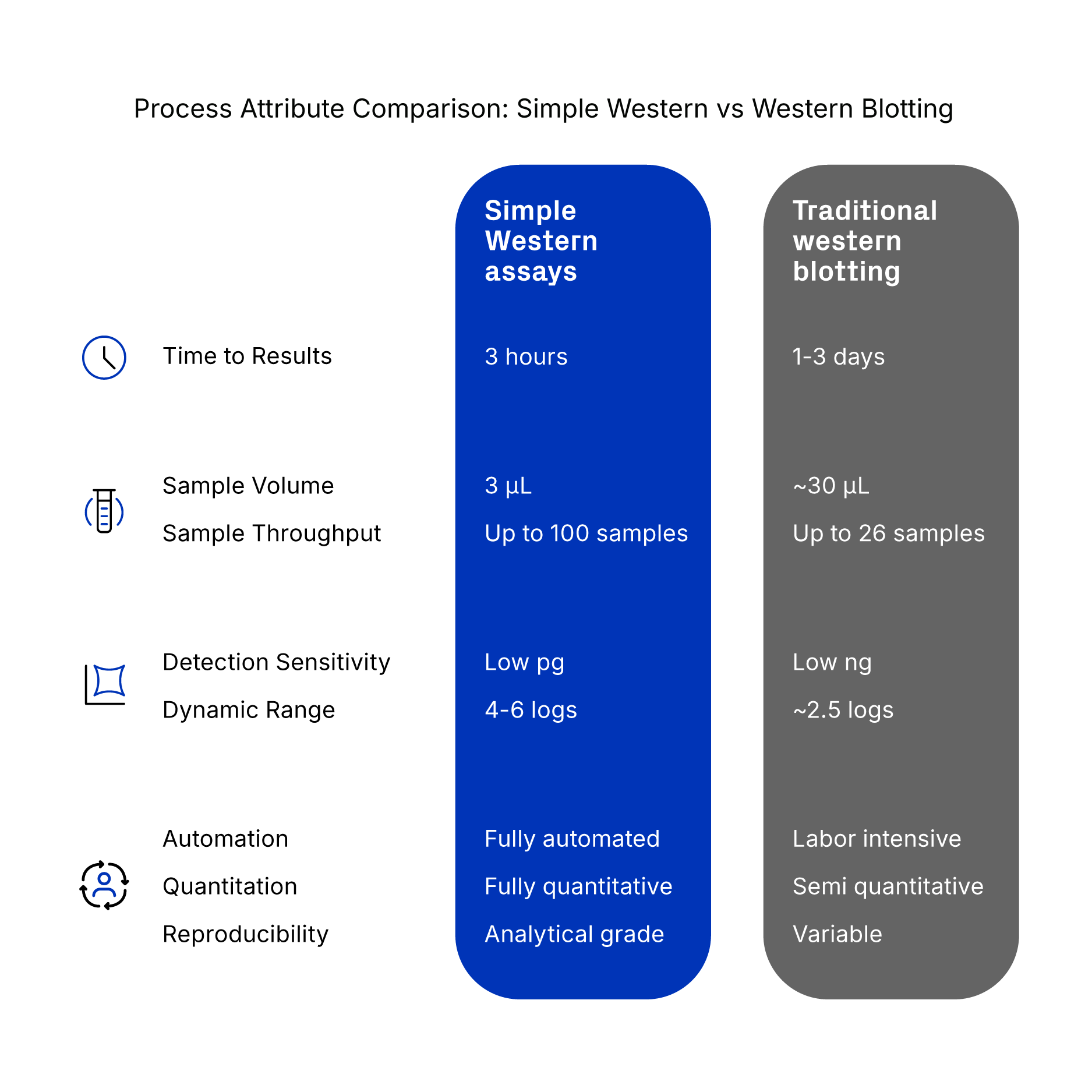
Simple Western vs Western Blot Infographic

Simple Western on Jess vs. traditional Western blot

Bio-Techne offers a wide-selection of antibodies validated for Simple Western

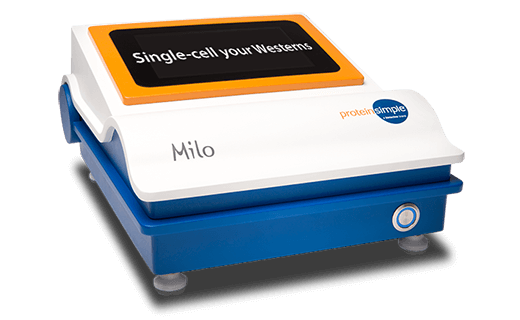
Single cell Western platform Milo measures gene transfer efficiency

Now You Can Perform Western Blotting in Single Cells with Milo™

Are you interested in single-cell proteomics? Milo™ is our Single-Cell Western blotting technique that measures protein expression in ~1,000 single cells in a single run. Validate your RNAseq data, analyze FACS-sorted cells, and gain a rich understanding of single-cell proteomics with Milo, the World’s first Single-Cell Western blotting technique.

Custom Antibody Services

If you can’t find the antibody that you need on our website, contact us. Custom antibody production is a complicated process. Leverage the experience and skill of our antibody development scientists for your custom antibody project.

Cancer Biomarker Discovery

Related Western Blot Resources

Western Blot Handbook

Our step-by-step Western blot guide is a great introduction to Western blot. It provides detailed information for understanding, performing, and troubleshooting a Western blot protocol.

Western Blot Troubleshooting Resource

A comprehensive, online resource for troubleshooting the most common problems of Western blot including no signal, multiple bands, and high background.

Development of Validated Monoclonal Antibodies

This white paper describes our validation process, including antigen design, feasibility testing, specificity and sensitivity testing, and quality control and release decisions, for our monoclonal antibodies.

Learn About Western Blot Antibody Staining and Detection

Background Information

About Western Blot

Western blot is a laboratory method that uses antibodies to identify individual proteins in cell or tissue lysates. Owing to the specific nature of antibody binding, Western blot analysis can be used to detect and quantify a single protein within a mixture of thousands of different proteins. In Western blot, samples are loaded onto a polyacrylamide gel and separated based on their molecular weight by SDS-PAGE electrophoresis. 

  • Sample Preparation The first step to a successful Western blot is sample preparation, requiring cell lysis to isolate proteins, proteolysis, dephosphorylation and denaturation are required. For information on sample preparation for Western blotting, view our Sample Preparation Protocol.
  • Separation:  Samples are loaded onto a polyacrylamide gel consisting of two sections, a stacking gel and a separating gel, and the proteins are separated based on their molecular weight by SDS-PAGE electrophoresis. The stacking gel contains less acrylamide and has a lower pH. This environment allows the proteins in the sample to form highly defined, sharp bands. The . The proteins pass from the stacking gel into the separating gel, which is more basic and has a higher gel concentration. This causes the proteins to separate by size, with the smaller proteins traveling faster through the gel. View our SDS-PAGE Gel Electrophoresis Protocol.
  • Transfer: The proteins are then transferred to a membrane by application of an electrical current. View our Protein Transfer Protocol.
  • Staining; The membrane can be incubated with primary antibodies specific for target protein(s) of interest. Secondary antibodies bound to enzymes or fluorochromes are applied to the membrane to visualize the protein/antibody complex.
  • Visualization: A band will appear at approximately its molecular weight, as marked by the molecular weight ladder. For more information on antibody staining and visualization, view our Immunoblotting Protocol.  

Overview of Conventional Western Blot Protocol

Overview of Conventional Western Blot Protocol

(A) Proteins are separated by polyacrylamide gel electrophoresis (PAGE) and (B) transferred to a membrane (e.g. nitrocellulose or PVDF) for detection. (C) The membrane is probed with a primary antibody specific for the target protein and typically followed by an enzyme conjugated secondary antibody to detect the antibody-antigen complex. The enzyme (e.g. horseradish peroxidase, HRP) acts on a substrate (e.g. electro-chemiluminescence, ECL) to emit light, (D) generating a signal captured on autoradiography film or a chemiluminescence imaging system. Learn more about perfecting Western blots

After completing a Western blot, the membrane can be stripped to remove the primary and secondary antibodies, allowing for the membrane to be incubated with additional antibodies.  For more information on this process, view our Membrane Stripping and Reprobing protocol. 

What is SDS-PAGE?

SDS-PAGE (sodium dodecyl sulfate polyacrylamide gel electrophoresis) is an electrophoresis method commonly used to separate proteins based by size. SDS is an anionic detergent, a detergent that has a negative charge, that binds to proteins and disrupts the non-covalent forces that are responsible for their three-dimensional structure, thus denaturing the proteins. SDS also gives the proteins a uniform net negative charge that is relative to its size. This causes the denatured proteins to migrate through the gel during electrophoresis solely based on its size. People typically do SDS-PAGE prior to Western blotting. SDS-PAGE separates the proteins while Western blotting involves the transfer of proteins from the gel to a membrane, and confirmation of the presence/absence/expression level of the proteins using an antibody.

What is native PAGE and why might it be used?

Native or non-denaturing gels do not use SDS. Nor is a reducing agent, such as DTT or beta-mercaptoethanol, added to the sample loading buffer. This means that the proteins maintain their native structure and charge. As a result, they will migrate through the gel during electrophoresis according to both their mass and their charge. Native gels are used to determine the aggregation state of a protein, study protein complexes, and isolate enzymes.

How much sample should be loaded for a Western blot?

The amount of protein that should be loaded into the loading gel for a Western blot depends a several factors including the expression level of the protein and the sample being probed. As a rule of thumb, 20-30 µg of total protein is loaded per well for cell and nuclear lysates and membrane samples. Ten to 100 ng of protein is typically loaded if probing for a purified protein. The appropriate protein amount to load, though, should be determined prior to starting a Western blot experiment.

What types of controls are needed for a Western blot?

Proper controls for Western blotting are important for determining the source of problems and for validating results. There are several controls that need to be used for a proper Western blot experiment.  

1. Positive Control Lysates – Positive control lysates are from cell lines or tissue samples that are known to express the protein of interest. This control will yield a positive band on the Western blot. This control is important as it ensures there were no issues in the Western blot protocols and that any negative results are due to a lack of protein in the sample and not to procedural problems.

2. Negative Control Lysates – Negative control lysates are from samples known to not express the target protein. This control will yield no band on the Western blot. This control is important for determining non-specific binding of the antibodies.

3. Positive Endogenous Control Lysates - Positive endogenous control lysates are from samples that are known to express the target of interest. This control should be used when testing a sample of recombinant protein, such as a tagged protein. Folding of a recombinant protein may be different than the native protein, and misfolding may prevent the antibody from accessing the epitope. This control will let the researcher know that a negative result is due to the epitope being blocked as opposed to the protocol not working.

4. Loading Control – Loading controls are housekeeping proteins, which are proteins that are expressed at equivalent levels in almost all tissues and cells. This control ensures that differences in protein expression between wells isn’t due to loading or protein transfer errors. Loading controls are required for the semi-quantification of protein levels between wells.

What is the difference between Simple Western and Western blot?

Simple Western assays are fully automated Western blotting systems based on capillary electrophoresis followed seamlessly by immunodetection. This platform automates all the steps involved in electrophoresis and Western blotting techniques, from protein loading and separation, immunoprobing, washing, detection and quantitative analysis of data. View Bio-Techne’s Simple Western overview page for more information on Simple Western.

Why is the actual Western blot band size different from the predicted?

In general, as proteins migrate through a PAGE gel matrix, they are separated according to their size (MW). The smaller the protein, the faster it migrates through the gel. However, migration may also be affected by other factors. Therefore, the actual band size observed may differ from the predicted size. Some of these factors include post-translational modification, post-translational cleavage, splice variation, relative charge variation, and the forming of protein multimers.

Do you have any recommendation for a blocking buffer for use of a primary antibody in Western blot?

The blocking buffer that is often employed in our Western Blot QC validation is either 3% BSA (Catalog # 5217), or 5% NFDM (Non-fat Dry Milk). In certain cases, a mixture of both BSA and NFDM will be employed. Ensure that BSA is used as the blocking buffer for antibodies that target phosphorylated post-translational modifications. This is to ensure that the antibody does not non-specifically bind the casein found in NFDM.

What should I use as blocking buffer when trying to detect phosphorylated epitopes in Western blot?

As a general guideline in Western blot to detect any phospho-protein, it is usually recommended to use 5% w/v BSA (in TBST) because milk contains casein which is a phosphoprotein and as a result it can cause high background by detecting the casein present in milk.

Have more questions relating to your Western blots?

View our Western Blot Troubleshooting Guide.