Scientific images may be resized, cropped, or adjusted for brightness or contrast for presentation purposes. These updates are limited to presentation and do not affect the underlying scientific interpretation of the data. Where available, additional source data may be provided upon request.
Key Product Details
Species Reactivity
Validated:
Mouse
Cited:
Mouse, Transgenic Mouse
Applications
Validated:
Western Blot, Flow Cytometry, CyTOF-ready
Cited:
Immunohistochemistry, Western Blot, Neutralization, Flow Cytometry, Immunocytochemistry, Immunoprecipitation, Electrophysiology
Label
Unconjugated
Antibody Source
Polyclonal Goat IgG
Loading...
Product Specifications
Immunogen
S. frugiperda insect ovarian cell line Sf 21-derived recombinant mouse IL‑17 RA/IL‑17 R
Extracellular domain
Extracellular domain
Specificity
Detects mouse IL‑17 RA/IL‑17 R in direct ELISAs and Western blots. In Western blots, approximately 5% cross-reactivity with recombinant human IL‑17 RA/IL‑17 R is observed and less than 1% cross-reactivity with recombinant mouse (rm) IL-17 RC and rmIL-17 RD is observed.
Clonality
Polyclonal
Host
Goat
Isotype
IgG
Scientific Data Images for Mouse IL-17RA/IL-17R Antibody
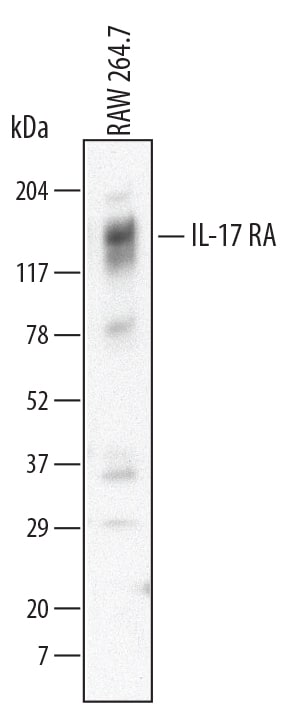
Detection of Mouse IL‑17 RA/IL‑17 R by Western Blot.
Western blot shows lysates of RAW 264.7 mouse monocyte/macrophage cell line. PVDF membrane was probed with 1 µg/mL of Goat Anti-Mouse IL-17 RA/IL-17 R Antigen Affinity-purified Polyclonal Antibody (Catalog # AF448) followed by HRP-conjugated Anti-Goat IgG Secondary Antibody (Catalog # HAF017). A specific band was detected for IL-17 RA/IL-17 R at approximately 150 kDa (as indicated). This experiment was conducted under reducing conditions and using Immunoblot Buffer Group 1.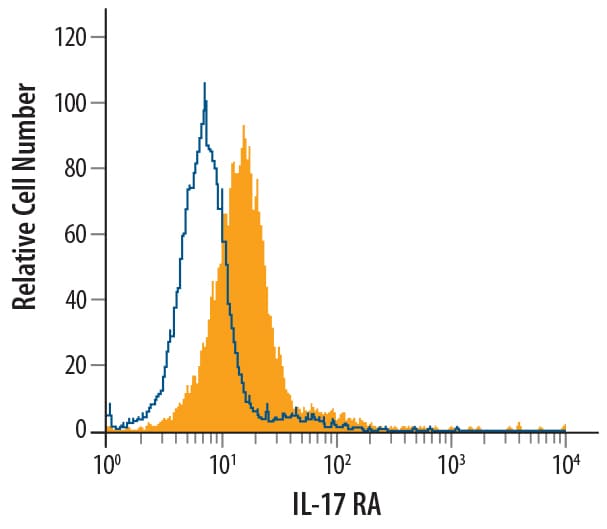
Detection of IL‑17 RA/IL‑17 R in RAW 264.7 Mouse Cell Line by Flow Cytometry.
RAW 264.7 mouse monocyte/macro-phage cell line was stained with Goat Anti-Mouse IL-17 RA/IL-17 R Antigen Affinity-purified Polyclonal Antibody (Catalog # AF448, filled histogram) or control antibody (Catalog # AB-108-C, open histogram), followed by Phycoerythrin-conjugated Anti-Goat IgG Secondary Antibody (Catalog # F0107).Applications for Mouse IL-17RA/IL-17R Antibody
Application
Recommended Usage
CyTOF-ready
Ready to be labeled using established conjugation methods. No BSA or other carrier proteins that could interfere with conjugation.
Flow Cytometry
2.5 µg/106 cells
Sample: RAW 264.7 mouse monocyte/macrophage cell line
Sample: RAW 264.7 mouse monocyte/macrophage cell line
Western Blot
1 µg/mL
Sample: RAW 264.7 mouse monocyte/macrophage cell line
Sample: RAW 264.7 mouse monocyte/macrophage cell line
Reviewed Applications
Read 1 review rated 4 using AF448 in the following applications:
Flow Cytometry Panel Builder
Bio-Techne Knows Flow Cytometry
Save time and reduce costly mistakes by quickly finding compatible reagents using the Panel Builder Tool.
Advanced Features
- Spectra Viewer - Custom analysis of spectra from multiple fluorochromes
- Spillover Popups - Visualize the spectra of individual fluorochromes
- Antigen Density Selector - Match fluorochrome brightness with antigen density

Formulation, Preparation, and Storage
Purification
Antigen Affinity-purified
Reconstitution
Reconstitute at 0.2 mg/mL in sterile PBS. For liquid material, refer to CoA for concentration.
Loading...
Formulation
Lyophilized from a 0.2 μm filtered solution in PBS with Trehalose. *Small pack size (SP) is supplied either lyophilized or as a 0.2 µm filtered solution in PBS.
Shipping
Lyophilized product is shipped at ambient temperature. Liquid small pack size (-SP) is shipped with polar packs. Upon receipt, store immediately at the temperature recommended below.
Stability & Storage
Use a manual defrost freezer and avoid repeated freeze-thaw cycles.
- 12 months from date of receipt, -20 to -70 °C as supplied.
- 1 month, 2 to 8 °C under sterile conditions after reconstitution.
- 6 months, -20 to -70 °C under sterile conditions after reconstitution.
Calculators
Background: IL-17RA/IL-17R
IL‑17 R consists of a 291 amino acid (aa) extracellular domain, a 21 aa transmembrane segment, and a 521 aa cytoplasmic domain (4). The cytoplasmic domain contains a region homologous to the TIR domain of the TLR/IL-1 R family (5). Mouse IL-17 R shares 84% and 72% aa sequence identity with rat and human IL-17 R, respectively. Within the extracellular domain, it shares 18-25% sequence identity with mouse IL-17 RB, C, D, and E. While the expression of IL-17 is restricted to activated T cells, IL-17 R exhibits a broad tissue distribution (4). Even in the absence of ligand, IL-17 R exists on the cell surface as a multimer (6). IL-17 R can bind IL-17 but must associate with IL-17 RC to transduce signals (7, 8). Interestingly, human IL-17 R does not appear to form productive complexes with mouse IL-17 RC (8). The IL-17 R can also signal in response to IL-17F (9). IL-17 R ligation promotes T cell activation and the production of IL-6, G-CSF, SCF, and multiple pro‑inflammatory chemokines (4, 7, 9, 10). IL-17A and IL-17F synergize with TNF-alpha in the induction of CXCL1, G-CSF, and IL-6 (9, 11). This effect requires the presence of both TNF RI and TNF RII (9). IL-17 interactions with IL-17 R also inhibit the TNF-alpha induced upregulation of fibroblast CCL5 and VCAM-1 (11). CCL5 and VCAM-1 induced effects are differentially sensitive to blockade with IL-17 R specific antibodies, suggesting that IL-17 R triggers divergent intracellular signals (11). In vivo, IL‑17 R activity is important for increased generation of neutrophils and their recruitment to sites of inflammation (10, 12, 13). IL-17 R is required for host defense against microbial infection and for the progression of arthritis from inflammation to destructive joint erosion (10, 13).
References
- Iwakura, Y. and H. Ishigame (2006) J. Clin. Invest. 116:1218.
- Moseley, T.A. et al. (2003) Cytokine Growth Factor Rev. 14:155.
- Kawaguchi, M. et al. (2004) J. Allergy Clin. Immunol. 114:1265.
- Yao, Z. et al. (1995) Immunity 3:811.
- Novatchkova, M. et al. (2003) Trends Biochem. Sci. 28:226.
- Kramer, J.M. et al. (2006) J. Immunol. 176:711.
- Hymowitz, S.G. et al. (2001) EMBO J. 20:5332.
- Toy, D. et al. (2006) J. Immunol. 177:36.
- McAllister, F. et al. (2005) J. Immunol. 175:404.
- Ye, P. et al. (2001) J. Exp. Med. 194:519.
- Schnyder, B. et al. (2005) Cytokine 31:191.
- Tan, W. et al. (2006) J. Immunol. 176:6186.
- Lubberts, E. et al. (2005) J. Immunol. 175:3360.
Long Name
Interleukin 17 Receptor
Alternate Names
CD217, Cdw217, IL-17 R, IL-17 RA, IL17RA
Entrez Gene IDs
Gene Symbol
IL17RA
Additional IL-17RA/IL-17R Products
Product Documents for Mouse IL-17RA/IL-17R Antibody
Certificate of Analysis
To download a Certificate of Analysis, please enter a lot or batch number in the search box below.
Note: Certificate of Analysis not available for kit components.
Product Specific Notices for Mouse IL-17RA/IL-17R Antibody
For research use only
Related Research Areas
Citations for Mouse IL-17RA/IL-17R Antibody
 Powered by Bioz
Customer Reviews for Mouse IL-17RA/IL-17R Antibody (1)
4 out of 5
1 Customer Rating
Have you used Mouse IL-17RA/IL-17R Antibody?
Submit a review and receive an Amazon gift card!
$25/€18/£15/$25CAN/¥2500 for a review with an image
$10/€7/£6/$10CAN/¥1110 for a review without an image
Submit a review
Customer Images
Showing
1
-
1 的
1 review
Showing All
Filter By:
-
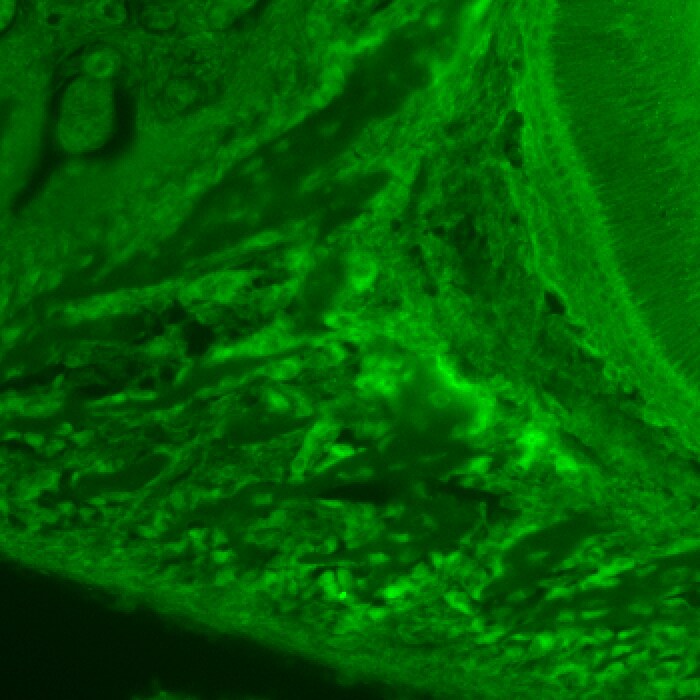
Application: Immunocytochemistry/ImmunofluorescenceVerified Customer | Posted 01/24/2024

There are no reviews that match your criteria.
Protocols
Find general support by application which include: protocols, troubleshooting, illustrated assays, videos and webinars.
- 7-Amino Actinomycin D (7-AAD) Cell Viability Flow Cytometry Protocol
- Cellular Response to Hypoxia Protocols
- Extracellular Membrane Flow Cytometry Protocol
- Flow Cytometry Protocol for Cell Surface Markers
- Flow Cytometry Protocol for Staining Membrane Associated Proteins
- Flow Cytometry Staining Protocols
- Flow Cytometry Troubleshooting Guide
- Intracellular Flow Cytometry Protocol Using Alcohol (Methanol)
- Intracellular Flow Cytometry Protocol Using Detergents
- Intracellular Nuclear Staining Flow Cytometry Protocol Using Detergents
- Intracellular Staining Flow Cytometry Protocol Using Alcohol Permeabilization
- Intracellular Staining Flow Cytometry Protocol Using Detergents to Permeabilize Cells
- Propidium Iodide Cell Viability Flow Cytometry Protocol
- Protocol for Liperfluo
- Protocol for the Characterization of Human Th22 Cells
- Protocol for the Characterization of Human Th9 Cells
- Protocol: Annexin V and PI Staining by Flow Cytometry
- Protocol: Annexin V and PI Staining for Apoptosis by Flow Cytometry
- R&D Systems Quality Control Western Blot Protocol
- Troubleshooting Guide: Fluorokine Flow Cytometry Kits
- Troubleshooting Guide: Western Blot Figures
- Western Blot Conditions
- Western Blot Protocol
- Western Blot Protocol for Cell Lysates
- Western Blot Troubleshooting
- Western Blot Troubleshooting Guide
- View all Protocols, Troubleshooting, Illustrated assays and Webinars