The Src family belongs to non-receptor tyrosine kinases. Src was originally identified as a transforming protein of the Rous Sarcoma Virus (RSV) that had the enzymatic ability to phosphorylate tyrosine in protein substrates (1). Src is over-expressed and activated in a large number of human malignancies and has been linked to the development of cancer and progression to distant metastases (2). In addition to increasing cell proliferation, a key role of Src in cancer seems to be the ability to promote invasion and motility, functions that might contribute to tumor progression.
Recombinant Human Active Src Protein, CF
R&D Systems | Catalog # 4595-KS

Loading...
Key Product Details
- R&D Systems Sf 9 (baculovirus)-derived Recombinant Human Active Src Protein (4595-KS)
- Quality control testing to verify active proteins with lot specific assays by in-house scientists
- All R&D Systems proteins are covered with a 100% guarantee
Source
Sf 9 (baculovirus)
Accession Number
Applications
Bioactivity
Loading...
Product Specifications
Source
Spodoptera frugiperda, Sf 9 (baculovirus)-derived human Src protein
N-terminal Sequence Analysis
Using an N-terminal GST tag
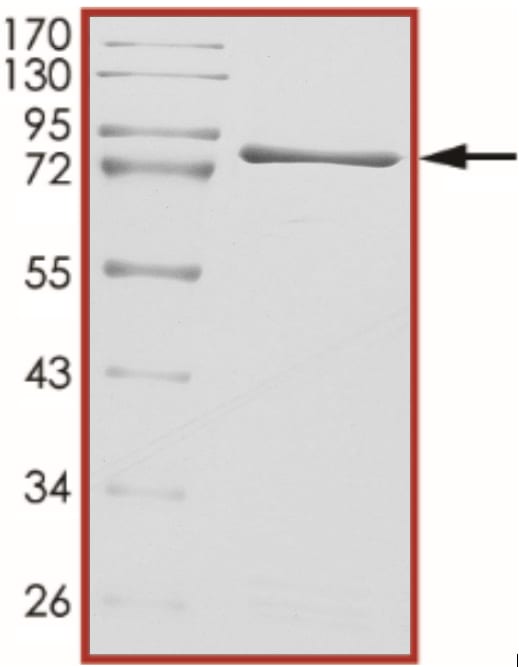
SDS-PAGE
83 kDa
Activity
The specific activity of Src was determined to be 100 nmol/min/mg using a synthetic peptide substrate.
Scientific Data Images for Recombinant Human Active Src Protein, CF
Recombinant Human Active Src Protein SDS-PAGE.
The approximate molecular weight is 83 kDa and the purity is > 90%.Formulation, Preparation, and Storage
4595-KS
| Formulation | Supplied in 50 mM Tris-HCl (pH 7.5), 150 mM NaCl, 10 mM Glutathione, 0.1 mM EDTA, 0.25 mM DTT, 0.1 mM PMSF, and 25% Glycerol. |
| Shipping | The product is shipped with dry ice or equivalent. Upon receipt, store it immediately at the temperature recommended below. |
| Stability & Storage | This product is stable at ≤ ‑70 °C for up to 1 year from the date of receipt. For optimal storage, aliquot into smaller quantities after centrifugation and store at recommended temperature. Avoid repeated freeze-thaw cycles. |
Background: Src
References
- Collett, M.S. et al. (1978) Proc. Natl. Acad. Sci. USA 75:2021.
- Jacobs, C. et al. (1983) Cancer Res. 43:1696.
Long Name
v-src Sarcoma [Schmidt-Ruppin A-2] Viral Oncogene Homolog
Alternate Names
ASV, c-Src, RSVgp4
Gene Symbol
SRC
UniProt
Additional Src Products
Product Documents for Recombinant Human Active Src Protein, CF
Certificate of Analysis
To download a Certificate of Analysis, please enter a lot or batch number in the search box below.
Note: Certificate of Analysis not available for kit components.
Product Specific Notices for Recombinant Human Active Src Protein, CF
For research use only
Citations for Recombinant Human Active Src Protein, CF
 Powered by Bioz
Customer Reviews for Recombinant Human Active Src Protein, CF
There are currently no reviews for this product. Be the first to review Recombinant Human Active Src Protein, CF and earn rewards!
Have you used Recombinant Human Active Src Protein, CF?
Submit a review and receive an Amazon gift card!
$25/€18/£15/$25CAN/¥2500 for a review with an image
$10/€7/£6/$10CAN/¥1110 for a review without an image
Submit a review
Protocols
View specific protocols for Recombinant Human Active Src Protein, CF (4595-KS):
Materials
- Active Kinase - Active Src (0.1 μg/μL) diluted with Kinase Dilution Buffer X (1X). Note: These are suggested working dilutions and it is recommended that the researcher perform a serial dilution of Active Src for optimal results.
- Kinase Assay Buffer II - Buffer components: 25 mM MOPS, pH 7.2, 12.5 beta -glycerol-phosphate, 20 mM MgC12, 12.5 mM MnC12, 2 mM EDTA. Add 0.25 mM DTT to Kinase Assay Buffer prior to use.
- Kinase Dilution Buffer IV - Kinase Assay Buffer II diluted at 1:4 ratio (5X dilution) with 50 ng/μL BSA solution.
- 10 mM ATP Stock Solution- Prepare ATP stock solution by disolving 55 mg of ATP in 10 mL of Kinase Assay Buffer II. Store 200 μL aliquots of ≤-20 °C.
- [33P]-ATP Assay Cocktail - Prepare 250 uM [33P]-ATP Assay Cocktail in a designated radioactive area by adding the following components: 150 μL of 10 mM ATP Stock Solutions, 100 μL [33P]-ATP, 5.75 mL of Kinase Assay Buffer II.Store 200 μL aliquots of ≤-20 °C.
- Substrate - Src synethic peptide substrate diluted in 20 mM Tris-HCI, pH 7.5 to a final concentration of 1 mg/mL.
2. Thaw the Active Src, Kinase Assay Buffer, Substrate and Kinase Dilution Buffer on ice.
3. In a pre-cooled microfuge tube, add the following reaction components bringing the initial reaction volume up to 20 μL:
a. Diluted Active Src: 10 μL
b. 1 mg/mL stock solution of substrate: 5 μL
c. Distilled water (2-4 °C)
4. Set up the blank control as outlined in Step 3, excluding the addition of the substrate. Replace the substrate with an equal volume of distilled water.
5. Initiate the reaction by the addition of 5 μL [33P]-ATP Assay Cocktail bringing the final volume up to 25 μL and incubate the mixture in a water bath at 30 °C for 15 minutes.
6. After the 15 minute incubation period, terminate the reaction by spotting 20 μL of the reaction mixture onto individual pre-cut strips of phosphocellulose P81 paper.
7. Air dry the pre-cut P81 strip and sequentially wash in a 1% phosphoric acid solution (dilute 10 mL of phosphoric acid and make a 1L solution with distilled water) with constant gentle stirring. It is recommended that the strips be washed a total of 3 intervals for approximately 10 minutes each.
8. Count the radioactivity on the P81 paper in the presence of scintillation fluid in a scintillation counter.
9. Determine the corrected cpm by removing the blank control value (Step 4) for each sample and calculate the kinase specific activity as outlined below.
Calculation of Specific Activity of ADP (RLU/pmol)Specific activity (SA) = cpm for 5 μL [33P]-ATP / pmoles of ATP (in 5 μL of a 250 μM ATP stock solution, i.e., 1250 pmoles)
Kinase Specific Activity (SA) (pmol/min/μg or nmol/min/mg)
Corrected cpm from reaction / [(SA of 33P-ATP in cpm/pmol) * (Reaction time in min) * (Enzyme amount in μg or mg)] * [(Reaction Volume) / (Spot Volume)]
Loading...
Associated Pathways


MAPK Signaling: Oxidative Stress Pathway
 MAPK Signaling Pathway: Mitogen Stimulation Pathway
 Pathogen or Damage-activated C-Type Lectin Receptor Signaling Pathways
 VEGF - VEGF R2 Signaling Pathways
 Wnt Signaling Pathways: beta-Catenin-dependent Wnt Signaling