
Vesicle-associated Membrane Protein (VAMP)-associated Protein B (VAP-B), also known as VAMP-B, is an ~30 Da ubiquitously expressed type IV transmembrane (TM) protein that belongs to the VAP family (1, 2). It is found in endoplasmic reticulum (ER), Golgi and other membranes as a homodimer or a heterodimer with VAP-A, probably associating through a GxxxG motif in the transmembrane regions (1, 2). Human VAP-B cDNA encodes 243 amino acids (aa) that include a 222 aa cytoplasmic domain and a 21 aa C-terminal membrane anchor. The cytoplasmic domain contains a mobile sperm protein (MSP) domain (aa 7‑124) plus a coiled-coil region (aa 159‑196) that initiates dimerization. Over aa 2-132, human VAP-B shares 97% aa sequence identity with mouse VAP-B and 81% aa sequence identity with VAP-A. VAP-A and VAP-B MSP domains recruit FFAT (two phenylalanines in an acidic tract)-motif-containing proteins to the cytosolic surface of ER membranes (2‑4). FFAT proteins mediate many of the effects of VAPs on regulation of membrane transport, phospholipid biosynthesis, microtubule organization, and the unfolded protein response (2, 3). VAPs also interact with some SNARE and viral proteins (2). A human polymorphism of VAP-B, P56S, is found in three familial motor neuron diseases, notably the amylotrophic lateral sclerosis variant ALS8 (2). It produces a non-functional protein that can dimerize with, and inhibit the function of, normal VAP-B, leading to formation of intracellular aggregates and increased ER-stress-induced death of motor neurons (5‑8). It can also promote cleavage and secretion of soluble VAP-B, which can then function as a ligand for EPH receptors (9). A naturally occurring 99 aa isoform of VAP-B that shows a 29 aa substitution for aa 71-243 is termed VAP-C (1, 10). It also appears to be a negative regulator of VAP-A and VAP-B (10). While VAP-B is used by hepatitis C virus (HCV) for its propagation, VAP-C inhibits HCV propagation (10).
Human VAP‑B PE‑conjugated Antibody
R&D Systems | Catalog # IC58551P

Key Product Details
Species Reactivity
Applications
Label
Antibody Source
Product Specifications
Immunogen
Ala2-Pro132
Accession # O95292
Specificity
Clonality
Host
Isotype
Scientific Data Images for Human VAP‑B PE‑conjugated Antibody
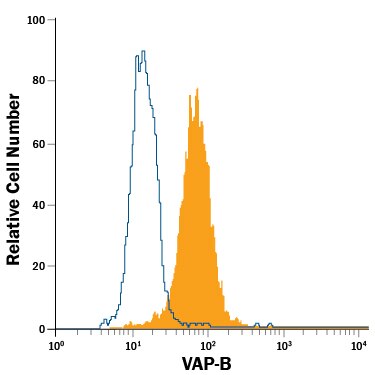
Detection of VAP‑B in T98G Human Cell Line by Flow Cytometry.
T98G human glioblastoma cell line was stained with Mouse Anti-Human VAP-B PE-conjugated Monoclonal Antibody (Catalog # IC58551P, filled histogram) or isotype control antibody (Catalog # IC002P, open histogram). To facilitate intracellular staining, cells were fixed with Flow Cytometry Fixation Buffer (Catalog # FC004) and permeabilized with Flow Cytometry Permeabilization/Wash Buffer I (Catalog # FC005). View our protocol for Staining Intracellular Molecules.
Applications for Human VAP‑B PE‑conjugated Antibody
Intracellular Staining by Flow Cytometry
Sample: T98G human glioblastoma cell line fixed with Flow Cytometry Fixation Buffer (Catalog # FC004) and permeabilized with Flow Cytometry Permeabilization/Wash Buffer I (Catalog # FC005)
Spectra Viewer
Plan Your Experiments
Use our spectra viewer to interactively plan your experiments, assessing multiplexing options. View the excitation and emission spectra for our fluorescent dye range and other commonly used dyes.
Spectra Viewer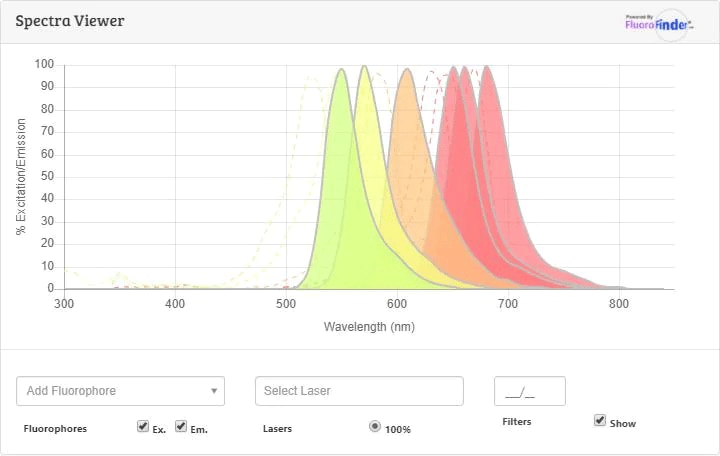
Flow Cytometry Panel Builder
Bio-Techne Knows Flow Cytometry
Save time and reduce costly mistakes by quickly finding compatible reagents using the Panel Builder Tool.
Advanced Features
- Spectra Viewer - Custom analysis of spectra from multiple fluorochromes
- Spillover Popups - Visualize the spectra of individual fluorochromes
- Antigen Density Selector - Match fluorochrome brightness with antigen density

Formulation, Preparation, and Storage
Purification
Formulation
Shipping
Stability & Storage
Background: VAP-B
References
- Nishimura, Y. et al. (1999) Biochem. Biophys. Res. Commun. 254:21.
- Lev, S. et al. (2008) Trends Cell Biol. 18:282.
- Peretti, D. et al. (2008) Mol. Biol. Cell 19:3871.
- Kaiser, S.E. et al. (2005) Structure 13:1035.
- Prosser, D.C. et al. (2008) J. Cell Sci. 121:3052.
- Gkogkas, C. et al. (2008) Hum. Mol. Genet. 17:1517.
- Suzuki, H. et al. (2009) J. Neurochem. 108:973.
- Kim, S. et al. (2010) J. Biol. Chem. 285:13839.
- Tsuda, H. et al. (2008) Cell 133:963.
- Kukihara, H. et al. (2009) J. Virol. 83:7959.
Long Name
Alternate Names
Gene Symbol
UniProt
Additional VAP-B Products
Product Documents for Human VAP‑B PE‑conjugated Antibody
Product Specific Notices for Human VAP‑B PE‑conjugated Antibody
For research use only
Customer Reviews for Human VAP‑B PE‑conjugated Antibody
There are currently no reviews for this product. Be the first to review Human VAP‑B PE‑conjugated Antibody and earn rewards!
Have you used Human VAP‑B PE‑conjugated Antibody?
Submit a review and receive an Amazon gift card!
$25/€18/£15/$25CAN/¥2500 Yen for a review with an image
$10/€7/£6/$10CAN/¥1110 Yen for a review without an image
Submit a review
Protocols
Find general support by application which include: protocols, troubleshooting, illustrated assays, videos and webinars.
- 7-Amino Actinomycin D (7-AAD) Cell Viability Flow Cytometry Protocol
- Extracellular Membrane Flow Cytometry Protocol
- Flow Cytometry Protocol for Cell Surface Markers
- Flow Cytometry Protocol for Staining Membrane Associated Proteins
- Flow Cytometry Staining Protocols
- Flow Cytometry Troubleshooting Guide
- Intracellular Flow Cytometry Protocol Using Alcohol (Methanol)
- Intracellular Flow Cytometry Protocol Using Detergents
- Intracellular Nuclear Staining Flow Cytometry Protocol Using Detergents
- Intracellular Staining Flow Cytometry Protocol Using Alcohol Permeabilization
- Intracellular Staining Flow Cytometry Protocol Using Detergents to Permeabilize Cells
- Propidium Iodide Cell Viability Flow Cytometry Protocol
- Protocol for the Characterization of Human Th22 Cells
- Protocol for the Characterization of Human Th9 Cells
- Protocol: Annexin V and PI Staining by Flow Cytometry
- Protocol: Annexin V and PI Staining for Apoptosis by Flow Cytometry
- Troubleshooting Guide: Fluorokine Flow Cytometry Kits
- View all Protocols, Troubleshooting, Illustrated assays and Webinars