

CD4+ T cells can differentiate into T helper (Th)1, Th2, Th17, and Regulatory T (Treg) cells by exposure to various cytokines and cellular interactions that induce expression of specific sets of transcription factors. Differentiation into Th1 cells is promoted through IL-12 and IFN-gamma. These cells are characterized by their secretion of IFN-gamma, IL-10, and TNF-alpha. Differentiation into Th2 cells is promoted by IL-4 in combination with either IL-2, IL-7, or TSLP. through IL-12 and IFN-gamma. These cells are characterized by their secretion of IFN-gamma, IL-10, and TNF-alpha. Th2 cells secrete IL-4, IL-5, IL-9, IL-13, and IL17E/IL-25. Differentiation into the Th17 lineage is promoted by cytokines such as TGF-beta and IL-6, while their survival and expansion are dependent on IL-21 and IL-23. Th17 cells secrete TNF-alpha, IL-6, IL-9, IL-17A, IL-17F, IL-21, IL-22, and (human) IL-26/AK155. The ability to differentiate CD4+ T cells ex vivo into Th1, Th2, Th17, or Treg cells is valuable to researchers who require specific T helper cell subsets for downstream applications, including studies for cell therapy and cancer immunotherapy.
Rat Regulatory T Cell Multi-Color Flow Kit
R&D Systems | Catalog # FMC015

Key Product Details
Species
Conjugate
Product Summary for Rat Regulatory T Cell Multi-Color Flow Kit
Kit Summary
For the flow cytometric analysis of rat regulatory T cells
Key Benefits
- Simultaneously detects three markers of regulatory T cells
- Cost-effective kit provides an optimized combination of antibodies
- Does not require the use of secondary antibodies
Why is it Important to Identify Regulatory T Cells Using Multiple Established Markers?
Regulatory T cells (Tregs) are critical mediators of immune homeostasis. Treg immunosuppressive effector functions act to prevent hyperimmunity, and reduced Treg populations or Treg activity are associated with autoimmune dysfunction. FoxP3, a defining intracellular marker of these cells, is a critical mediator of Treg effector functions. The accurate identification of Treg populations supports the advancement of autoimmune disease and organ transplantation research. Using multiple established markers to identify Treg cells increases confidence in cell identity and minimizes experimental variation. In addition, simultaneous use of multiple markers cost-effectively minimizes the required sample volume, which is critical in Treg research where experiments are costly and sample volumes may be limited.
The Rat Regulatory T Cell Multi-Color Flow Cytometry Kit offers users an efficient and quantitative method to identify rat regulatory T cells by flow cytometry using three established cell lineage markers.
The Rat Regulatory T Cell Multi-Color Flow Cytometry Kit:
- Efficiently identifies rat Treg cells using three established cell lineage markers.
- Minimizes experimental variability via simultaneous staining of multiple markers.
- Identifies multiple markers in a small sample volume.
- Does not require the use of secondary antibodies.
- Includes enough reagents to perform 50 assays.
Kit Components
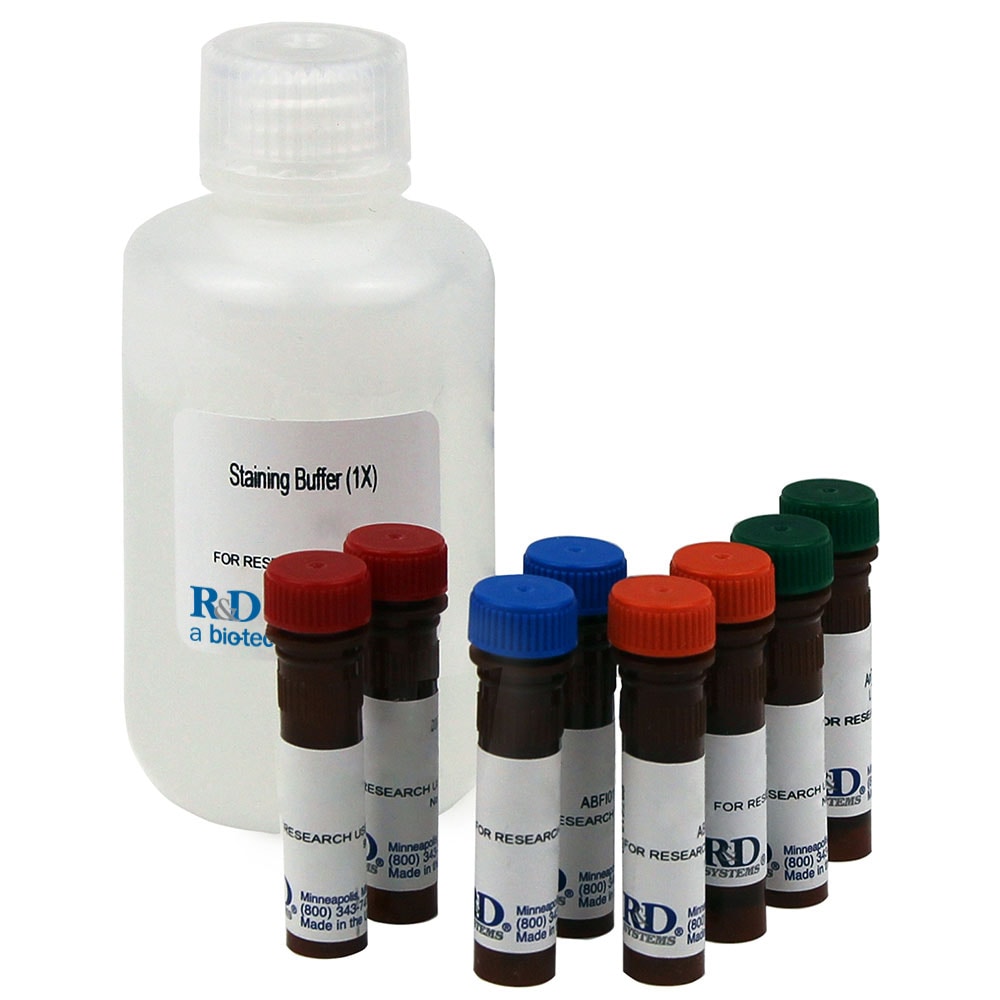
The Rat Regulatory T Cell Multi-Color Flow Cytometry Kit includes three fluorochrome-conjugated primary antibodies, isotype controls, and buffers to fix, permeabilize, and wash cells.
- CD25-PE (goat IgG)
- CD4-FITC (Clone OX-38; mouse IgG2A)
- FoxP3-APC (Goat IgG)
- Goat IgG-APC Isotype Control
- Flow Cytometry FoxP3 Staining Buffer (with 1% formaldehyde and 0.09% sodium azide)
- Flow Cytometry Staining Buffer (with BSA and 0.09% sodium azide)
- Includes enough reagents to perform 50 assays
Formaldehyde is a suspected carcinogen. Avoid contact with skin, eyes, and mucous membranes, and avoid inhaling fumes. In case of contact, wash immediately with water and seek medical advice.
Sodium azide may react with lead and copper plumbing to form explosive metallic azides. Flush with large volumes of water during disposal.
 View Larger Image |
Detection of CD4+ FoxP3+ Rat Regulatory T Cells by Multi-Color Flow Cytometry. Rat splenocytes were stained using reagents included in the Rat Regulatory T Cell Multi-Color Flow Cytometry Kit (Catalog # FMC015). Cells were stained simultaneously for the expression of rat regulatory T cell markers including CD25, CD4, and FoxP3. Quadrants were set based on isotype controls. The upper right quandrant shows FoxP3+ and CD4+ splenocyte populations. |
 View Larger Image |
Detection of CD25+ FoxP3+ Rat Regulatory T Cells by Multi-Color Flow Cytometry. Rat splenocytes were stained using reagents included in the Rat Regulatory T Cell Multi-Color Flow Cytometry Kit (Catalog # FMC015). Cells were stained simultaneously for the expression of rat regulatory T cell markers including CD25, CD4, and FoxP3. Quadrants were set based on isotype controls. The upper right quandrant shows FoxP3+ and CD25+ splenocyte populations. |
Formulation, Preparation, and Storage
Shipping
Storage
Background: Regulatory T Cell Kits
Additional Regulatory T Cell Kits Products
Product Documents for Rat Regulatory T Cell Multi-Color Flow Kit
Certificate of Analysis
To download a Certificate of Analysis, please enter a lot or batch number in the search box below.
Note: Certificate of Analysis not available for kit components.
Product Specific Notices for Rat Regulatory T Cell Multi-Color Flow Kit
For research use only
Related Research Areas
Citations for Rat Regulatory T Cell Multi-Color Flow Kit
 Powered by Bioz
Customer Reviews for Rat Regulatory T Cell Multi-Color Flow Kit
There are currently no reviews for this product. Be the first to review Rat Regulatory T Cell Multi-Color Flow Kit and earn rewards!
Have you used Rat Regulatory T Cell Multi-Color Flow Kit?
Submit a review and receive an Amazon gift card!
$25/€18/£15/$25CAN/¥2500 Yen for a review with an image
$10/€7/£6/$10CAN/¥1110 Yen for a review without an image
Submit a review
Protocols
View specific protocols for Rat Regulatory T Cell Multi-Color Flow Kit (FMC015):
Refer to the product datasheet for complete product details.
Briefly, rat regulatory T cells are assessed by flow cytometry using the following procedure:
- Wash and resuspend cells in Flow Cytometry Staining Buffer
- Stain cells with cell surface marker fluorochrome-conjugated antibodies or isotype controls
- Wash and resuspend cells in Flow Cytometry FoxP3 Staining Buffer
- Stain cells with FoxP3-APC antibody or isotype control
- Wash cells and resuspend in Flow Cytometry Staining Buffer
- Analyze samples by flow cytometry

Reagents Supplied in the Rat Regulatory T Cell Multi-Color Flow Cytometry Kit (Catalog # FMC015):
- CD25-PE (goat IgG)
- CD4-FITC (Clone OX-38; mouse IgG2A)
- FoxP3-APC (Goat IgG)
- Goat IgG-APC Isotype Control
- Flow Cytometry FoxP3 Staining Buffer (with 1% formaldehyde and 0.09% sodium azide)
- Flow Cytometry Staining Buffer (with BSA and 0.09% sodium azide)
- Includes enough reagents to perform 50 assays
Other Supplies Required
- PBS or Hanks’ Balanced Salt Solution (HBSS)
Cell Staining Protocol with Simultaneous Fixation/Permeabilization
Harvest cells and wash 2 times with PBS or HBSS.
Resuspend cells in Fixation Cytometry Staining Buffer (approximately 1 x 10⁶ cells/100 µL) and transfer to 5 mL flow cytometry tubes.

Add 10 µL CD25 and CD4 fluorochrome-conjugated antibodies.
Incubate the samples at room temperature for 30-45 minutes in the dark.
Wash the cells in Flow Cytometry FoxP3 Staining Buffer.

Add 10 µL FoxP3-APC antibody or goat IgG Isotype Control.
Incubate the samples at room temperature for 1 hour in the dark.

Wash the cells in Flow Cytometry FoxP3 Staining Buffer.
Resuspend the cells in 200-400 μL of Flow Cytometry Staining Buffer.
Analyze the expression of regulatory T cell markers simultaneously by flow cytometry.
