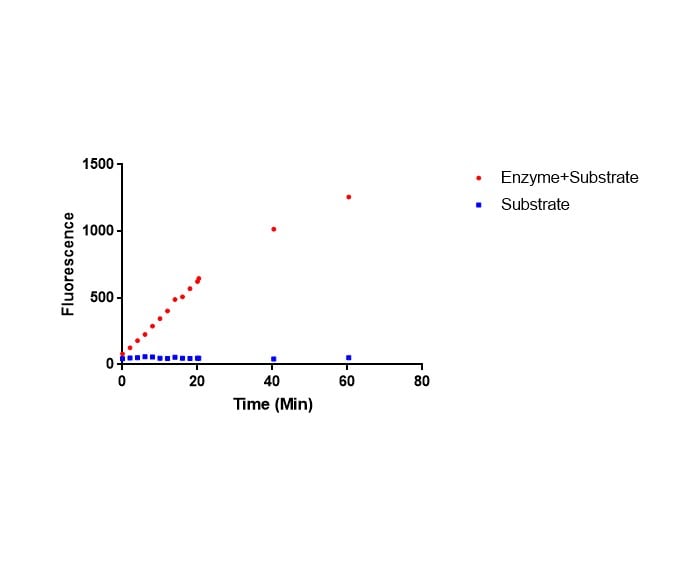
Ataxin-3, also known as Machado-Joseph Disease (MJD) Protein 1 and Spinocerebellar Ataxia Type 3, is a 364 amino acid (aa), ubiquitously expressed cytoplasmic and nuclear protein with a predicted molecular weight of 42 kDa. Ataxin-3 functions as a deubiquitinating enzyme. Human Ataxin-3 shares 87% and 86% aa sequence identity with mouse and rat Ataxin-3, respectively. Full-length Ataxin-3 contains an N-terminal Josephin domain, two Ubiquitin interacting motifs, and a variable C-terminus consisting of a polyglutamine stretch and tail (1,2). As a deubiquitinating enzyme, Ataxin-3 plays a critical role in affecting the ubiquitination status of proteins for quality control and other cellular pathways (3). In turn, the ubiquitination of Ataxin-3 is was shown to enhance its capacity to cleave Ubiquitin chains (4). By opposing the actions of the Ubiquitin-conjugating (E2) enzyme UBE2W, Ataxin-3 is believed to control the activity of the Ubiquitin ligase (E3) C-terminus of Hsp70 Interacting Protein (CHIP) (5). CHIP binds to protein chaperones and represents an important molecular link between the chaperone and Ubiquitin-proteasome system (6). Expression of murine Ataxin-3 is thought to be important for myogenesis, an effect that is dependent on the regulation of Integrin alpha 5 levels (7). Mutations in the ATXN3 gene are the cause of MJD, also known as spinocerebellar ataxia 3, an autosomal dominant neurodegenerative disorder characterized by nuclear aggregation of Ataxin-3 molecules featuring an expanded polyglutamine tract (2,8).
This recombinant protein is N-terminally tagged.
 Powered by Bioz