CRISPR-Cas9-based Genome Editing For aTAG Knock-ins
This protocol is intended as a guide only.
In Brief
Cationic Lipid Delivery of CRISPR Ribonucleoprotein Complex into Mammalian Cells
Step 1: Design and Synthesis of Guide RNA and ssDNA HDR Template
- Guide RNA: Design/identify sgRNA against genomic region of interest for target aTAG knock-in, e.g. 5’ or 3’ region of target gene for aTAG fusion knock-in generation.We recommend trying a minimum of two sgRNAs per target site.
- ssDNA HDR Template: Design a ssDNA HDR template via de novo synthesis or via a kit production system. The HDR template includes the aTAG sequence, plus any additional linkers/tags desired, flanked by ~80-100 flanking homology arms. Consider including 5' and 3' phosphorothioate bond substitutes to inhibit exonuclease degradation.
Step 2: Prepare RNP Complex
- Combine the sgRNA and Cas9 (pure Cas9 protein) in a final concentration ratio of approximately 4 µM Cas9 to 4.8 µM sgRNA.
- Incubate at room temperature for 20 minutes
Step 3: Resuspend Donor Template
- Resuspend donor template in appropriate buffer, depending on method of transfection, e.g. electroporation, nucleofection.
- Leave at room temperature while preparing cells for delivery.
Step 4: Prepare Cells for Delivery
- Harvest cells and transfect/electroporate etc. according to manufacturer's instructions.
- Introduce RNP complex along with HDR template according to manufacturer's instructions.
- Transfer cells to appropriate vessel. Allow to recover for 24-48 hours and confirm presence of knock-in via preferred method, e.g. sequencing, etc.
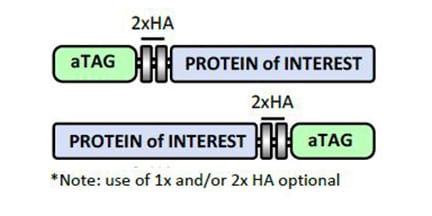
N-terminal/C-terminal aTAG Schematic
Sequence Map of N-terminal/C-terminal aTAG: View and copy the N-terminal/C-terminal aTAG sequence in the attached Protocol PDF.