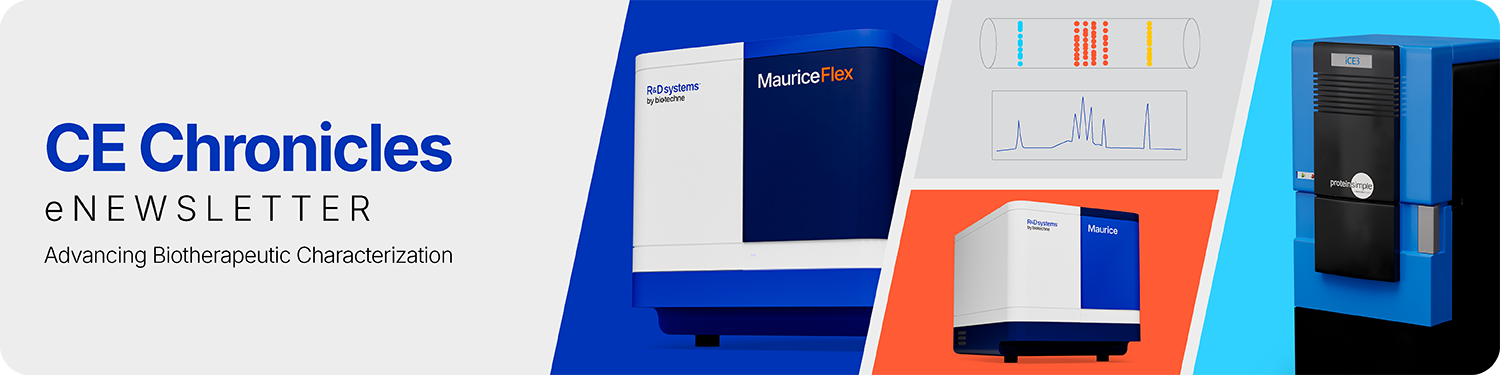
Volume 3, Issue 1, Fall 2026
Table of Contents
- Staying Ahead of the Curve: Article on Transitioning from iCE3 to Maurice
- Industry News
- Latest Resources for iCE3 Transition
- Latest Webinars
- Let’s Connect
- Product Updates
- Technical Tips from Monica Tyagi
- Hear from your Peers – Anne Reis, Boehringer Ingelheim and Leonard Bell, Labcorp
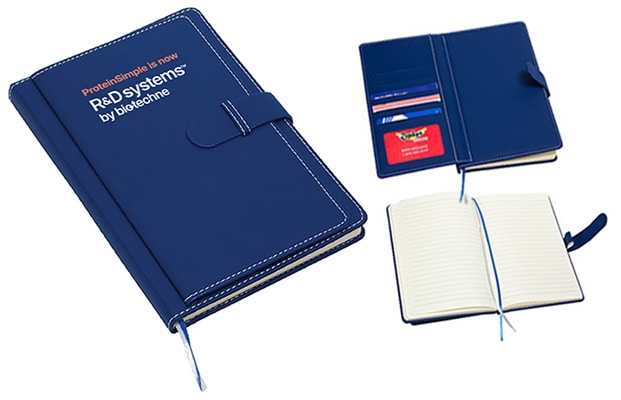
- Test your Knowledge and Win a Notebook
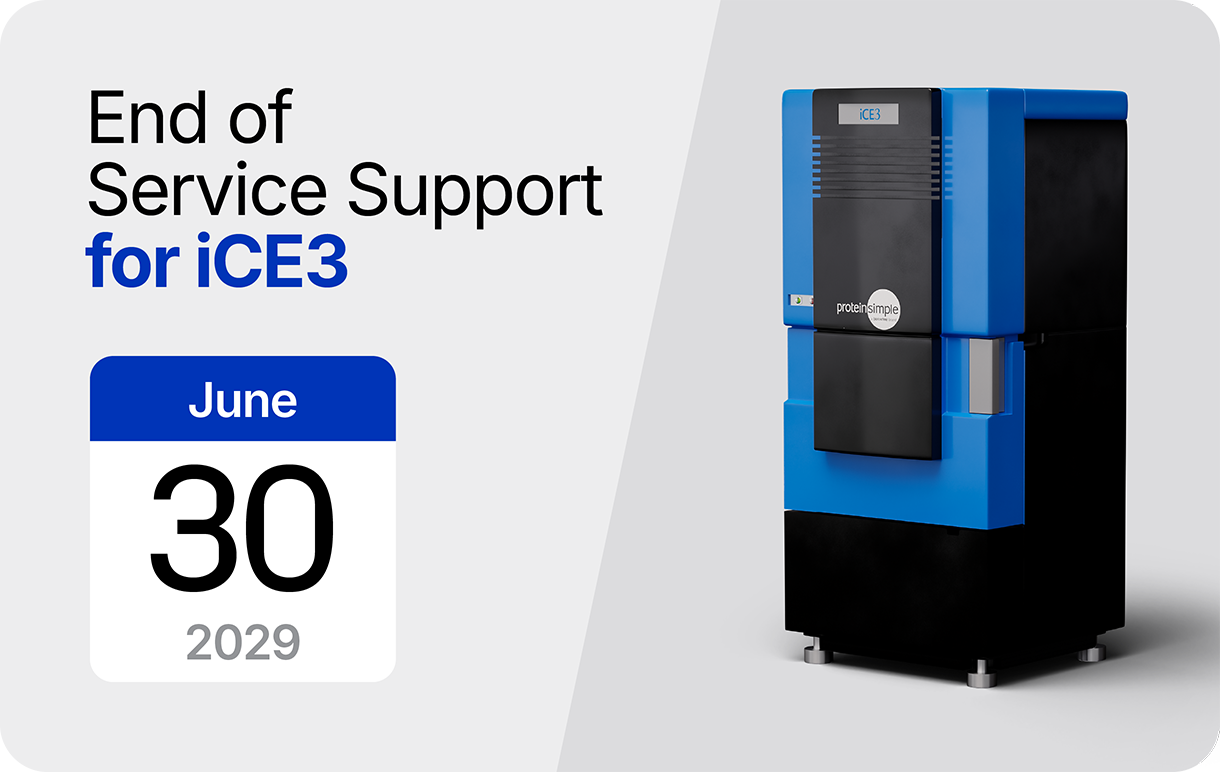
When the iCE3 System was introduced in 2012, it was rapidly adopted for its unparalleled icIEF performance for measuring the charge heterogeneity in biotherapeutic molecules. However, significant improvements and additions led to the development of the Maurice systems, which were built on the same iCE technology. As Maurice and MauriceFlex instruments started to be increasingly validated within the industry and widely implemented, the iCE3 platform was discontinued in June 2022, with full instrument service and support available until June 30, 2029.
Learn how icIEF became the gold standard for charge heterogeneity analysis and the numerous benefits that the Maurice platform offers over iCE3.

Industry News
- Bio-Techne shareholders approve acquisition by Merck KGaA, Darmstadt, Germany. Read full Press Release.
- How is the biopharma industry thinking about AI in manufacturing? This article sheds some light.
- Personalized mRNA cancer vaccines show promise, but manufacturing challenges remain. Read more.
- FDA issue draft guidance on container closure systems for drugs and biologics. Read more.
Bio-Techne News
Maurice and MauriceFlex Instruments and consumables are now part of the R&D Systems Family! The R&D Systems portfolio brings together Bio-Techne's trusted proteins, antibodies, immunoassays, small molecules, and innovative instruments used by scientists worldwide. This change is designed to help you navigate our portfolio faster and with greater clarity.

Publication: Universal Study Design for Instrument Changes
This instrument comparability study was designed to understand potential performance differences between instruments and to rationalize risk assessment and the decision process The core study confirmed “equal or better performance of Maurice C. to iCE3 in all parameters and serves as a base for seamless continuation of release measurements on Maurice C.”
Brochure: iCE3 Transition Support
This 12-page brochure provides valuable information to help make the transition, including key publications, summaries from customers who have completed their bridging studies, bridging study models, timelines, FAQs and reagents that will still be available after the iCE3 instrument service support is discontinued.
Publication: Global iCE3 and Maurice Data Comparability Study
This study describes a global multi-company (19 companies/ 20 labs) icIEF study that demonstrates the comparability of iCE3 and Maurice. Both systems produce identical apparent pI values for the main isoform and comparable relative peak areas for the acidic, main, and basic isoforms for the NIST mAb and rhPDL1-Fc. Full details were published in the Electrophoresis Journal in March 2022.
App Note: iCE3 and Maurice Data Comparability Evaluation

This application note demonstrates the data comparability between iCE3 and Maurice and showcases the charge isoform characterization of three molecules: erythropoietin (EPO), monoclonal antibody 11 (mAb11). Each of these molecules was analyzed on both platforms for charge isoform peak quantitation and pI reproducibility using absorbance detection.
Article: Fujifilm's Story on Replacing iCE3 with Maurice
The team at Fujifilm analyzed 5 different mAbs on iCE3 and Maurice system and found that the data were comparable between the two instruments. They experienced shorter run times, operator training times, and fewer errors. They successfully completed the transition and gained numerous advantages switching to the Maurice system.
Register now: iCE3 Virtual User Meeting 2026 – Transitioning to Maurice (October 21)
We’re excited to invite you to our webinar featuring Leonard Bell from Labcorp, who will share his team’s real-world experience transferring iCE3 methods to Maurice systems. Learn about key challenges, practical solutions, and how this transition opens doors to a more streamlined Analytical Method Lifecycle approach. Following Leonard’s talk, Monica Tyagi from Bio-Techne will offer valuable technical tips and highlight how Maurice platforms can boost your lab’s capabilities and productivity. They will be joined during the live Q&A with industry experts Seth Madren (Biogen) and Chris Cammarata (J&J). Don’t miss out on this opportunity to enhance your QC analysis with expert guidance.

iCE3 Virtual User Meeting 2025 – Transitioning to Maurice (on-demand)
The featured speaker, Anne Ries (Boehringer Ingelheim) was part of successful bridging study and shares her team's experience in instrument changes, bridging study designs and results, technical tips, and best practices. In addition, learn about the data comparability between iCE3 & Maurice systems, along with the additional capabilities Maurice platforms offer. Following the talks, listen to the recorded panel discussion with additional industry experts: John Orlet (Pfizer), Seth Madren (Biogen) and Sylvia Caciolli (Lonza), who answer questions about planning for and successfully transitioning from the iCE3 to Maurice platforms.
Schedule a Biologics Bitesize Tech Talk
Do you want to learn about the latest applications for the Maurice and MauriceFlex platforms - but don't have much time? We’re happy to host lunch or a break at your convenience to discuss the topics of most interest to your lab. Choose from our menu of 15-minute bitesize talks to discover what’s new in the areas of biomolecular-specific analysis, icIEF fractionation, CE-SDS, Gene Therapy, and more!
Choose from a full menu of topics.

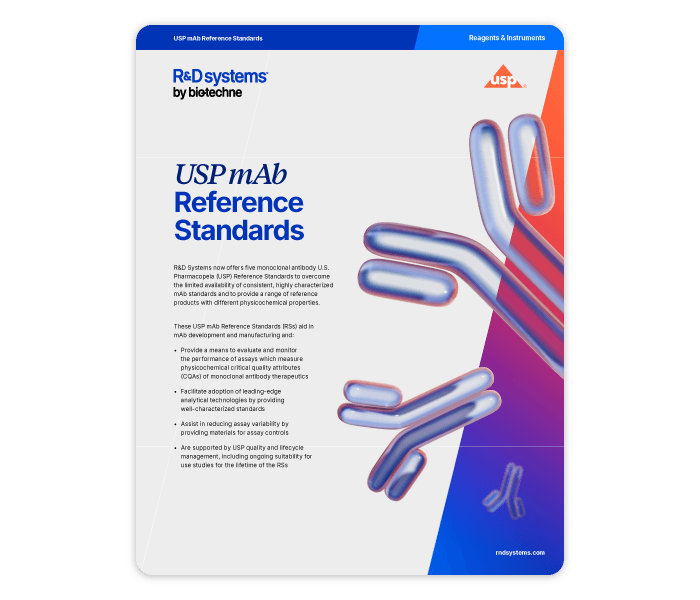
Bio-Techne now offers five monoclonal antibody U.S. Pharmacopeia (USP) Reference Standards (IgG System Suitability, mAb 001, mAb 002, mAb 003 and mAb 004) to overcome the limited availability of consistent, highly characterized mAb standards and to provide a range of reference products with different physicochemical properties. For Gene Therapy manufacturing and QC, AAV8 Empty/Full controls are also available. See the latest data on our new Flyer: USP mAb Reference Standards
Optimizing your iCE3 transition experience
In her training series “Technical Tips from Monica Tyagi,” Dr. Tyagi discusses some simple but important steps to facilitate your transition from the iCE3 instrument to the Maurice platforms. She shares data comparability results from key publications, bridging study summaries and models, example timelines, hands on differences between iCE3 and Maurice systems, frequently asked questions (FAQs), and more.
Approaching Instrument Changes in QC: One Team's Journey Transitioning from the iCE3 to the Maurice C. System
“We assessed relevant instrument and method performance aspects such as sensitivity, proportionality between product concentration and observed signal, baseline comparability, peak position shifts, resolution, relative peak area, and measurement variance. Based on the generated data, we concluded that Maurice C was suitable to seamlessly continue iCE3-based release icIEF measurements.”
Anne Ries, PhD
Scientist, Boehringer Ingelheim
Insights from a CRO Scientist on Making the Transition from iCE3 to Maurice Systems
Leonard Bell, Labcorp
Read full article below

After 13 years of service in our lab, the iCE3 systems are now being phased out as Bio-Techne will be discontinuing support in June 2029. We evaluated both the Maurice and other promising alternatives. As a CRO, we are ultimately guided by our client’s preference. So independent of pure performance excellence, or demonstrated direct equivalence to the iCE3, our client’s preference meant that our chosen solution was the new Bio-Techne instrument, Maurice.
The Maurice system is compatible with Chromeleon, so at long last an icIEF analysis can be completely run under Chromeleon, including full instrument control similar to how we already run LC analysis in our lab.
Our clients, like us, expected this switch over to be relatively straightforward: Simply take the current iCE3 instrument method, translate it into Maurice, and away you go. How hard can it be? But as you might expect, rarely does anything go that smoothly. Instead, we found that the ease of transfer is very method and molecule dependent. Competing icIEF platform manufacturers point to the change in capillary configuration and orientation amongst other things. As, for example, the Maurice icIEF capillary is now vertical rather than horizontal as it is in the iCE3. Although to me, a key factor is just how good and well optimized the original method was; coupled with how well the methods previous performance and data are really understood by those using the method today, as they are rarely the original method developers and validation analysts.
This presents a classic problem: Analytical methods are expected to evolve throughout their lifecycle, incorporating new technologies when appropriate. However, the adoption of new technologies can reveal previously unknown limitations to the existing method. These limitations can raise more questions than they answer about the original method, the test material and all the associated data. In a GxP / QC world that can present a challenge! A similar phenomenon occurred when some HPLC methods were updated to UPLC, where some “simple” method transfers uncovered previously unknown “new peaks” and sources of variability, which had been invisible before lost in the background. For the Maurice platform, our recommendation is to embrace the change. Though before you begin, ensure you properly understand your historical data; Know what the current method data really looks like beyond the summary tables of final reported results; but also, down to the underlying data so you properly visually understand the natural variability in what an “acceptable” profile can look like. Then consider other changes that can be made to make the method better and easier to run in the lab. For example, the Maurice automation (Maurice OBM) can mix sample aliquots with the Separation Master Mix immediately prior to analysis, potentially leading to a more consistent sample preparation. It also offers native tryptophan fluorescence detection which can improve method sensitivity.
For analysts, the Maurice instrument presents a simpler and easier icIEF instrument with a more straightforward assay and instrument set up. However, “Special features” are emerging as we start to use it more, applying it to different test materials, client test methods, and with a larger pool of regular users of the new instrument and software.
The Maurice system can also run CE-SDS, and its simplicity of use and set up has the potential to rival our current standard CE instrumentation for routine QC analysis. As the need for new CE-SDS analytical methods in our lab arises, we will further evaluate this capability.
Test your knowledge of the iCE3 and Maurice systems and enter for a chance to win a Notebook. Complete our short quiz using information from Volume 3, Issue 1 of CE Chronicles.