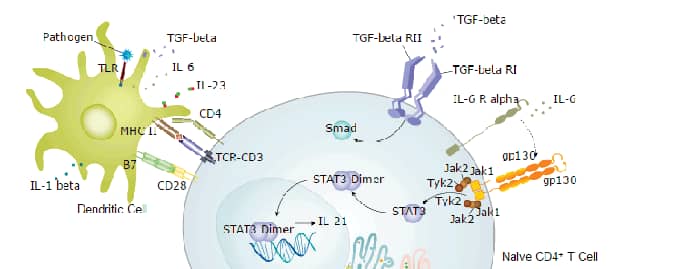
Interleukin 17 (IL-17; also IL-17A and CTLA-8) is a 17 kDa member of the IL-17 family of cytokines (1). Members of this family demonstrate a structural motif termed a cysteine knot which characterize a large superfamily of growth factors. Although most cysteine knot superfamily members use three intrachain disulfide bonds to create a knot, IL-17 family molecules generate the same structural form with only two disulfide links (2-4). Based on the amino acid (aa) sequence alignment with human IL-17, canine IL-17 is 130 aa in length. It is secreted as a 35 kDa disulfide-linked homodimer and as a 40 kDa disulfide-linked heterodimer with IL-17F (5). Canine IL‑17 is 81% identical on the aa level to human IL-17. IL-23 drives Th17 lymphocytes to produce IL-17 (6-8). IL-17’s production has also been demonstrated in gamma delta T cells (9), CD8+ memory T cells (10-11), eosinophils (12), neutrophils (10), and monocytes (13). Studies have identified that the widely expressed receptors IL‑17RA and IL-17RC form a heterodimer for the binding of IL-17 (6, 14-15). The predominant function of IL-17 is thought to be as a proinflammatory mediator through a variety of mechanisms (16). Locally, IL‑17 stimulates production of IL-6, prostaglandin E and nitric oxide (16-19), and synergy with other inflammatory cytokines such as TNF-alpha, IL‑1 beta and IFN -gamma leads to up-regulation of gene expression and progression and amplification of local inflammation (16, 20-22). IL‑17 also mediates chemotaxis of neutrophils and monocytes to sites of inflammation through the chemoattractant mediators IL-8, GRO‑ alpha, and MCP-1 (16, 22-25) while augmenting production of hematopoietic growth factors, such as G-CSF and GM-CSF (16, 26, 27), which promote the growth and maturation of the recruited myeloid cells. In addition, IL-17 serves as a bridge between innate and adaptive immune responses by enhancing the induction of co-stimulatory molecules such as ICAM-1 and other cytokines (16, 22, 28), thereby supporting T cell activation. IL-17 expression has been associated with many inflammatory diseases, such as rheumatoid arthritis, multiple sclerosis, asthma, systemic lupus erythematosus and allograft rejection (15).
Canine IL-17/IL-17A Antibody (665909) [Alexa Fluor® 350]
R&D Systems | Catalog # FAB5848U

![Canine IL-17/IL-17A Antibody (665909) [Alexa Fluor® 350]](https://resources.rndsystems.com/images/icons/RnD-Default-Product-Image_Antibodies-Icon.svg "Canine IL-17/IL-17A Antibody (665909) [Alexa Fluor® 350]")
Key Product Details
Species Reactivity
Applications
Label
Antibody Source
Product Specifications
Immunogen
Gly26-Ala155
Accession # NP_001159350
Specificity
Clonality
Host
Isotype
Applications for Canine IL-17/IL-17A Antibody (665909) [Alexa Fluor® 350]
Neutralization
Formulation, Preparation, and Storage
Purification
Formulation
Shipping
Stability & Storage
Background: IL-17/IL-17A
Long Name
Alternate Names
Entrez Gene IDs
Gene Symbol
UniProt
Additional IL-17/IL-17A Products
Product Documents for Canine IL-17/IL-17A Antibody (665909) [Alexa Fluor® 350]
Certificate of Analysis
To download a Certificate of Analysis, please enter a lot or batch number in the search box below.
Note: Certificate of Analysis not available for kit components.
Product Specific Notices for Canine IL-17/IL-17A Antibody (665909) [Alexa Fluor® 350]
This product is provided under an agreement between Life Technologies Corporation and R&D Systems, Inc, and the manufacture, use, sale or import of this product is subject to one or more US patents and corresponding non-US equivalents, owned by Life Technologies Corporation and its affiliates. The purchase of this product conveys to the buyer the non-transferable right to use the purchased amount of the product and components of the product only in research conducted by the buyer (whether the buyer is an academic or for-profit entity). The sale of this product is expressly conditioned on the buyer not using the product or its components (1) in manufacturing; (2) to provide a service, information, or data to an unaffiliated third party for payment; (3) for therapeutic, diagnostic or prophylactic purposes; (4) to resell, sell, or otherwise transfer this product or its components to any third party, or for any other commercial purpose. Life Technologies Corporation will not assert a claim against the buyer of the infringement of the above patents based on the manufacture, use or sale of a commercial product developed in research by the buyer in which this product or its components was employed, provided that neither this product nor any of its components was used in the manufacture of such product. For information on purchasing a license to this product for purposes other than research, contact Life Technologies Corporation, Cell Analysis Business Unit, Business Development, 29851 Willow Creek Road, Eugene, OR 97402, Tel: (541) 465-8300. Fax: (541) 335-0354.
For research use only
Customer Reviews for Canine IL-17/IL-17A Antibody (665909) [Alexa Fluor® 350]
There are currently no reviews for this product. Be the first to review Canine IL-17/IL-17A Antibody (665909) [Alexa Fluor® 350] and earn rewards!
Have you used Canine IL-17/IL-17A Antibody (665909) [Alexa Fluor® 350]?
Submit a review and receive an Amazon gift card!
$25/€18/£15/$25CAN/¥2500 for a review with an image
$10/€7/£6/$10CAN/¥1110 for a review without an image
Submit a review
Associated Pathways