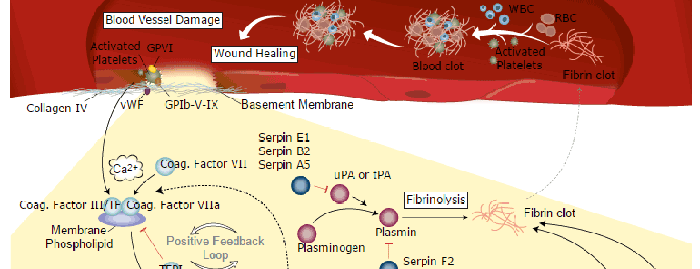
Platelet glycoprotein Ib alpha chain (GPIb alpha ), also known as CD42b alpha, is a 145 kDa type I transmembrane protein that is a member of the leucine-rich repeat (LRR) family of ligand binding proteins (1‑3). It is expressed by platelets as the ligand-binding subunit of the platelet GPIb-IX-V complex (4). Human GPIb alpha contains a 16 amino acid (aa) signal sequence, a 489 aa extracellular domain (ECD), a 21-aa transmembrane domain, and a 100 aa cytoplasmic region. The ECD contains 8 LRRs, with # 2, 3, and 4 having been demonstrated to regulate shear-dependent adhesion to von Willebrand factor (vWF) (5, 6). The LRRs are followed by a thrombin-binding anionic region that includes three sulfated tyrosines, a sialomucin domain with N- and O-linked carbohydrates, and two cysteines near the membrane that allow dimerization with GP1b alpha beta (1‑6). Four human isoforms with 1 to 4 repeats of aa 398‑411 within the sialomucin domain of mature GPIb alpha are known to exist but have unknown significance (7). The ECD of human GPIb alpha shares 48‑51% aa identity with mouse, rat, bovine, and canine GPIb alpha. The metalloproteinase TACE/ADAM17 constitutively and inducibly cleaves GPIb alpha, between Gly480 and Val481. This releases a soluble form called glycocalicin that circulates at ~2 μg/mL (8, 9). GPIb alpha binding to ligands such as thrombin, kininogen, and coagulation factors XI and XII helps to initiate platelet activation and coordinate the coagulation cascade (1, 10‑12). Binding of GPIb alpha to vWF or thrombospondin in the plasma or matrix, vWF or P-selectin on endothelial cells, or the integrin alpha M beta 2 (MAC-1) on myeloid cells, controls response to vascular injury (1, 13). Bernard-Soulier syndrome and platelet-type von Willebrand disease are platelet function disorders that can be caused by mutations in GPIb alpha (1, 14).
Human CD42b/GPIb alpha Antibody
R&D Systems | Catalog # AF4067

Scientific images may be resized, cropped, or adjusted for brightness or contrast for presentation purposes. These updates are limited to presentation and do not affect the underlying scientific interpretation of the data. Where available, additional source data may be provided upon request.
Key Product Details
Species Reactivity
Validated:
Cited:
Applications
Validated:
Cited:
Label
Antibody Source
Product Specifications
Immunogen
His17-Leu505
Accession # P07359
Specificity
Clonality
Host
Isotype
Scientific Data Images for Human CD42b/GPIb alpha Antibody
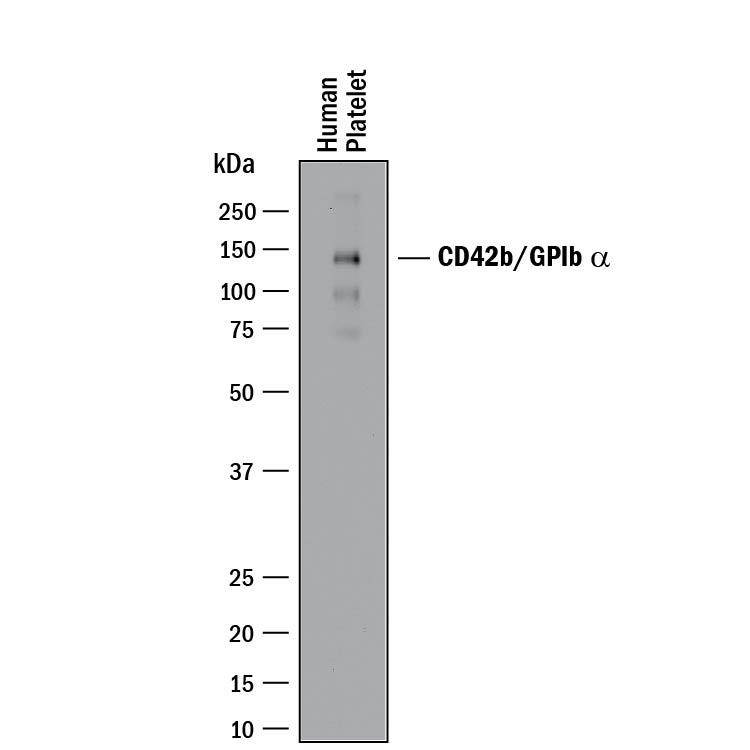
Detection of Human CD42b/GPIb alpha by Western Blot.
Western blot shows lysates of human platelets. PVDF membrane was probed with 1 µg/mL of Sheep Anti-Human CD42b/GPIb a Antigen Affinity-purified Polyclonal Antibody (Catalog # AF4067) followed by HRP-conjugated Anti-Sheep IgG Secondary Antibody (Catalog # HAF016). A specific band was detected for CD42b/GPIb a at approximately 135 kDa (as indicated). This experiment was conducted under reducing conditions and using Immunoblot Buffer Group 1.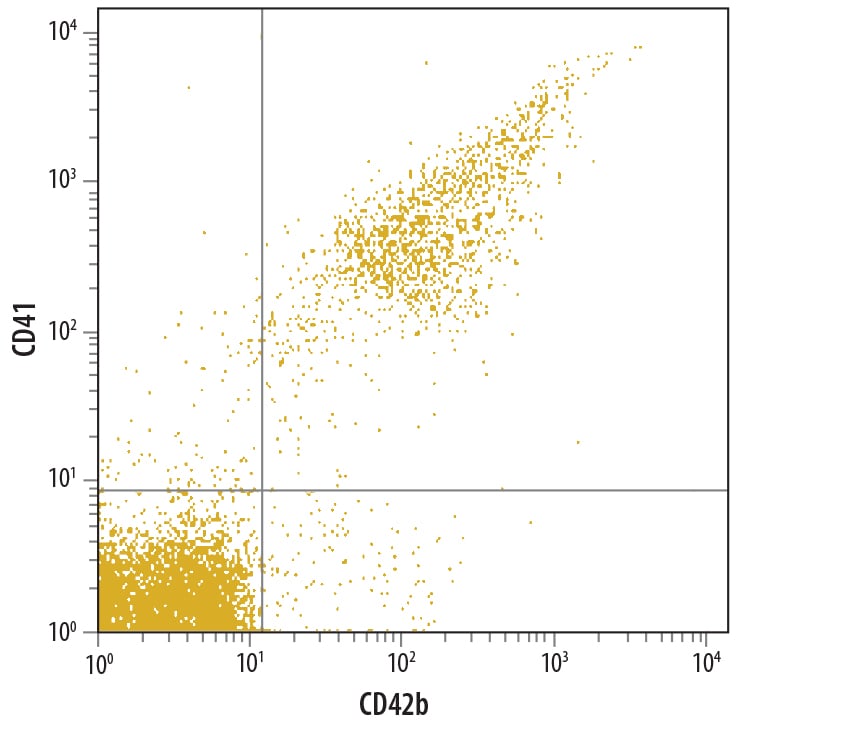
Detection of Human CD42b/GPIb alpha in Human Whole Blood CD41+Platelets by Flow Cytometry.
Human whole blood CD41+platelets were stained with Sheep Anti-Human CD42b/GPIb a Polyclonal Antibody (Catalog # AF4067) followed by NL637-conjugated anti sheep antibody (Catalog # NL011) and Human CD41 FITC-conjugated Monoclonal Antibody. Quadrant markers were set based on control antibody staining (Catalog # 5-001-A).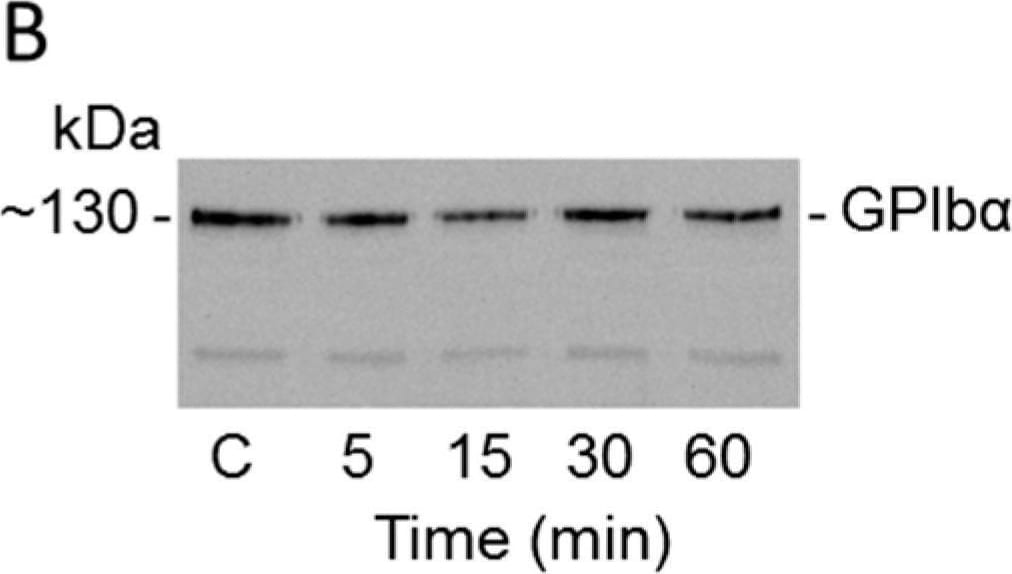
Detection of CD42b/GPIb alpha by Western Blot
(A) Western blot analysis of Bar-III on recombinant vWF-A1 domain (rvWF-A1). vWF-A1 (5 µg) was treated with Bar-III (4 µg) for 60 min at 37 °C, as described in methodology section. The proteolysis of vWF-A1 (indicated by an arrow) was analyzed using SDS-PAGE (7–15% gradient gel) and blotted with mice anti-vWF IgG. (B) Bar-III does not cleave the vWF receptor partner GPIb alpha on platelets. Washed platelets were incubated with Bar-III (4 µg) at 37 °C at the indicated intervals, and the reactions were terminated by addition of SDS loading sample buffer. The platelet lysate was probed in WB with anti-CD42/GPIb. Note the intact ~130-kDa GPIb alpha expression on platelets. (C) Platelet pellets or supernatants of WPs treated with Bar-III (4 µg) for 60 min at 37 °C. The positions of GPVI (~62-kDa) and the soluble GPVI fragment (~55-kDa) are indicated. C, platelet control. These results are representative of at least three similar experiments for each item. Image collected and cropped by CiteAb from the following open publication (https://pubmed.ncbi.nlm.nih.gov/39591241), licensed under a CC-BY license. Not internally tested by R&D Systems.Applications for Human CD42b/GPIb alpha Antibody
CyTOF-ready
Flow Cytometry
Sample: Human whole blood CD41+ platelets
Western Blot
Sample: Human platelets
Flow Cytometry Panel Builder
Bio-Techne Knows Flow Cytometry
Save time and reduce costly mistakes by quickly finding compatible reagents using the Panel Builder Tool.
Advanced Features
- Spectra Viewer - Custom analysis of spectra from multiple fluorochromes
- Spillover Popups - Visualize the spectra of individual fluorochromes
- Antigen Density Selector - Match fluorochrome brightness with antigen density

Formulation, Preparation, and Storage
Purification
Reconstitution
Reconstitute at 0.2 mg/mL in sterile PBS. For liquid material, refer to CoA for concentration.
Formulation
Shipping
Stability & Storage
- 12 months from date of receipt, -20 to -70 °C as supplied.
- 1 month, 2 to 8 °C under sterile conditions after reconstitution.
- 6 months, -20 to -70 °C under sterile conditions after reconstitution.
Calculators
Background: CD42b/GPIb alpha
References
- Andrews, R.K. et al. (2007) Arterioscler. Thromb. Vasc. Biol. 27:1511.
- Lopez, J.A. et al. (1987) Proc. Natl. Acad. Sci. USA 84:5615.
- Wenger, R.H. et al. (1988) Biochem. Biophys. Res. Commun. 156:389.
- Luo, S-Z. et al. (2007) Blood 109:603.
- Uff, S. et al. (2002) J. Biol. Chem. 277:35657.
- Shen, Y. et al. (2006) J. Biol. Chem. 281:26419.
- Ishida, F. et al. (1995) Blood 86:1356.
- Gardiner, E.E. et al. (2007) J. Thromb. Haemost. 5:1530.
- Beer, J.H. et al. (1994) Blood 83:691.
- Adam, F. et al. (2003) Eur. J. Biochem. 270:2959.
- Baglia, F.A. et al. (2004) J. Biol. Chem. 279:49323.
- Bradford, H.N. et al. (2000) J. Biol. Chem. 275:22756.
- Wang, Y. et al. (2005) Circulation 112:2993.
- Othman, M. et al. (2005) Blood 105:4330.
Long Name
Alternate Names
Gene Symbol
UniProt
Additional CD42b/GPIb alpha Products
Product Documents for Human CD42b/GPIb alpha Antibody
Certificate of Analysis
To download a Certificate of Analysis, please enter a lot or batch number in the search box below.
Note: Certificate of Analysis not available for kit components.
Product Specific Notices for Human CD42b/GPIb alpha Antibody
For research use only
Related Research Areas
Citations for Human CD42b/GPIb alpha Antibody
 Powered by Bioz
Customer Reviews for Human CD42b/GPIb alpha Antibody
There are currently no reviews for this product. Be the first to review Human CD42b/GPIb alpha Antibody and earn rewards!
Have you used Human CD42b/GPIb alpha Antibody?
Submit a review and receive an Amazon gift card!
$25/€18/£15/$25CAN/¥2500 for a review with an image
$10/€7/£6/$10CAN/¥1110 for a review without an image
Submit a review
Protocols
Find general support by application which include: protocols, troubleshooting, illustrated assays, videos and webinars.
- 7-Amino Actinomycin D (7-AAD) Cell Viability Flow Cytometry Protocol
- Cellular Response to Hypoxia Protocols
- Extracellular Membrane Flow Cytometry Protocol
- Flow Cytometry Protocol for Cell Surface Markers
- Flow Cytometry Protocol for Staining Membrane Associated Proteins
- Flow Cytometry Staining Protocols
- Flow Cytometry Troubleshooting Guide
- Intracellular Flow Cytometry Protocol Using Alcohol (Methanol)
- Intracellular Flow Cytometry Protocol Using Detergents
- Intracellular Nuclear Staining Flow Cytometry Protocol Using Detergents
- Intracellular Staining Flow Cytometry Protocol Using Alcohol Permeabilization
- Intracellular Staining Flow Cytometry Protocol Using Detergents to Permeabilize Cells
- Propidium Iodide Cell Viability Flow Cytometry Protocol
- Protocol for Liperfluo
- Protocol for the Characterization of Human Th22 Cells
- Protocol for the Characterization of Human Th9 Cells
- Protocol: Annexin V and PI Staining by Flow Cytometry
- Protocol: Annexin V and PI Staining for Apoptosis by Flow Cytometry
- R&D Systems Quality Control Western Blot Protocol
- Troubleshooting Guide: Fluorokine Flow Cytometry Kits
- Troubleshooting Guide: Western Blot Figures
- Western Blot Conditions
- Western Blot Protocol
- Western Blot Protocol for Cell Lysates
- Western Blot Troubleshooting
- Western Blot Troubleshooting Guide
- View all Protocols, Troubleshooting, Illustrated assays and Webinars
Associated Pathways