
GDNF (Glial Cell Line-derived Neurotrophic Factor) is a secreted protein that promotes the survival of motoneurons, midbrain dopaminergic neurons, Purkinje cells, and sympathetic neurons. It is produced by Sertoli cells, type 1 astrocytes, Schwann cells, neurons, pinealocytes, and skeletal muscle cells. GDNF binding to GFR alpha 1 induces the recruitment of Ret, NCAM-1/CD56, various integrins, Syndecan-3, or N-Cadherin. GDNF-based therapies show promise in several neurodegenerative disorders, particularly Parkinson’s disease.
Human GDNF ELISpot Development Module, 5 Plate
R&D Systems | Catalog # SEL212

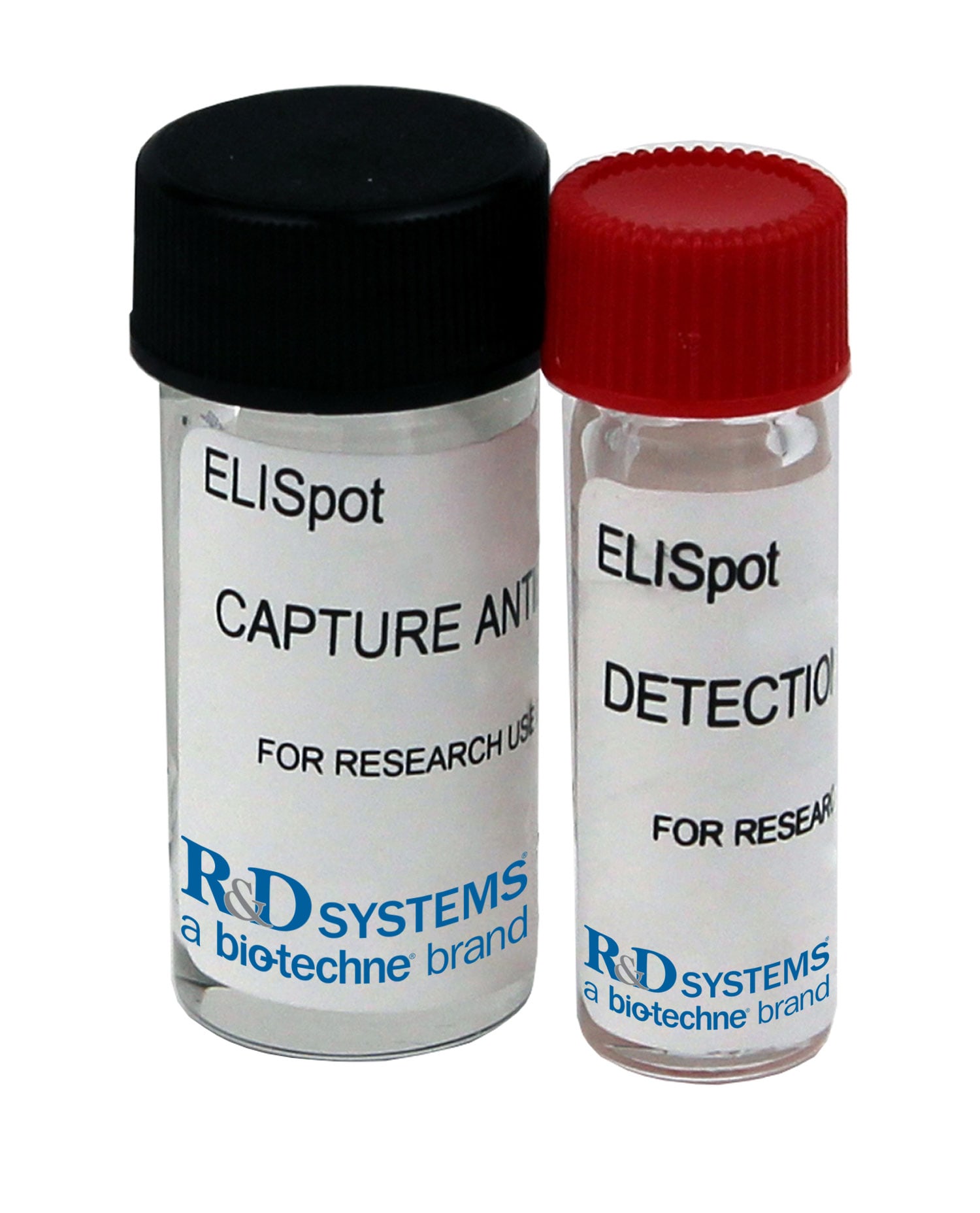
Discontinued Product
SEL212 has been discontinued.
View all GDNF products.
Key Product Details
Species
Human
Assay Type
Quantitative Sandwich ELISA Development Module
Format
96-well microplate, sold separately (see Other Reagents Required)
Assay Length
3 hours 35 mins to 4 hours 50 mins (plus plate coating)
Sample Type
Whole Cells
Product Summary for Human GDNF ELISpot Development Module, 5 Plate
PRODUCT SUMMARY
Complete ELISpot kits are highly sensitive, microplate-based assays for the detection of cytokine secreting cells. Kits are available for detection and enumeration of a single analyte or two analytes simultaneously. Complete ELISpot kits are ready-to-run and require no assay development or refinement. ELISpot Development Modules contain the basic components required to develop an ELISpot assay. They offer an economical alternative to buying separate antibodies.
ELISpot development modules are an alternative to ELISpot kits. A basic understanding of ELISpot assay development is required for the successful use of these reagents. Each investigator should optimize the coating conditions, the assay sensitivity, the type of enzyme and substrate, as well as the concentrations of the capture and detection antibodies to achieve desired results. The analyte-specific ELISpot Development Module and the ELISpot Blue Color Module contain the necessary components for analyte detection and visualization, respectively. These modules can be used together but are sold separately. Each module contains enough reagents for at least five 96-well microplates.
PRODUCT FEATURES
- An economical alternative to ELISpot Kits
- Optimized capture and detection antibody pairings and recommended concentrations save lengthy development time
- Generic development protocols provide direction to start an optimization protocol
- Customize the assay to your specific needs
MODULE CONTENTS
- Human GDNF Capture Antibody
- Human GDNF Biotinylated-conjugated Detection Antibody
OTHER REAGENTS REQUIRED
- ELISpot Blue Color Module or equivalent (R&D Systems, Catalog # SEL002)
- PBS - 137 mM NaCl, 2.7 mM KCl, 8.1 mM Na2HPO4, 1.5 mM KH2PO4, pH 7.2 - 7.4, 0.2 µm filtered
- Wash Buffer - 0.05% Tween® 20 in PBS
- Blocking Buffer - 1% BSA, 5% Sucrose in PBS
- Reagent Diluent - 1% BSA in PBS, pH 7.2 - 7.4, 0.2 µm filtered
- 2 °C – 8 °C refrigerator
- 37 °C CO2 incubator
- Positive Control - Use Recombinant Human GDNF or cells known to secrete Human GDNF
- 96-well plates - Nitrocellulose-bottom plates, PVDF-bottom Immunospot® plates, or flat-bottom polystyrene Immulon® ELISA plates
- Multi-channel pipette, squirt bottle, manifold dispenser, or automated microplate washer
- Dissection microscope or an automated ELISpot Reader
- Deionized H2O
Trademarks and registered trademarks are the property of their respective companies.
Loading...
Formulation, Preparation, and Storage
Shipping
The product is shipped at ambient temperature. Upon receipt, store it immediately at the temperature recommended below.
Storage
Store the unopened product at -20 to -70 °C. Use a manual defrost freezer and avoid repeated freeze-thaw cycles. Do not use past expiration date.
Background: GDNF
Long Name
Glial Cell line-derived Growth Factor
Alternate Names
ATF, HFB1-GDNF, HGDNF, HSCR3
Gene Symbol
GDNF
Additional GDNF Products
Product Documents for Human GDNF ELISpot Development Module, 5 Plate
Certificate of Analysis
To download a Certificate of Analysis, please enter a lot or batch number in the search box below.
Note: Certificate of Analysis not available for kit components.
Product Specific Notices for Human GDNF ELISpot Development Module, 5 Plate
For research use only
Related Research Areas
Customer Reviews for Human GDNF ELISpot Development Module, 5 Plate
There are currently no reviews for this product. Be the first to review Human GDNF ELISpot Development Module, 5 Plate and earn rewards!
Have you used Human GDNF ELISpot Development Module, 5 Plate?
Submit a review and receive an Amazon gift card!
$25/€18/£15/$25CAN/¥2500 for a review with an image
$10/€7/£6/$10CAN/¥1110 for a review without an image
Submit a review
Protocols
View specific protocols for Human GDNF ELISpot Development Module, 5 Plate (SEL212):
This protocol requires an analyte-specific ELISpot Development Module and the ELISpot Blue Color Module (Catalog # SEL002). These modules can be used together but are sold separately.
PRECAUTIONS
Although the toxicity of the chromogenic substrate BCIP/NBT is not currently known, wear gloves to avoid contact with skin. Follow local, state and federal regulations to dispose of used BCIP/NBT.
REAGENT PREPARATION AND STORAGE
Capture Antibody Concentrate: Reconstitute as recommended in the product datasheet and mix well. After reconstitution, store at 2 °C – 8 °C for up to 60 days or aliquot and store at -20 °C to -70 °C in a manual defrost freezer for up to 6 months.
Detection Antibody Concentrate: Reconstitute as recommended in the product datasheet and mix well. After reconstitution, store at 2 °C – 8 °C for up to 60 days or aliquot and store at -20 °C to -70 °C in a manual defrost freezer for up to 6 months.
Note: For optimal performance, prepare the working dilutions of the Capture and Detection Antibodies immediately before use.
ELISpot DEVELOPMENT MODULE PROTOCOL
When a 96-well PVDF-backed microplate is used, 1:60 dilutions of the Capture and Detection Antibodies are recommended. Each investigator should determine the optimal working dilution of the antibodies depending on the type of microplate, Wash Buffer and Blocking Buffer used.
- Calculate the total volume of Capture Antibody needed and dilute to the working concentration using PBS.
- Immediately add 100 µL of the diluted Capture Antibody per well. Cover the plate with the lid and incubate overnight at 2 °C – 8 °C.
- Aspirate Capture Antibody from each well and wash 3 times with Wash Buffer or PBS (350 µL/well) using either a squirt bottle, multi-channel pipette, manifold dispenser, or autowasher. After the final wash, remove any remaining liquid by inverting the plate and blotting it against a clean paper towel. Do not touch the membranes during washing to avoid damage.
- Block membranes by adding 200 µL of Blocking Buffer to each well. Incubate for 2 hours at room temperature.
- Aspirate Blocking Buffer. Rinse with the same media in which the cells will be cultured. Do not discard the culture media until cells are ready to be plated.
- Aspirate culture media from the plate and immediately fill appropriate wells with 100 µL of culture media containing the cells. Incubate at 37 °C in a 5% CO2 incubator. Incubation time must be determined empirically. We recommend running a positive control (recombinant protein), negative control (same number of unstimulated cells as stimulated cells), and background control (sterile culture media) with each assay.
- Wash the plate 4 times with Wash Buffer. Remove any remaining Wash Buffer by inverting the plate and blotting it against a clean paper towel.
- Calculate the total volume of Detection Antibody needed and dilute to the working concentration using Reagent Diluent.
- Add 100 µL of the diluted Detection Antibody per well. Cover the plate with the lid and incubate overnight at 2 °C – 8 °C.
- Aspirate Detection Antibody and wash as described in step 3. Microplates are ready for color development.
COLOR DEVELOPMENT
Color development may be done using the ELISpot Blue Color Module (Catalog # SEL002) that may be purchased separately. The ELISpot Blue Color Module contains Streptavidin-AP and BCIP/NBT substrate. Alternatively, another chromogen of choice may be used.
COLOR DEVELOPMENT PROTOCOL
- Calculate the total volume of Streptavidin-AP needed and dilute the Streptavidin-AP Concentrate with Reagent Diluent to a working dilution of 1:60.
- Add 100 µL of the diluted Streptavidin-AP into each well and incubate for 2 hours at room temperature.
- Wash the plate 3 times with Wash Buffer. Rinse again with deionized water. Remove excess water by inverting the plate and blotting it against a clean paper towel.
- Add 100 µL of BCIP/NBT solution into each well. Cover the plate and incubate in the dark for 30 minutes at room temperature.
- Rinse with deionized water. Invert plate and tap to remove excess water. Allow the plate to dry at room temperature or at 37 °C.
- Spots can be quantified manually using a dissection microscope or automatically by using a specialized automated ELISpot reader.
LIMITATIONS OF ELISPOT REAGENTS
- A basic understanding of ELISpot assay development is required for the successful use of these reagents. The protocol provided is for demonstration purposes only. The type of enzyme and substrate and the concentrations of capture/detection antibodies used can give varied results.
- Individual results may vary due to differences in technique, plasticware, and water sources.
- Working dilutions should be prepared and used immediately.
- Each investigator should optimize the experimental conditions, such as cell type, cell stimulation conditions, and cell dilutions, of the assay.
- Reagents should not be used beyond the expiration date on the labels.
ELISpot Troubleshooting Guide
Loading...
Associated Pathways
