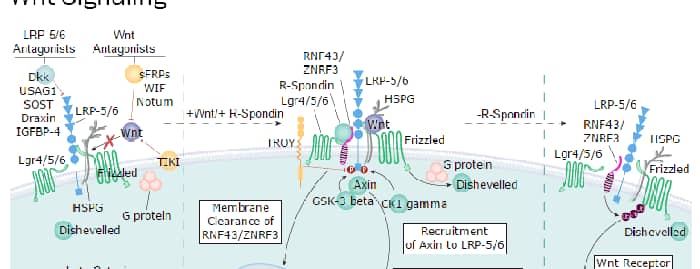
R-Spondin 1 (RSPO1, Roof plate-specific Spondin 1), also known as cysteine-rich and single thrombospondin domain containing protein 3 (Cristin 3), is a 27 kDa secreted protein that shares ~40% amino acid (aa) identity with three otherR-Spondin family members (1, 2). All R-Spondins regulate Wnt/ beta -catenin signaling, but have distinct expression patterns (1‑3). Like other R-Spondins, R-Spondin 1 contains two adjacent cysteine-rich furin-like domains (aa 34‑135) with one potential N‑glycosylation site, followed by a thrombospondin (TSP-1) motif (aa 147‑207) and a region rich in basic residues (aa 211‑263). Only the furin-like domains are needed for beta -catenin stabilization (2, 4). A putative nuclear localization signal at the C-terminus may allow some expression in the nucleus (5). Potential isoforms of 200 and 236 aa have an alternate, shorter N‑terminus or are missing aa 146‑208, respectively (6). Over aa 21‑263, human R-Spondin 1 shares 89%, 87%, 92%, 91%, 91% and 89% aa identity with mouse, rat, equine, canine, caprine and bovine R-Spondin 1, respectively. R-Spondin 1 is expressed in early development at the roof plate boundary and is thought to contribute to dorsal neural tube development (3, 5). In humans, rare disruptions of the R-Spondin 1 gene are associated with tendencies for XX sex reversal (phenotypic male) or hermaphroditism, indicating a role for R-Spondin 1 in gender-specific differentiation (7, 8). Disruption is also associated with palmoplantar keratosis (7, 8). Postnatally, R-Spondin 1 is expressed by neuroendocrine cells in the intestine, adrenal gland and pancreas, and by epithelia in kidney and prostate (9). Injection of recombinant R-Spondin 1 in mice causes activation of beta -catenin and proliferation of intestinal crypt epithelial cells, and ameliorates experimental colitis (9, 10). R-Spondin 1 regulates Wnt/ beta -catenin by competing with the Wnt antagonist DKK-1 for binding to the Wnt co-receptors, Kremen and LRP-6, reducing their DKK-1-mediated internalization (11). Reports differ on whether R-Spondin 1 binds LRP-6 directly (11‑13).
Human R-Spondin 1 Antibody [Alexa Fluor® 350]
R&D Systems | Catalog # AF4645U

![Human R-Spondin 1 Antibody [Alexa Fluor® 350]](https://resources.rndsystems.com/images/icons/RnD-Default-Product-Image_Antibodies-Icon.svg "Human R-Spondin 1 Antibody [Alexa Fluor® 350]")
Key Product Details
Species Reactivity
Applications
Label
Antibody Source
Product Specifications
Immunogen
Arg31-Ala263
Accession # Q2MKA7
Specificity
Clonality
Host
Isotype
Applications for Human R-Spondin 1 Antibody [Alexa Fluor® 350]
Neutralization
Formulation, Preparation, and Storage
Purification
Formulation
Shipping
Stability & Storage
Background: R-Spondin 1
Long Name
Alternate Names
Gene Symbol
UniProt
Additional R-Spondin 1 Products
Product Documents for Human R-Spondin 1 Antibody [Alexa Fluor® 350]
Certificate of Analysis
To download a Certificate of Analysis, please enter a lot or batch number in the search box below.
Note: Certificate of Analysis not available for kit components.
Product Specific Notices for Human R-Spondin 1 Antibody [Alexa Fluor® 350]
This conjugate is made on demand and is not held in inventory. Each order represents a unique lot. All conjugates are generated using validated conjugation protocols and meet strict degree of labeling (F/P) specifications; additional information is available upon request. The antibody concentration is provided on the individual product label.
Recommended applications are based on validated applications from the unconjugated base product AF4645.
For specialized conjugation needs, like large quantities, specific concentrations, and defined F/P ratios, bulk and custom antibody conjugation services are available.
This product is provided under an agreement between Life Technologies Corporation and R&D Systems, Inc, and the manufacture, use, sale or import of this product is subject to one or more US patents and corresponding non-US equivalents, owned by Life Technologies Corporation and its affiliates. The purchase of this product conveys to the buyer the non-transferable right to use the purchased amount of the product and components of the product only in research conducted by the buyer (whether the buyer is an academic or for-profit entity). The sale of this product is expressly conditioned on the buyer not using the product or its components (1) in manufacturing; (2) to provide a service, information, or data to an unaffiliated third party for payment; (3) for therapeutic, diagnostic or prophylactic purposes; (4) to resell, sell, or otherwise transfer this product or its components to any third party, or for any other commercial purpose. Life Technologies Corporation will not assert a claim against the buyer of the infringement of the above patents based on the manufacture, use or sale of a commercial product developed in research by the buyer in which this product or its components was employed, provided that neither this product nor any of its components was used in the manufacture of such product. For information on purchasing a license to this product for purposes other than research, contact Life Technologies Corporation, Cell Analysis Business Unit, Business Development, 29851 Willow Creek Road, Eugene, OR 97402, Tel: (541) 465-8300. Fax: (541) 335-0354.
For research use only
Customer Reviews for Human R-Spondin 1 Antibody [Alexa Fluor® 350]
There are currently no reviews for this product. Be the first to review Human R-Spondin 1 Antibody [Alexa Fluor® 350] and earn rewards!
Have you used Human R-Spondin 1 Antibody [Alexa Fluor® 350]?
Submit a review and receive an Amazon gift card!
$25/€18/£15/$25CAN/¥2500 for a review with an image
$10/€7/£6/$10CAN/¥1110 for a review without an image
Submit a review
Associated Pathways