
RIG-I (Retinoic-acid inducible gene I; also Dead-box protein 58) is a 100 kDa member of the DexH-box family of proteins. It is expressed in smooth muscle cells and endothelium. RIG-I is normally an inactive monomer. Upon Sendai and Hepatitis C virus infection, RIG-I binds to dsRNA, initiating homodimerization and downstream activation of IRF3 and KF kappa B genes. Human RIG-I is 925 amino acids (aa) in length. It contains two CARD domains (aa 1‑172), one helicase ATP-binding region (aa 251‑430), and one C-terminal repressor domain (aa 735‑925). There are three potential splice variants. One shows an alternate start site at Met204, while another shows deletion of aa 3‑80, and a third shows a deletion of aa 36‑80 plus 749‑925. Over aa 724‑925, human RIG-I is 76% aa identical to mouse RIG-I.


Scientific images may be resized, cropped, or adjusted for brightness or contrast for presentation purposes. These updates are limited to presentation and do not affect the underlying scientific interpretation of the data. Where available, additional source data may be provided upon request.
Key Product Details
Species Reactivity
Validated:
Cited:
Applications
Validated:
Cited:
Label
Antibody Source
Product Specifications
Immunogen
Met724-Lys925
Accession # O95786
Specificity
Clonality
Host
Isotype
Scientific Data Images for Human RIG-I Antibody
Detection of Human RIG-I by Western Blot.
Western blot shows lysates of A172 human glioblastoma cell line and Nalm-6 human Pre-B acute lymphocytic leukemia cell line. PVDF membrane was probed with 1 µg/mL of Goat Anti-Human RIG-I Antigen Affinity-purified Polyclonal Antibody (Catalog # AF4859) followed by HRP-conjugated Anti-Goat IgG Secondary Antibody (Catalog # HAF019). A specific band was detected for RIG-I at approximately 105 kDa (as indicated). This experiment was conducted under reducing conditions and using Immunoblot Buffer Group 8.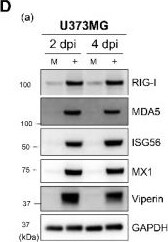
Detection of RIG-I by Western Blot
RuV infection induces STAT1 activation and ISG expression. (A) Protein lysates from U373MG cells (a) or CCF-STTG1 cells (b) that were uninfected (M) or infected with RuV RA27/3 strain (+) at 2 and 4 days postinfection (dpi) (MOI of 1.8) were analyzed by immunoblotting for STAT1, Tyr701-phosphorylated STAT1 (p-STAT1), and RuV-encoded capsid protein. GAPDH protein expression was analyzed as a reference. Densitometric analysis of the capsid protein was performed with NIH ImageJ software. Signal intensity of the capsid protein was normalized to that of GAPDH, then shown as a relative ratio of U373MG cells infected with RuV at 2 dpi. (B) STAT1-EGFP fusion protein (green) translocated to the nucleus was detected in RuV-infected U373MG-STAT1-EGFP cells at 2 dpi by fluorescence microscopy. Typical cells positive for nuclear localization of EGFP fusion protein are shown. Nuclei were counterstained with Hoechst 33342 (blue). Images were acquired at a magnification of 40× objective lens. (C) Total RNAs extracted from U373MG cells infected with RuV RA27/3 strain (+) or heat-inactivated RuV RA27/3 strain (HI) or uninfected (M) at 2 and 4 dpi were subjected to RT-PCR for the detection of expression of MDA5, ISG56, OAS1, MX1, and viperin mRNAs. TBP mRNA was analyzed as a reference. The PCR products were analyzed by agarose gel electrophoresis. (D) Protein lysates from U373MG cells (a) or CCF-STTG1 cells (b) that were uninfected (M) or infected with RuV RA27/3 strain (+) at 2 and 4 dpi (MOI of 1.8) were analyzed by immunoblotting for the protein expression of ISGs (RIG-I, MDA5, ISG56, MX1, and viperin). Glyceraldehyde-3-phosphate dehydrogenase (GAPDH) protein was analyzed as a reference. Image collected and cropped by CiteAb from the following open publication (https://pubmed.ncbi.nlm.nih.gov/36077193), licensed under a CC-BY license. Not internally tested by R&D Systems.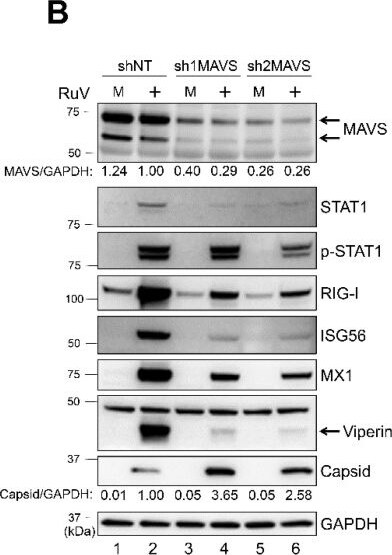
Detection of RIG-I by Western Blot
Short hairpin RNA-mediated MAVS knockdown attenuated the RuV-triggered IFN-beta signaling pathway. (A) Total RNAs extracted from U373MG cells expressing MAVS-targeting shRNAs (sh1MAVS and sh2MAVS) or a non-targeting shRNA (shNT) that were uninfected (M) or infected with the RuV RA27/3 strain (+) at 2 dpi (MOI of 1.8) were subjected to RT-PCR for the detection of MAVS, IFN-beta, and viperin mRNAs and RuV RNAs encoding the capsid protein. TBP mRNA was analyzed as a reference. The products were analyzed by agarose gel electrophoresis. (B) Protein lysates from shRNAs (sh1MAVS, sh2MAVS, and shNT)-expressing U373MG cells that were uninfected (M) or infected with the RuV RA27/3 strain (+) at 2 dpi (MOI of 1.8) were analyzed by immunoblotting for the protein expression of MAVS, STAT1, Tyr701-phosphorylated STAT1 (p-STAT1), ISGs (RIG-I, ISG56, MX1, and viperin), and RuV-encoded capsid proteins. GAPDH protein was analyzed as a reference. Densitometric analysis of MAVS and capsid proteins was performed with NIH ImageJ software. Signal intensity of those proteins was normalized to that of GAPDH, then shown as a relative ratio of shNT-expressing U373MG cells infected with the RuV RA27/3 strain. Image collected and cropped by CiteAb from the following open publication (https://pubmed.ncbi.nlm.nih.gov/36077193), licensed under a CC-BY license. Not internally tested by R&D Systems.Applications for Human RIG-I Antibody
Western Blot
Sample: A172 human glioblastoma cell line and Nalm‑6 human Pre‑B acute lymphocytic leukemia cell line
Formulation, Preparation, and Storage
Purification
Reconstitution
Reconstitute at 0.2 mg/mL in sterile PBS. For liquid material, refer to CoA for concentration.
Formulation
Shipping
Stability & Storage
- 12 months from date of receipt, -20 to -70 °C as supplied.
- 1 month, 2 to 8 °C under sterile conditions after reconstitution.
- 6 months, -20 to -70 °C under sterile conditions after reconstitution.
Calculators
Background: RIG-I
Long Name
Alternate Names
Gene Symbol
UniProt
Additional RIG-I Products
Product Documents for Human RIG-I Antibody
Certificate of Analysis
To download a Certificate of Analysis, please enter a lot or batch number in the search box below.
Note: Certificate of Analysis not available for kit components.
Product Specific Notices for Human RIG-I Antibody
For research use only
Related Research Areas
Citations for Human RIG-I Antibody
 Powered by Bioz
Customer Reviews for Human RIG-I Antibody
There are currently no reviews for this product. Be the first to review Human RIG-I Antibody and earn rewards!
Have you used Human RIG-I Antibody?
Submit a review and receive an Amazon gift card!
$25/€18/£15/$25CAN/¥2500 for a review with an image
$10/€7/£6/$10CAN/¥1110 for a review without an image
Submit a review
Protocols
Find general support by application which include: protocols, troubleshooting, illustrated assays, videos and webinars.
- Cellular Response to Hypoxia Protocols
- R&D Systems Quality Control Western Blot Protocol
- Troubleshooting Guide: Western Blot Figures
- Western Blot Conditions
- Western Blot Protocol
- Western Blot Protocol for Cell Lysates
- Western Blot Troubleshooting
- Western Blot Troubleshooting Guide
- View all Protocols, Troubleshooting, Illustrated assays and Webinars