CD1d is a 48 kDa transmembrane glycoprotein that belongs to the CD1 family of glycolipid antigen-presenting MHC-like molecules. In mouse, there are two closely related CD1d genes, CD1d1 and CD1d2, whereas human and rat have only one (1, 2). Mature mouse CD1d1 consists of a 284 amino acid (aa) extracellular domain (ECD) with one Ig-like domain, a 21 aa transmembrane segment, and a 10 aa cytoplasmic tail (3). Within the ECD, mouse CD1d1 shares 94% aa sequence identity with mouse CD1d2, and 65% and 87% with human and rat CD1d, respectively. Complexes of CD1d1 with beta 2-microglobulin and endogenous glycolipids are constitutively expressed on antigen presenting cells, cortical thymocytes, liver sinusoidal endothelial cells, Kupffer cells, and hepatocytes (1). A cytoplasmic motif mediates CD1d1 recycling through the endosomal/lysosomal system where it is loaded with processed exogenous glycolipids by saposin lipid transfer proteins (4 - 8). CD1d1-presented glycolipids are recognized by canonical NKT cells that utilize an invariant V alpha 14-J alpha 18 chain in their T cell receptor (V alpha 24-J alpha 18 in human) (9, 10). NKT cells that express V chains other than alpha 14 can also recognize CD1d1-presented glycolipids but do not require them to be endosomally loaded (10, 11). NKT cells respond to a variety of CD1d1-presented glycolipids including alpha -galactosylceramide ( alpha -GalCer), a structural relative of microbial cell wall components, and the endogenous isoglobotrihexosylceramide (iGb3) (2, 9, 12). The interaction with glycolipid-loaded CD1d1 is critical for NKT cell development and induces their rapid secretion of both Th1 and Th2 type cytokines (10, 11, 13, 14). In humans, infection with HSV-1 suppresses NKT cell activation by blocking the intracellular cycling of CD1d in antigen presenting cells (15).

Scientific images may be resized, cropped, or adjusted for brightness or contrast for presentation purposes. These updates are limited to presentation and do not affect the underlying scientific interpretation of the data. Where available, additional source data may be provided upon request.
Key Product Details
Species Reactivity
Applications
Label
Antibody Source
Product Specifications
Immunogen
Gln22-Gly305
Accession # NP_031665
Specificity
Clonality
Host
Isotype
Scientific Data Images for Mouse CD1d1 Antibody
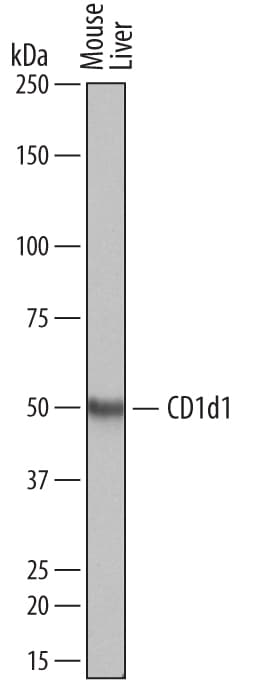
Detection of Mouse CD1d1 by Western Blot.
Western blot shows lysates of mouse liver tissue. PVDF membrane was probed with 0.5 µg/mL of Sheep Anti-Mouse CD1d1 Antigen Affinity-purified Polyclonal Antibody (Catalog # AF4884) followed by HRP-conjugated Anti-Sheep IgG Secondary Antibody (Catalog # HAF016). A specific band was detected for CD1d1 at approximately 50 kDa (as indicated). This experiment was conducted under reducing conditions and using Immunoblot Buffer Group 1.Applications for Mouse CD1d1 Antibody
Western Blot
Sample: Mouse liver tissue
Formulation, Preparation, and Storage
Purification
Reconstitution
Sterile PBS to a final concentration of 0.2 mg/mL. For liquid material, refer to CoA for concentration.
Formulation
Shipping
Stability & Storage
- 12 months from date of receipt, -20 to -70 °C as supplied.
- 1 month, 2 to 8 °C under sterile conditions after reconstitution.
- 6 months, -20 to -70 °C under sterile conditions after reconstitution.
Calculators
Background: CD1d1
References
- Bendelac, A. et al. (2007) Annu. Rev. Immunol. 25:297.
- Brutkiewicz, R.R. (2006) J. Immunol. 177:769.
- Balk, S.P. et al. (1991) J. Immunol. 146:768.
- De Silva, A.D. et al. (2002) J. Immunol. 168:723.
- Roberts, T.J. et al. (2002) J. Immunol. 168:5409.
- Kang, S.J. and P. Cresswell (2004) Nat. Immunol. 5:175.
- Zhou, D. et al. (2004) Science 303:523.
- Prigozy, T.O. et al. (2001) Science 291:664.
- Kawano, T. et al. (1997) Science 278:1626.
- Chiu, Y.H. et al. (1999) J. Exp. Med. 189:103.
- Behar, S.M. et al. (1999) J. Immunol. 162:161.
- Zhou, D. et al. (2004) Science 306:1786.
- Mendiratta, S.K. et al. (1997) Immunity 6:469.
- Stanic, A.K. et al. (2003) J. Immunol. 171:4539.
- Yuan, W. et al. (2006) Nat. Immunol. 7:835.
Alternate Names
Gene Symbol
UniProt
Additional CD1d1 Products
Product Documents for Mouse CD1d1 Antibody
Certificate of Analysis
To download a Certificate of Analysis, please enter a lot or batch number in the search box below.
Note: Certificate of Analysis not available for kit components.
Product Specific Notices for Mouse CD1d1 Antibody
For research use only
Customer Reviews for Mouse CD1d1 Antibody
There are currently no reviews for this product. Be the first to review Mouse CD1d1 Antibody and earn rewards!
Have you used Mouse CD1d1 Antibody?
Submit a review and receive an Amazon gift card!
$25/€18/£15/$25CAN/¥2500 for a review with an image
$10/€7/£6/$10CAN/¥1110 for a review without an image
Submit a review
Protocols
Find general support by application which include: protocols, troubleshooting, illustrated assays, videos and webinars.
- Cellular Response to Hypoxia Protocols
- R&D Systems Quality Control Western Blot Protocol
- Troubleshooting Guide: Western Blot Figures
- Western Blot Conditions
- Western Blot Protocol
- Western Blot Protocol for Cell Lysates
- Western Blot Troubleshooting
- Western Blot Troubleshooting Guide
- View all Protocols, Troubleshooting, Illustrated assays and Webinars
Associated Pathways