
Growth arrest-specific gene 6 (Gas6) was initially characterized as a gene whose expression was up-regulated in serum starved NIH 3T3 fibroblasts and whose expression is down-regulated during growth induction. Mouse Gas6 is a 673 amino acid protein that shares 81% identity to its human homolog. Gas6 is a member of the vitamin K-dependent family of proteins that includes human protein S, a negative coregulator in the blood coagulation pathway. Gas6 and protein S share structural motifs that characterize this family: an extensively gamma -carboxylated amino terminus (Gla domain), four EGF-like repeats, and a carboxy terminus containing globular (G) domains with homology to steroid hormone-binding globulin. It is a ligand for the Axl (Ufo/Ark), Sky (Dtk/Tyro3/Rse/Brt/Tif), and Mer (Eyk) families of tyrosine kinase receptors. Gas6 binds to these receptors via tandem G domains at its C-terminus. Gas6 is ubiquitously expressed, but most abundantly in lung, intestine, bone marrow and endothelium. Gas6 has been implicated in a variety of biological processes. It serves as a mitogen for fibroblasts, endothelial cells, neural cells, vascular smooth muscle cells and several tumor-derived cell lines. In addition, Gas6 prevents apoptosis, independent of its mitogenic activity. Gas6 is capable of inducing cell adhesion and chemotaxis in specific cell types. It also supports vitamin K-independent hematopoiesis when expressed by stromal cells. Gas6 signal transduction following Axl/Sky/Mer receptor activation has been reported to occur through such diverse signaling pathways as PI3K, MAP kinase, Src, Ras and beta -catenin.

Scientific images may be resized, cropped, or adjusted for brightness or contrast for presentation purposes. These updates are limited to presentation and do not affect the underlying scientific interpretation of the data. Where available, additional source data may be provided upon request.
Key Product Details
Species Reactivity
Validated:
Cited:
Applications
Validated:
Cited:
Label
Antibody Source
Product Specifications
Immunogen
Asp115-Pro674 (Del Pro530)
Accession # Q61592.2
Specificity
Clonality
Host
Isotype
Scientific Data Images for Mouse Gas6 Antibody (126618)
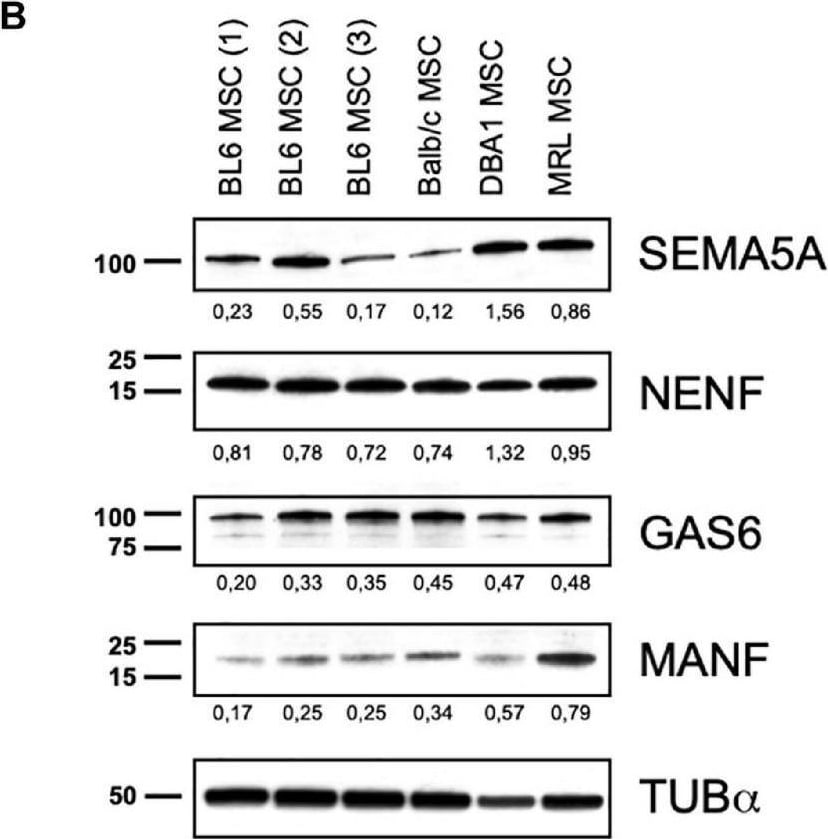
Detection of Gas6 by Western Blot
MRL MSC produced and released higher amount of MANF than BL6, BALB/c and DBA1 MSC. (A) Proteomic analysis of differential expression of MANF, GAS6, NENF, and SEMA5A in MRL MSC compared to BL6 MSC secretomes. Effect size indicate the standardized mean difference in protein expression level between MRL MSC and BL6 MSC. For each protein, the median intensity levels (Log 2 value) in MRL MSC and BL6 MSC are indicated. Normalized protein intensities were used to calculate the Effect size MRL/BL6. (B) Western blot analysis of MANF, GAS6, NENF, and SEMA5A in whole-cell extracts from BL6, BALB/c and DBA1 MSC. The intensity value of each target protein band was normalized against the intensity value of alpha -Tubulin gel band used as the internal loading control for each sample. (C)MANF mRNA expression level in MRL MSC and BL6 MSC. Western blot analysis of supernatants of BL6, BALB/c, and DBA1 MSC showing blotted proteins stained with Ponceau S (D) and the MANF protein band revealed by the anti-MANF antibody (E). MRL MSC whole cell extract was used as a positive control. Image collected and cropped by CiteAb from the following open publication (https://pubmed.ncbi.nlm.nih.gov/33738280), licensed under a CC-BY license. Not internally tested by R&D Systems.Applications for Mouse Gas6 Antibody (126618)
Western Blot
Sample: Recombinant Mouse Gas6 (Catalog # 986-GS)
under non-reducing conditions only
Reviewed Applications
Read 1 review rated 5 using MAB986 in the following applications:
Formulation, Preparation, and Storage
Purification
Reconstitution
Reconstitute at 0.5 mg/mL in sterile PBS. For liquid material, refer to CoA for concentration.
Formulation
Shipping
Stability & Storage
- 12 months from date of receipt, -20 to -70 °C as supplied.
- 1 month, 2 to 8 °C under sterile conditions after reconstitution.
- 6 months, -20 to -70 °C under sterile conditions after reconstitution.
Calculators
Background: Gas6
References
- Manfioletti, G. et al. (1993) Mol. Cell Biol. 13:4976.
- Goruppi, S. et al. (1996) Oncogene 12:471.
- Crosier, K and P. Crosier (1997) Pathology 29:131.
- Dormady, S. et al. (2000) Proc. Natl. Acad. Sci. USA 97:12260.
- Goruppi, S. et al. (2001) Mol. Cell Biol. 21:902.
Long Name
Alternate Names
Gene Symbol
UniProt
Additional Gas6 Products
Product Documents for Mouse Gas6 Antibody (126618)
Certificate of Analysis
To download a Certificate of Analysis, please enter a lot or batch number in the search box below.
Note: Certificate of Analysis not available for kit components.
Product Specific Notices for Mouse Gas6 Antibody (126618)
For research use only
Related Research Areas
Citations for Mouse Gas6 Antibody (126618)
 Powered by Bioz
Customer Reviews for Mouse Gas6 Antibody (126618) (1)
Have you used Mouse Gas6 Antibody (126618)?
Submit a review and receive an Amazon gift card!
$25/€18/£15/$25CAN/¥2500 for a review with an image
$10/€7/£6/$10CAN/¥1110 for a review without an image
Submit a review
Customer Images
-
Application: Functional AssaySample Tested: PlasmaSpecies: MouseVerified Customer | Posted 11/29/2020

There are no reviews that match your criteria.
Protocols
Find general support by application which include: protocols, troubleshooting, illustrated assays, videos and webinars.
- Cellular Response to Hypoxia Protocols
- R&D Systems Quality Control Western Blot Protocol
- Troubleshooting Guide: Western Blot Figures
- Western Blot Conditions
- Western Blot Protocol
- Western Blot Protocol for Cell Lysates
- Western Blot Troubleshooting
- Western Blot Troubleshooting Guide
- View all Protocols, Troubleshooting, Illustrated assays and Webinars