
IFN-alpha / beta R1, also known as IFNAR1, belongs to the class II cytokine receptor family of proteins. Class II cytokine receptors form heterodimeric receptor complexes that mediate class II cytokine signals. Subunits of the different receptor complexes are shared and serve multiple functions (1-3). IFN-alpha / beta R1, in association with IFN-alpha / beta R2, is required for propagating antiviral signal transduction triggered by IFN-alpha and IFN-beta (4, 5). The mouse IFN-alpha / beta R1 cDNA encodes a 590 amino acid (aa) precursor including a 26 aa signal sequence, a 403 aa extracellular domain (ECD), a 20 aa transmembrane segment, and a 141 aa cytoplasmic domain (6). The ECD contains three tandem fibronectin type III repeats and is extensively glycosylated. The ECD of mouse IFN-alpha / beta R1 shares 47-48% aa identity with that of human, bovine, porcine, and ovine IFN-alpha / beta R1. IFN-alpha / beta R1 interacts very weakly or not at all with type 1 interferons and does not stably interact with IFN-alpha / beta R2. Ligands associate with IFN-alpha / beta R2, and this complex subsequently forms a stable ternary assembly with IFN-alpha / beta R1 (7, 8). IFN-alpha / beta R1 also associates with IFN-gamma R2 even in the absence of IFN-gamma stimulation (5). Tyrosine phosphorylation within the juxtamembrane cytoplasmic domain of IFN-alpha / beta R1 provides a docking site for the SH2 domains of Tyk2 and STAT2 (9-11). Tyk2 can directly phosphorylate IFN-alpha / beta R1 (10). Tyk2 also increases the level of cell surface expression of IFN-alpha / beta R1 by preventing constitutive internalization (12). Human IFN-alpha / beta R1 contains a nuclear localization signal in its ECD which is required for receptor translocation to the nucleus following interaction with ligand (13).
Mouse IFN-alpha/beta R1 Antibody
R&D Systems | Catalog # AF3039

Scientific images may be resized, cropped, or adjusted for brightness or contrast for presentation purposes. These updates are limited to presentation and do not affect the underlying scientific interpretation of the data. Where available, additional source data may be provided upon request.
Key Product Details
Species Reactivity
Validated:
Cited:
Applications
Validated:
Cited:
Label
Antibody Source
Product Specifications
Immunogen
Glu27-Thr429
Accession # P33896
Specificity
Clonality
Host
Isotype
Endotoxin Level
Scientific Data Images for Mouse IFN-alpha/beta R1 Antibody
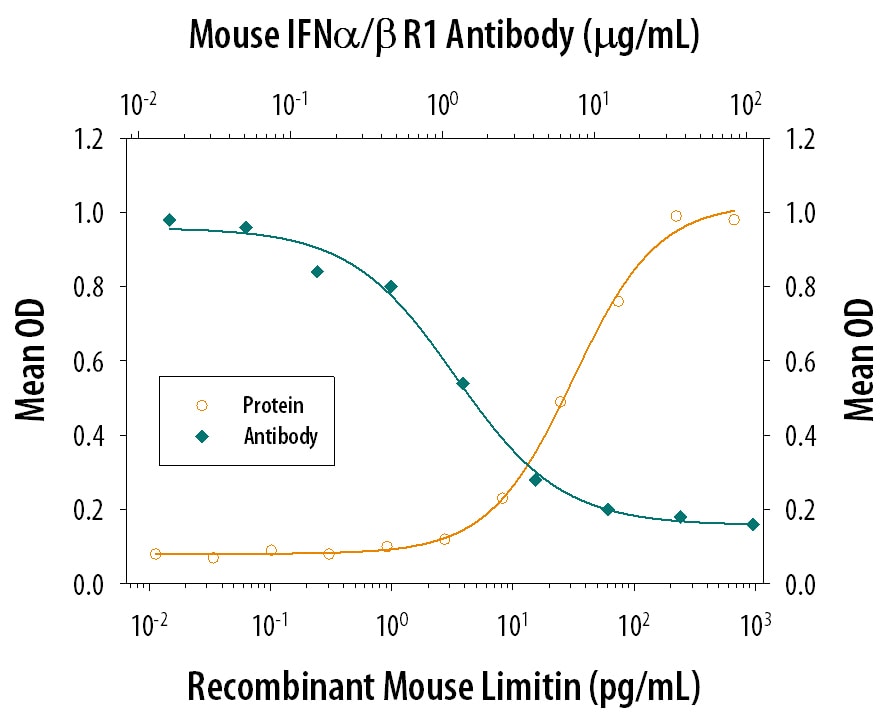
Limitin Inhibition of EMCV-induced Cytopathy and Neutralization by Mouse IFN‑ alpha / beta R1 Antibody.
Recombinant Mouse Limitin (Catalog # 1535-LM) reduces the Encephalomyocarditis Virus (EMCV)-induced cytopathy in the L-929 mouse fibroblast cell line in a dose-dependent manner (orange line). Inhibition of EMCV activity elicited by Recombinant Mouse Limitin (30 pg/mL) is neutralized (green line) by increasing concentrations of Mouse IFN-a/ beta R1 Antigen Affinity-purified Polyclonal Antibody (Catalog # AF3039). The ND50 is typically 1-4 µg/mL.Applications for Mouse IFN-alpha/beta R1 Antibody
Western Blot
Sample: Recombinant Mouse IFN-alpha / beta R1 (Catalog # 3039-AB)
Neutralization
Reviewed Applications
Read 1 review rated 4 using AF3039 in the following applications:
Formulation, Preparation, and Storage
Purification
Reconstitution
Reconstitute at 0.2 mg/mL in sterile PBS. For liquid material, refer to CoA for concentration.
Formulation
Shipping
Stability & Storage
- 12 months from date of receipt, -20 to -70 °C as supplied.
- 1 month, 2 to 8 °C under sterile conditions after reconstitution.
- 6 months, -20 to -70 °C under sterile conditions after reconstitution.
Calculators
Background: IFN-alpha/beta R1
References
- Langer, J.A. et al. (2004) Cytokine Growth Factor Rev. 15:33.
- Kotenko, S.V. and J.A. Langer (2004) Int. Immunopharmacol. 4:593.
- Donnelly, R.P. et al. (2004) J. Leukoc. Biol. 76:314.
- Hwang, S.Y. et al. (1995) Proc. Natl. Acad. Sci. USA 92:11284.
- Takaoka, A. et al. (2000) Science 288:2357.
- Uze, G. et al. (1992) Proc. Natl. Acad. Sci. USA 89:4774.
- Lamken, P. et al. (2004) J. Mol. Biol. 341:303.
- Arduini, R.M. et al. (1999) Prot. Sci. 8:1867.
- Krishnan, K. et al. (1998) J. Biol. Chem. 273:19495.
- Yan, H. et al. (1996) Mol. Cell. Biol. 16:2074.
- Yan, H. et al. (1996) EMBO J. 15:1064.
- Ragimbeau, J. et al. (2003) EMBO J. 22:537.
- Subramaniam, P.S. and H.M. Johnson (2004) FEBS Lett. 578:207.
Long Name
Alternate Names
Gene Symbol
UniProt
Additional IFN-alpha/beta R1 Products
Product Documents for Mouse IFN-alpha/beta R1 Antibody
Certificate of Analysis
To download a Certificate of Analysis, please enter a lot or batch number in the search box below.
Note: Certificate of Analysis not available for kit components.
Product Specific Notices for Mouse IFN-alpha/beta R1 Antibody
For research use only
Related Research Areas
Citations for Mouse IFN-alpha/beta R1 Antibody
 Powered by Bioz
Customer Reviews for Mouse IFN-alpha/beta R1 Antibody (1)
Have you used Mouse IFN-alpha/beta R1 Antibody?
Submit a review and receive an Amazon gift card!
$25/€18/£15/$25CAN/¥2500 for a review with an image
$10/€7/£6/$10CAN/¥1110 for a review without an image
Submit a review
Customer Images
-
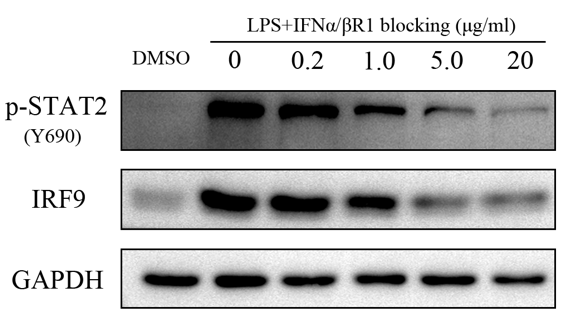
Application: Block/NeutralizeSample Tested: Bone Marrrow Derived MacrophagesSpecies: MouseVerified Customer | Posted 11/22/2019Different concentration of anti-IFN alpha / beta R1 block M-CSF induced BMDM for 30 min, then stimulated by 100 ng/ml LPS for 4 h

There are no reviews that match your criteria.
Protocols
Find general support by application which include: protocols, troubleshooting, illustrated assays, videos and webinars.
- Cellular Response to Hypoxia Protocols
- R&D Systems Quality Control Western Blot Protocol
- Troubleshooting Guide: Western Blot Figures
- Western Blot Conditions
- Western Blot Protocol
- Western Blot Protocol for Cell Lysates
- Western Blot Troubleshooting
- Western Blot Troubleshooting Guide
- View all Protocols, Troubleshooting, Illustrated assays and Webinars
Associated Pathways
