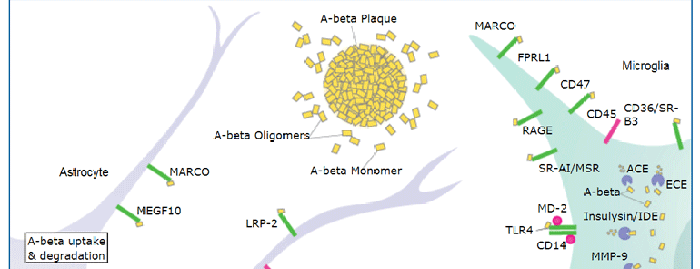
MARCO (macrophage receptor with collagenous structure), also known as SCARA2, is an 80 kDa type II transmembrane glycoprotein that belongs to the class A scavenger receptor family (1). Mouse MARCO consists of a 48 amino acid (aa) cytoplasmic domain, a 21 aa transmembrane segment, and a 449 aa extracellular domain (ECD) that includes a stalk region, a collagen-like region, and one SRCR domain (2). Within the ECD, mouse MARCO shares 69% and 86% aa sequence identity with human and rat MARCO, respectively. It shares 18%‑28% aa sequence identity with other mouse class A scavenger receptors CL-P1, SCARA3, SCARA5, and SR-A1/MSR. MARCO is constitutively expressed on the surface of splenic and lymph node macrophages (2, 3). Its expression is induced on Kupffer cells and alveolar macrophages by microbial infection, chemical irritants, and Th1 polarizing factors (3‑5). MARCO binds LPS, lipoteichoic acid, and other determinants on Gram positive and Gram negative bacteria (2, 6‑8). It also binds modified LDL, CpG oligonucleotides, UGRP1, silica, and TiO2 (2, 9‑11). MARCO is required for the organization of the splenic marginal zone and the interaction of local macrophages and B cells (12, 13). The SRCR domain mediates binding of MARCO to its various ligands (3, 12), while the collagen-like region mediates assembly into a disulfide-linked trimeric molecule (2, 7). MARCO ligation induces, but is not required for the production of IL-12, NO, or TNF-alpha by macrophages (5, 6, 9). MARCO knockout mice show a reduced clearance of bacterial infections, reduced mast cell mediated silicosis, increased pulmonary inflammation, and increased sensitivity to ozone induced lung damage (4, 9, 14‑16).

Scientific images may be resized, cropped, or adjusted for brightness or contrast for presentation purposes. These updates are limited to presentation and do not affect the underlying scientific interpretation of the data. Where available, additional source data may be provided upon request.
Key Product Details
Species Reactivity
Validated:
Cited:
Applications
Validated:
Cited:
Label
Antibody Source
Product Specifications
Immunogen
Gln70-Ser518
Accession # Q60754
Specificity
Clonality
Host
Isotype
Scientific Data Images for Mouse MARCO Antibody
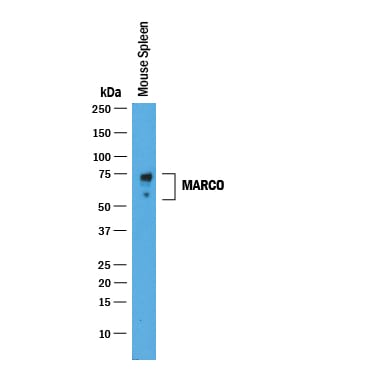
Detection of Mouse MARCO by Western Blot.
Western blot shows lysates of mouse spleen tissue. PVDF membrane was probed with 0.25 µg/mL of Goat Anti-Mouse MARCO Antigen Affinity-purified Polyclonal Antibody (Catalog # AF2956) followed by HRP-conjugated Anti-Goat IgG Secondary Antibody (Catalog # HAF019). Specific bands were detected for MARCO at approximately 65-75 kDa (as indicated). This experiment was conducted under reducing conditions and using Immunoblot Buffer Group 1.Applications for Mouse MARCO Antibody
Western Blot
Sample: Mouse spleen tissue
Reviewed Applications
Read 1 review rated 4 using AF2956 in the following applications:
Formulation, Preparation, and Storage
Purification
Reconstitution
Reconstitute at 0.2 mg/mL in sterile PBS. For liquid material, refer to CoA for concentration.
Formulation
Shipping
Stability & Storage
- 12 months from date of receipt, -20 to -70 °C as supplied.
- 1 month, 2 to 8 °C under sterile conditions after reconstitution.
- 6 months, -20 to -70 °C under sterile conditions after reconstitution.
Calculators
Background: MARCO
References
- Murphy, J.E. et al. (2005) Atherosclerosis 182:1.
- Elomaa, O. et al. (1995) Cell 80:603.
- Van der Laan, L.J.W. et al. (1999) J. Immunol. 162:939.
- Dahl, M. et al. (2007) J. Clin. Invest. 117:757.
- Jozefowski, S. et al. (2005) J. Immunol. 175:8032.
- Mukhopadhyay, S. et al. (2006) Eur. J. Immunol. 36:940.
- Sankala, M. et al. (2002) J. Biol. Chem. 277:33378.
- Chen, Y. et al. (2006) J. Biol. Chem. 281:12767.
- Jozefowski, S. et al. (2006) J. Leukoc. Biol. 80:870.
- Bin, L.-H. et al. (2003) J. Immunol. 171:924.
- Hamilton, Jr. R.F. et al. (2006) J. Biol. Chem. 281:34218.
- Karlsson, M.C.I. et al. (2003) J. Exp. Med. 198:333.
- Chen, Y. et al. (2005) J. Immunol. 175:8173.
- Arredouani, M. et al. (2004) J. Exp. Med. 200:267.
- Arredouani, M.S. et al. (2007) J. Immunol. 178:5912.
- Brown, J.M. et al. (2007) Am. J. Respir. Cell Mol. Biol. 36:43.
Long Name
Alternate Names
Gene Symbol
UniProt
Additional MARCO Products
Product Documents for Mouse MARCO Antibody
Certificate of Analysis
To download a Certificate of Analysis, please enter a lot or batch number in the search box below.
Note: Certificate of Analysis not available for kit components.
Product Specific Notices for Mouse MARCO Antibody
For research use only
Related Research Areas
Citations for Mouse MARCO Antibody
 Powered by Bioz
Customer Reviews for Mouse MARCO Antibody (1)
Have you used Mouse MARCO Antibody?
Submit a review and receive an Amazon gift card!
$25/€18/£15/$25CAN/¥2500 for a review with an image
$10/€7/£6/$10CAN/¥1110 for a review without an image
Submit a review
-
Application: Western BlotSample Tested: See PMID 23667110Species: MouseVerified Customer | Posted 01/07/2015
There are no reviews that match your criteria.
Protocols
Find general support by application which include: protocols, troubleshooting, illustrated assays, videos and webinars.
- Cellular Response to Hypoxia Protocols
- R&D Systems Quality Control Western Blot Protocol
- Troubleshooting Guide: Western Blot Figures
- Western Blot Conditions
- Western Blot Protocol
- Western Blot Protocol for Cell Lysates
- Western Blot Troubleshooting
- Western Blot Troubleshooting Guide
- View all Protocols, Troubleshooting, Illustrated assays and Webinars
Associated Pathways