
Osteoactivin (also GPNMB and DC-HIL) is a variably glycosylated 75 - 125 kDa member of the NMB/pMEL-17 family of molecules. It is found in multiple subcellular sites, but is most often associated with the endosomal/lysosomal compartment (1, 2, 3). Human Osteoactivin is a 560 amino acid (aa) type I transmembrane protein. Its precursor contains a 21 aa signal sequence, a 465 aa luminal/extracellular domain, a 21 aa transmembrane segment and a 53 aa cytoplasmic tail (4, 5). The luminal region contains an N-terminal heparin-binding motif (aa 23 - 26), multiple glycosylation sites, an RGD motif (aa 64 - 66) and an 88 aa PKD domain (aa 240 - 327). The intracellular tail has an ITAM (Y-x-x-I) and lysosomal targeting (L-L) motif (4, 5). The extracellular/luminal region shares 94% aa identity between human and cynomolgus monkey Osteoactivin. Multiple isoforms would appear to exist. There is one alternate splice form known that shows a 12 aa insert between aa 339 - 340 (6). An addtional 206 aa isoform shows a mutation at position # 181 that results in a 26 aa substitution for the C-terminal 380 amino acids (7, 8). This has the potential to be soluble and may represent a counterpart to a secreted isoform of rat Osteoactivin (9). Cells known to express Osteoactivin include macrophages/Kupffer cells, fibroblasts, osteoblasts, myeloid dendritic cells, retinal pigment epithelial cells and melanocytes, plus fetal chondrocytes and stratum basale keratinocytes (3, 4, 5, 10, 11, 12). In mice, Osteoactivin is reported to bind to heparan sulfate-proteoglycan, possibly on the surface of endothelial cells and may also interact with integrins (13). It also appears to act as an inflammatory suppressor gene, as its expression downregulates the macrophage inflammatory response by inhibiting IL-6 and IL-12p40 production (3).
Recombinant Cyno/Rhesus Osteoactivin/GPNMB Fc Protein, CF
R&D Systems | Catalog # 11154-AC
Cynomolgus Monkey/Rhesus Macaque Fc Chimera

Loading...
Key Product Details
- R&D Systems CHO-derived Recombinant Cyno/Rhesus Osteoactivin/GPNMB Fc Protein (11154-AC)
- Quality control testing to verify active proteins with lot specific assays by in-house scientists
- All R&D Systems proteins are covered with a 100% guarantee
Source
CHO
Accession Number
Structure / Form
Disulfide-linked homodimer
Applications
Bioactivity
Loading...
Product Specifications
Source
Chinese Hamster Ovary cell line, CHO-derived Osteoactivin/GPNMB protein
| Cyno/Rhesus Osteoactivin (Lys23-Asn487) Accession # XP_005550047.1 |
IEGRMD | Human IgG1 (Pro100-Lys330) |
| N-terminus | C-terminus |
Purity
>95%, by SDS-PAGE visualized with Silver Staining and quantitative densitometry by Coomassie® Blue Staining.
Endotoxin Level
<0.10 EU per 1 μg of the protein by the LAL method.
N-terminal Sequence Analysis
Lys23
Predicted Molecular Mass
78 kDa
SDS-PAGE
111-122 kDa, under reducing conditions.
Activity
Measured by its binding ability in a functional ELISA.
When Recombinant Human Integrin alpha V beta 3 (Catalog # 3050-AV) is immobilized at 2 µg/mL (100 µL/well), Recombinant Cynomolgus Monkey/Rhesus Macaque Osteoactivin/GPNMB Fc Chimera (Catalog # 11154-AC) binds with an ED50 of 0.750-9.00 µg/mL.
When Recombinant Human Integrin alpha V beta 3 (Catalog # 3050-AV) is immobilized at 2 µg/mL (100 µL/well), Recombinant Cynomolgus Monkey/Rhesus Macaque Osteoactivin/GPNMB Fc Chimera (Catalog # 11154-AC) binds with an ED50 of 0.750-9.00 µg/mL.
Scientific Data Images for Recombinant Cyno/Rhesus Osteoactivin/GPNMB Fc Protein, CF
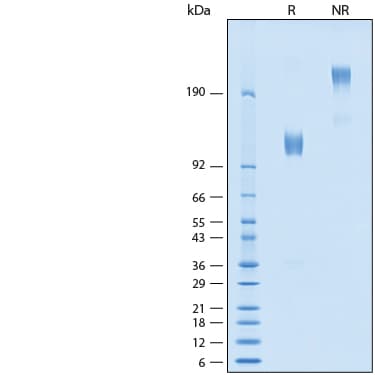
Recombinant Cynomolgus/Rhesus Osteoactivin/GPNMB Fc Chimera Protein SDS-PAGE.
2 μg/lane of Recombinant Cynomolgus/Rhesus Osteoactivin/GPNMB Fc Chimera Protein (Catalog # 11154-AC) was resolved with SDS-PAGE under reducing (R) and non-reducing (NR) conditions and visualized by Coomassie® Blue staining, showing bands at 111-122 kDa and 220-245 kDa, respectively.Formulation, Preparation, and Storage
11154-AC
| Formulation | Lyophilized from a 0.2 μm filtered solution in PBS with Trehalose. |
| Reconstitution | Reconstitute at 500 μg/mL in PBS. |
| Shipping | The product is shipped at ambient temperature. Upon receipt, store it immediately at the temperature recommended below. |
| Stability & Storage | Use a manual defrost freezer and avoid repeated freeze-thaw cycles.
|
Calculators
Background: Osteoactivin/GPNMB
References
- Bachner, D. et al. (2002) Gene Exp. Patterns 1:159.
- Safadi, F.F. et al. (2002) J. Cell. Biochem. 84:12.
- Ripoll, V.M. et al. (2007) J. Immunol. 178:6557.
- Owen, T.A. et al. (2003) Crit. Rev. Eukaryot. Gene Expr. 13:205.
- Weterman, M.A.J. et al. (1995) Int. J. Cancer 60:73.
- Kuan, C-T. et al. (2006) Clin. Cancer Res. 12:1970.
- Lennerz, V. et al. (2005) Proc. Natl. Acad. Sci. USA 102:16013.
- Genbank Accession # AAH11595.
- Abdelmagid, S.M. et al. (2007) J. Cell. Physiol. 210:26.
- Haralanova-Ilieva, B. et al. (2005) J. Hepatol. 42:565.
- Ahn, J.H. et al. (2002) Blood 100:1742.
- Anderson, M.G. et al. (2002) Nat. Genet. 30:81.
- Shikano, S. et al. (2001) J. Biol. Chem. 276:8125.
Long Name
Glycoprotein Non-Metastatic Melanoma Protein B
Alternate Names
DC-HIL, GPNMB, HGFIN
Gene Symbol
GPNMB
UniProt
Additional Osteoactivin/GPNMB Products
Product Documents for Recombinant Cyno/Rhesus Osteoactivin/GPNMB Fc Protein, CF
Certificate of Analysis
To download a Certificate of Analysis, please enter a lot or batch number in the search box below.
Note: Certificate of Analysis not available for kit components.
Product Specific Notices for Recombinant Cyno/Rhesus Osteoactivin/GPNMB Fc Protein, CF
For research use only
Related Research Areas
Customer Reviews for Recombinant Cyno/Rhesus Osteoactivin/GPNMB Fc Protein, CF
There are currently no reviews for this product. Be the first to review Recombinant Cyno/Rhesus Osteoactivin/GPNMB Fc Protein, CF and earn rewards!
Have you used Recombinant Cyno/Rhesus Osteoactivin/GPNMB Fc Protein, CF?
Submit a review and receive an Amazon gift card!
$25/€18/£15/$25CAN/¥2500 for a review with an image
$10/€7/£6/$10CAN/¥1110 for a review without an image
Submit a review
Loading...