
Dickkopf related protein 2 (Dkk-2) is a member of the Dickkopf family of secreted Wnt modulators (1-3). Dkk proteins contain a signal peptide and two conserved cysteine-rich domains that are separated by a linker region. The second cysteine-rich domain mediates Dkk-2 binding activities, and its interaction with beta -propeller domains of LRP‑5/6 has been mapped (2-4, 7). The 226 amino acid (aa), ~35 kDa mature human Dkk-2 shares 96%, 97%, 97%, 97%, 97% and 98% aa identity with mouse, rat, canine, equine, bovine and porcine Dkk-2, respectively. Mouse Dkk-2 can activate the canonical Wnt signaling pathway in Xenopus embryos, showing evolutionary conservation of function (5). Dkk proteins modify Wnt engagement of a receptor complex composed of a Frizzled protein and a low-density lipoprotein receptor-related protein, either LRP‑5 or LRP‑6 (3). Also, Kremen-1 and Kremen-2 are high affinity receptors for Dkk-1 and Dkk-2 (9). When LRP‑6 is over-expressed, direct high‑affinity binding of Dkk-2 to LRP can enhance canonical Wnt signaling (6-8). However, when Dkk‑2 and LRP‑6 form a ternary complex with Kremen‑2, Wnt signaling is inhibited due to internalization of Dkk‑2/LRP6/Krm2 complexes (9, 10). Thus, depending on the cellular context, Dkk‑2 can either activate or inhibit canonical Wnt signaling (3). In contrast, binding of Dkk-1 or Dkk-4 to LRP is consistently antagonistic (3). Dkk proteins are expressed in mesenchymal tissues and control epithelial transformations. Dkk-2 expression has been studied most in bone and eye, although it is expressed as early as periimplantation in mice (11). Mouse Dkk-1 or Dkk-2 deficiencies have opposite effects on bone homeostasis, despite down‑regulating Wnt antagonism in both cases (12, 13). Dkk-2 expression is induced by Wnts in bone, and is thought to enhance bone density by promoting terminal differentiation of osteoblasts and mineral deposition (12). In contrast, Dkk-1 negatively regulates late osteoblast proliferation, which limits bone density (13). Dkk-2-deficient mice are blind, exhibiting faulty differentiation of corneal epithelium and ectopic blood vessels in the periocular mesenchyme (14, 15).

Key Product Details
- R&D Systems CHO-derived Recombinant Human Dkk-2 Protein (6628-DK)
- Quality control testing to verify active proteins with lot specific assays by in-house scientists
- All R&D Systems proteins are covered with a 100% guarantee
Source
Accession Number
Applications
Product Specifications
Source
Met1-Ile259
Purity
Endotoxin Level
N-terminal Sequence Analysis
Predicted Molecular Mass
SDS-PAGE
Activity
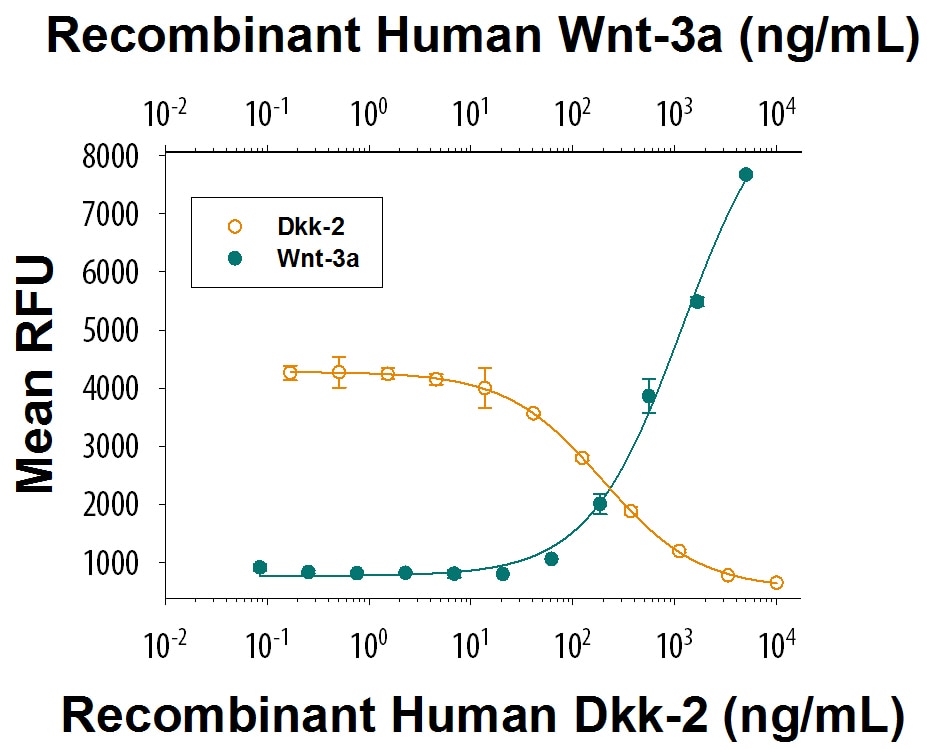
The ED50 for this effect is 50-300 ng/mL.
Reviewed Applications
Read 1 review rated 5 using 6628-DK in the following applications:
Scientific Data Images for Recombinant Human Dkk-2 Protein
Recombinant Human Dkk-2 Protein Bioactivity
Recombinant Human Wnt-3a (Catalog # 5036-WN) induces a dose responsive increase in Wnt reporter activity in HEK293 cells (green circles). Recombinant Human Dkk-2 (Catalog # 6628-DK) inhibits Recombinant Human Wnt-3a. The ED50 for this effect is 50-300 ng/mL (orange circles).Formulation, Preparation, and Storage
Carrier Free
What does CF mean?CF stands for Carrier Free (CF). We typically add Bovine Serum Albumin (BSA) as a carrier protein to our recombinant proteins. Adding a carrier protein enhances protein stability, increases shelf-life, and allows the recombinant protein to be stored at a more dilute concentration. The carrier free version does not contain BSA.
What formulation is right for me?In general, we advise purchasing the recombinant protein with BSA for use in cell or tissue culture, or as an ELISA standard. In contrast, the carrier free protein is recommended for applications, in which the presence of BSA could interfere.
Carrier: 6628-DK
| Formulation | Lyophilized from a 0.2 μm filtered solution in PBS and EDTA with BSA as a carrier protein. |
| Reconstitution | Reconstitute at 100 μg/mL in PBS. |
| Shipping | The product is shipped at ambient temperature. Upon receipt, store it immediately at the temperature recommended below. |
| Stability & Storage | Use a manual defrost freezer and avoid repeated freeze-thaw cycles.
|
Carrier Free: 6628-DK/CF
| Formulation | Lyophilized from a 0.2 μm filtered solution in PBS and EDTA. |
| Reconstitution | Reconstitute at 100 μg/mL in PBS. |
| Shipping | The product is shipped at ambient temperature. Upon receipt, store it immediately at the temperature recommended below. |
| Stability & Storage | Use a manual defrost freezer and avoid repeated freeze-thaw cycles.
|
Calculators
Background: Dkk-2
References
- Monaghan, A.P. et al. (1999) Mech. Dev. 87:45.
- Krupnik, V.E. et al. (1999) Gene 238:301.
- Niehrs, C. (2006) Oncogene 25:7469.
- Chen, L. et al. (2008) J. Biol. Chem. 283:23364.
- Wu, W. et al. (2000) Current Biol. 10:1611.
- Mao, B. et al. (2001) Nature 411:321.
- Li, L. et al. (2002) J. Biol. Chem. 277:5977.
- Brott, B. and S.Y. Sokol (2002) Mol. Cell. Biol. 22:6100.
- Mao, B. et al. (2002) Nature 417:664.
- Mao, B. and C. Niehrs (2003) Gene 302:179.
- Zhang, Y. et al. (2009) J. Reprod. Dev. 55:17.
- Li, X. et al. (2005) Nat. Genet. 37:945.
- van der Horst, G. et al. (2005) J. Bone Miner. Res. 20:1867.
- Mukhopadhyay, M. et al. (2006) Development 133:2149.
- Gage, P.J. et al. (2008) Dev. Biol. 317:310.
Long Name
Alternate Names
Gene Symbol
UniProt
Additional Dkk-2 Products
Product Documents for Recombinant Human Dkk-2 Protein
Certificate of Analysis
To download a Certificate of Analysis, please enter a lot or batch number in the search box below.
Note: Certificate of Analysis not available for kit components.
Product Specific Notices for Recombinant Human Dkk-2 Protein
For research use only
Related Research Areas
Citations for Recombinant Human Dkk-2 Protein
 Powered by Bioz
Customer Reviews for Recombinant Human Dkk-2 Protein (1)
Have you used Recombinant Human Dkk-2 Protein?
Submit a review and receive an Amazon gift card!
$25/€18/£15/$25CAN/¥2500 for a review with an image
$10/€7/£6/$10CAN/¥1110 for a review without an image
Submit a review
Customer Images
-
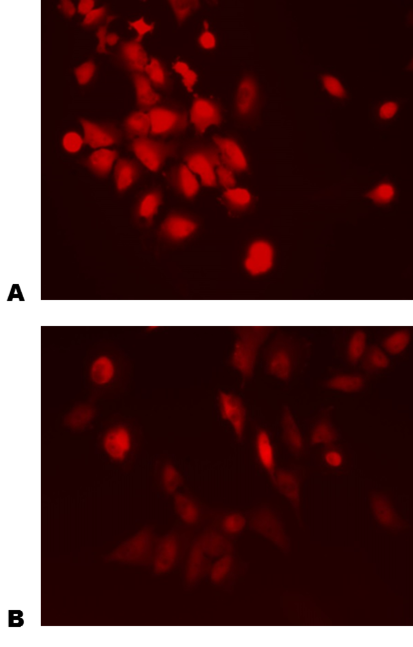
Application: In vitro bioactivity in cell cultureVerified Customer | Posted 04/19/2017Immunofluorescent staining of MDA-MB-231 cells using Wnt5a antibody before (A) and after (B) treatment with Wnt-inhibitor DKK-2 protein (#6628-DK) for 72 hours. Primary antibody 1:50, secondary antibody 1:100.

There are no reviews that match your criteria.