Recombinant Human PCNA His-tag Protein, CF

R&D Systems | Catalog # 11805-PC

R&D Systems
Loading...

Key Product Details

Source

E. coli

Applications

Bioactivity
Loading...

Product Specifications

Source

E. coli-derived human PCNA protein
Met HHHHHH Human PCNA
(Phe2-Ser261)
Accession # P12004.1
N-terminus C-terminus

Purity

>95%, by SDS-PAGE visualized with Silver Staining and quantitative densitometry by Coomassie® Blue Staining.

Endotoxin Level

<0.10 EU per 1 μg of the protein by the LAL method.

N-terminal Sequence Analysis

Met

Predicted Molecular Mass

30 kDa

SDS-PAGE

32-37 kDa, under reducing conditions.

Activity

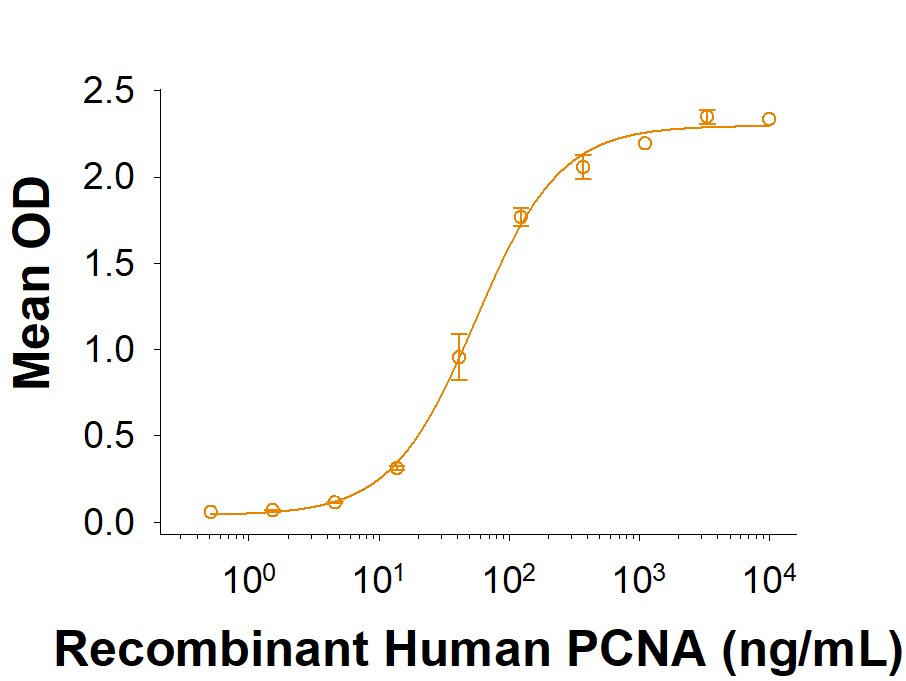
Measured by its binding ability in a functional ELISA.
Recombinant Human PCNA His-tag (Catalog # 11805-PC) binds to PCNA Antibody with an ED50 of <500 ng/mL.

Scientific Data Images for Recombinant Human PCNA His-tag Protein, CF

Recombinant Human PCNA His-tag Protein Binding Activity.

In a functional ELISA, Recombinant Human PCNA His-tag Protein (Catalog # 11805-PC) binds to PCNA Antibody with an ED50 of <500 ng/mL.
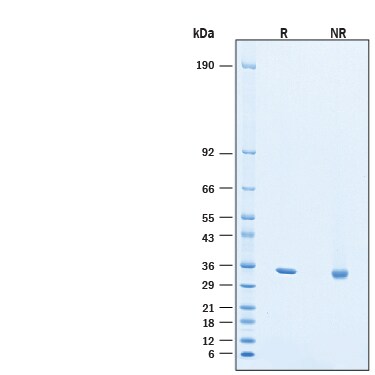
Recombinant Human PCNA His-tag Protein SDS-PAGE.

2 μg/lane of Recombinant Human PCNA His-tag Protein (Catalog # 11805-PC) was resolved with SDS-PAGE under reducing (R) and non-reducing (NR) conditions and visualized by Coomassie® Blue staining, showing bands at 32-37 kDa, under reducing conditions.

Formulation, Preparation, and Storage

11805-PC
Formulation Lyophilized from a 0.2 μm filtered solution in Tris, NaCl and TCEP with Trehalose.
Reconstitution Reconstitute at 250 μg/mL in water.
Shipping The product is shipped with polar packs. Upon receipt, store it immediately at the temperature recommended below.
Stability & Storage Use a manual defrost freezer and avoid repeated freeze-thaw cycles.
  • 6 months from date of receipt, -20 to -70 °C as supplied.
  • 3 months, -20 to -70 °C under sterile conditions after reconstitution.

Calculators

The reconstitution calculator allows you to quickly calculate the volume of a reagent to reconstitute your vial. Simply enter the mass of reagent and the target concentration and the calculator will determine the rest.

=
÷

Background: PCNA

Proliferating cell nuclear antigen (PCNA) is a highly conserved ~36 kDa nuclear protein that acts as a sliding clamp essential for DNA replication, repair, and cell‑cycle progression. In eukaryotic cells, PCNA forms a homotrimeric ring that encircles duplex DNA and functions as a mobile platform to recruit and coordinate a wide range of replication‑ and repair‑associated proteins at the replication fork (1, 2). Due to its tight association with S‑phase activity, PCNA is widely used as a marker of cell proliferation in both normal and pathological tissues. During DNA replication, PCNA serves as the primary processivity factor for DNA polymerases delta and epsilon, ensuring efficient and continuous DNA synthesis. Beyond replication, PCNA integrates DNA metabolic pathways by binding numerous partner proteins involved in nucleotide excision repair, base excision repair, mismatch repair, chromatin assembly, and translesion DNA synthesis (2, 3). Many of these interactions are mediated through conserved PCNA‑interacting peptide (PIP) motifs present in client proteins, enabling PCNA to function as a central molecular hub for genome maintenance. PCNA activity is dynamically regulated by post‑translational modifications, most notably ubiquitination at Lys164. Monoubiquitination of PCNA promotes recruitment of specialized translesion polymerases that bypass DNA lesions, whereas polyubiquitination directs error‑free damage avoidance pathways, thereby preserving genome integrity under replicative stress (4). Proper loading and timely unloading of PCNA from chromatin are also critical for normal DNA metabolism; failure to remove PCNA after replication can interfere with chromatin maturation and repair processes. In addition to its canonical nuclear roles, PCNA participates in cell‑cycle control and DNA damage signaling through interactions with regulatory proteins such as the CDK inhibitor p21(Cip1/Waf1). Binding of p21 to PCNA inhibits PCNA‑dependent DNA synthesis and links checkpoint activation to suppression of replication following genotoxic stress (5). Through these combined functions, PCNA acts as a coordinator of DNA synthesis, repair pathway choice, and cell‑cycle progression. Aberrant PCNA expression or regulation is closely associated with oncogenesis, reflecting the increased proliferative and replicative stress states of cancer cells. Consequently, PCNA has emerged not only as a diagnostic and prognostic marker but also as a potential therapeutic target in cancer and genome‑instability–related diseases (2, 6). Recombinant human PCNA is therefore a key research reagent for studies of DNA replication and repair, cell‑cycle regulation, genome stability, and cancer biology, as well as for mechanistic analysis of PCNA‑dependent protein–protein interactions.

References

  1. Mailand, N. et al. (2013) Nat. Rev. Mol. Cell Biol. 14:269.
  2. González‑Magaña, A. et al. (2020) Biomolecules. 10:570.
  3. Kang, S. et al. (2024) Trends Genet. 40:526.
  4. Lee, K.‑Y. et al. (2008) Mol. Cells 26:5.
  5. Mansilla, S. F. et al. (2020) Genes 11:593.
  6. Gera, M. et al. (2024) Clin. Transl. Metab. 22:7. 

Long Name

Proliferating Cell Nuclear Antigen

Alternate Names

cyclin, DNA polymerase delta auxiliary protein, MGC8367, proliferating cell nuclear antigen

Entrez Gene IDs

5111 (Human)

Gene Symbol

PCNA

Additional PCNA Products

Product Documents for Recombinant Human PCNA His-tag Protein, CF

Certificate of Analysis

To download a Certificate of Analysis, please enter a lot or batch number in the search box below.

Note: Certificate of Analysis not available for kit components.

Product Specific Notices for Recombinant Human PCNA His-tag Protein, CF

For research use only

Customer Reviews for Recombinant Human PCNA His-tag Protein, CF

There are currently no reviews for this product. Be the first to review Recombinant Human PCNA His-tag Protein, CF and earn rewards!

Have you used Recombinant Human PCNA His-tag Protein, CF?

Submit a review and receive an Amazon gift card!

$25/€18/£15/$25CAN/¥2500 Yen for a review with an image

$10/€7/£6/$10CAN/¥1110 Yen for a review without an image

Submit a review

Amazon Gift Card

FAQs

No product specific FAQs exist for this product.

View all FAQs for Proteins and Enzymes
Loading...