
The human PCSK9 gene encodes Proprotein Convertase 9 (PC9), which is also known as Neural Apoptosis Regulated Convertase 1 (NARC1) (1). The deduced amino acid sequence of human PCSK9 consists of a signal peptide (residues 1 to 30), a pro peptide (residue 31 to 152), and a mature chain (residues 153 to 692) that contains a serine protease domain (residues 161 to 431) found in members of the furin/PC family. PCSK9 protease activity may be limited, since it has only been demonstrated through its own autocatalytic processing (2). After the autocleavage in the ER, the pro domain and mature chain exit the cell together through non‑covalent interactions (3). PCSK9 is a key regulator of LDL-cholesterol levels (LDL-C) through binding of the LDL receptor, resulting in the reduction of receptor recycling to the cell surface and the acceleration of receptor degradation in lysosomes (3). Both gain of function (GOF) and loss-of-function (LOF) mutations have been found in the PCSK9 gene (3). GOF mutations are linked to familial autosomal dominant hypercholesterolemia, a disease characterized by elevated plasma levels of LDL-C. In comparison, LOF mutations lead to low levels of LDL-C and protection against coronary heart disease.
Recombinant Human Proprotein Convertase 9/PCSK9 Protein, CF
R&D Systems | Catalog # 3888-SE

Key Product Details
- R&D Systems NS0-derived Recombinant Human Proprotein Convertase 9/PCSK9 Protein (3888-SE)
- Quality control testing to verify active proteins with lot specific assays by in-house scientists
- All R&D Systems proteins are covered with a 100% guarantee
Source
Accession Number
Structure / Form
Applications
Product Specifications
Source
Gln31-Gln152 & Ser153-Gln692, with a C-terminal 10-His tag
Purity
Endotoxin Level
N-terminal Sequence Analysis
Predicted Molecular Mass
SDS-PAGE
Activity
When Recombinant Human LDL R (Catalog # 2148-LD) is coated at 2 µg/mL, Recombinant Human Proprotein Convertase 9/PCSK9 binds with an ED50 of 70-420 ng/mL.
Reviewed Applications
Read 1 review rated 5 using 3888-SE in the following applications:
Scientific Data Images for Recombinant Human Proprotein Convertase 9/PCSK9 Protein, CF
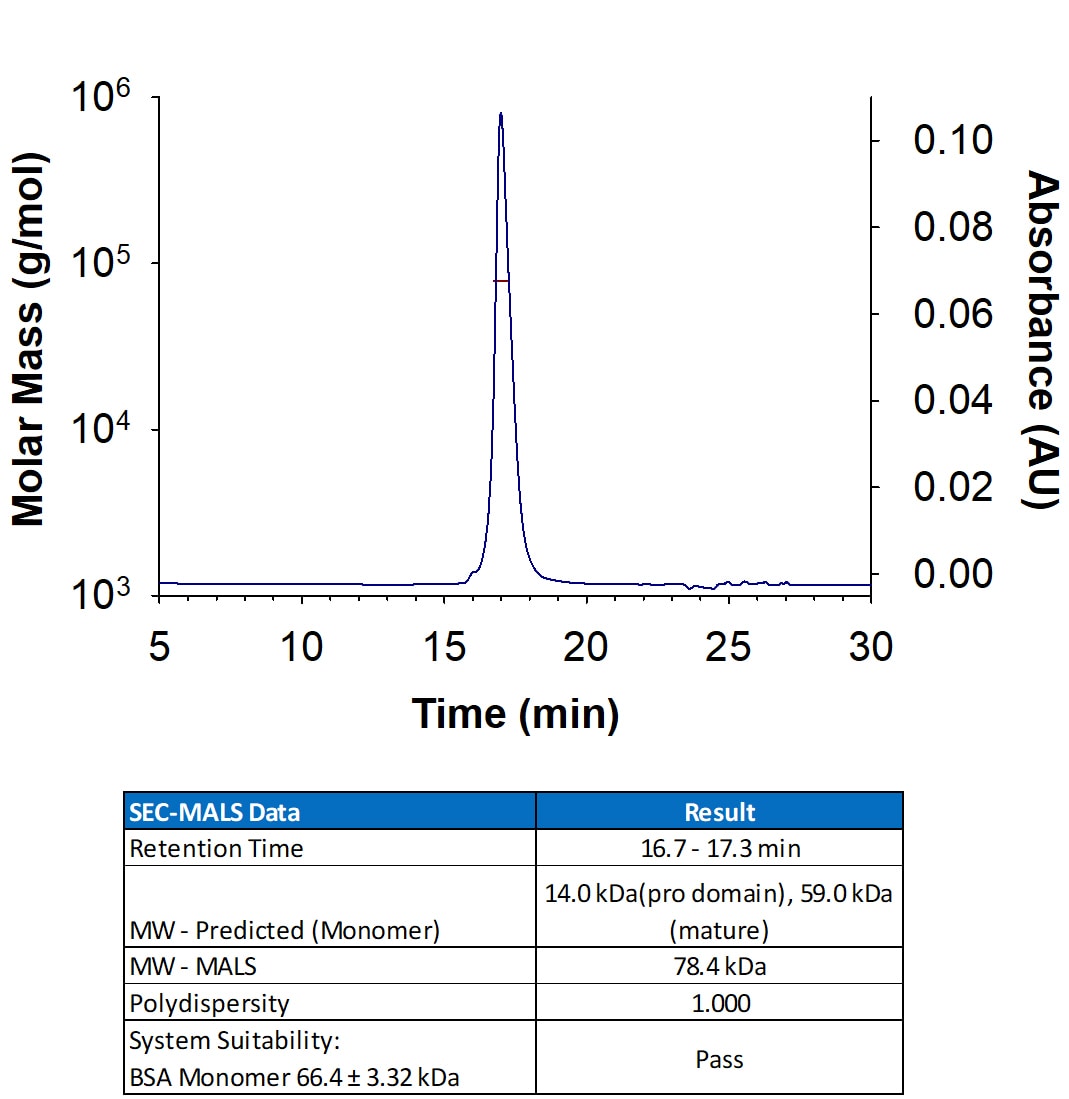
Recombinant Human Proprotein Convertase 9/PCSK9 SEC-MALS.
Recombinant Human Proprotein Convertase 9/PCSK9 (Catalog # 3888-SE) has a molecular weight (MW) of 74-82 kDa as analyzed by SEC-MALS, suggesting that this protein is a monomer. MW may differ from predicted MW due to post-translational modifications (PTMs) present (i.e. Glycosylation).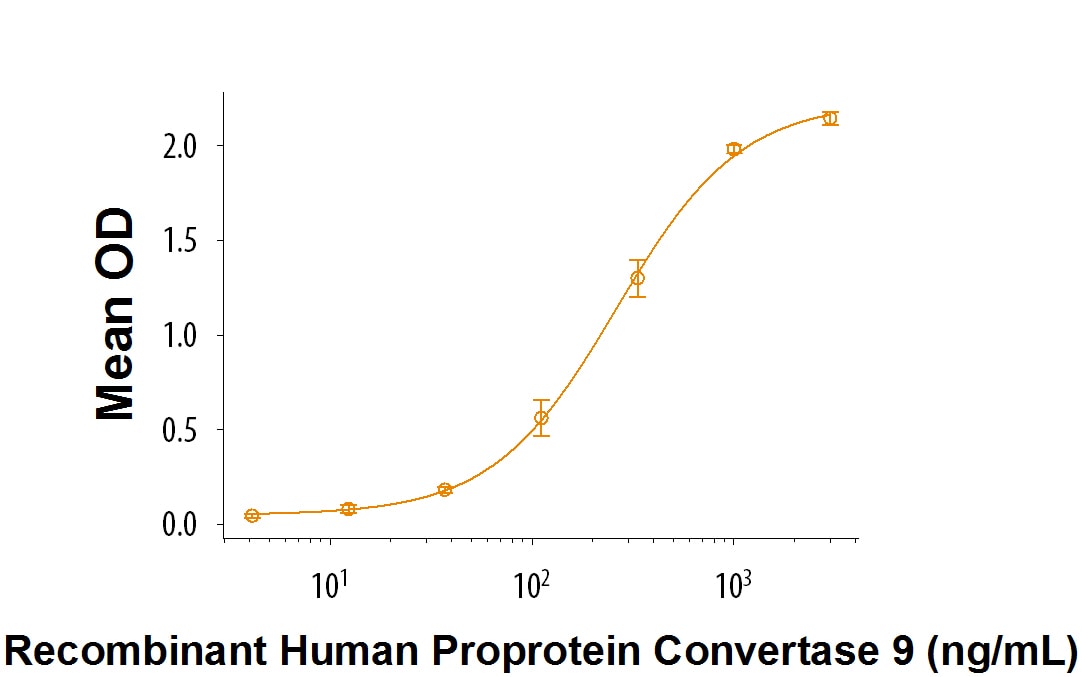
Recombinant Human Proprotein Convertase 9/PCSK9 Protein Binding Activity
When Recombinant Human LDL R (Catalog # 2148-LD) is coated at 2 µg/mL, Recombinant Human Proprotein Convertase 9/ PCSK9 (Catalog # 3888-SE) binds with an ED50 of 70-420 ng/mL.Formulation, Preparation, and Storage
3888-SE
| Formulation | Supplied as a 0.2 μm filtered solution in Tris, NaCl and Glycerol. |
| Shipping | The product is shipped with polar packs. Upon receipt, store it immediately at the temperature recommended below. |
| Stability & Storage | Use a manual defrost freezer and avoid repeated freeze-thaw cycles.
|
Background: Proprotein Convertase 9/PCSK9
References
- Seidah, N.G. et al. (2003) Proc. Natl. Acad. Sci. USA 100:928.
- Naureckiene, S. et al. (2003) Arch. Biochem. Biophys. 420:55.
- Costet, P. et al. (2008) Trends Biochem. Sci. 33:426.
Alternate Names
Gene Symbol
UniProt
Additional Proprotein Convertase 9/PCSK9 Products
- All Products for Proprotein Convertase 9/PCSK9
- Proprotein Convertase 9/PCSK9 cDNA Clones
- Proprotein Convertase 9/PCSK9 ELISA Kits
- Proprotein Convertase 9/PCSK9 Lysates
- Proprotein Convertase 9/PCSK9 Primary Antibodies
- Proprotein Convertase 9/PCSK9 Proteins and Enzymes
- Proprotein Convertase 9/PCSK9 Simple Plex
Product Documents for Recombinant Human Proprotein Convertase 9/PCSK9 Protein, CF
Certificate of Analysis
To download a Certificate of Analysis, please enter a lot or batch number in the search box below.
Note: Certificate of Analysis not available for kit components.
Product Specific Notices for Recombinant Human Proprotein Convertase 9/PCSK9 Protein, CF
For research use only
Related Research Areas
Citations for Recombinant Human Proprotein Convertase 9/PCSK9 Protein, CF
 Powered by Bioz
Customer Reviews for Recombinant Human Proprotein Convertase 9/PCSK9 Protein, CF (1)
Have you used Recombinant Human Proprotein Convertase 9/PCSK9 Protein, CF?
Submit a review and receive an Amazon gift card!
$25/€18/£15/$25CAN/¥2500 for a review with an image
$10/€7/£6/$10CAN/¥1110 for a review without an image
Submit a review
-
Application: Binding assay/Protein-protein interactionVerified Customer | Posted 04/25/2019
There are no reviews that match your criteria.
FAQs for Recombinant Human Proprotein Convertase 9/PCSK9 Protein, CF
-
Q: Does Recombinant Human Proprotein Convertase 9/PCSK9 Protein, CF (Catalog # 3888-SE) include only the active form of the protein?
A: Catalog # 3888-SE is supplied as a mixture of the pro domain and the mature (active) form. The sequence is Gln31-Gln152 (pro domain) & Ser153-Gln692 (mature form), with a C-terminal 10-His tag. This sequence is based on Accession # Q8NBP7.
-
Q: Has R&D Systems evaluated the ratio of the pro domain and the mature form in the final product of Human Proprotein Convertase 9/PCSK9 Protein, CF (Catalog # 3888-SE)?
A: The pro domain is the small region cleaved from the mature form. Catalog # 3888-SE undergoes autocleavage during processing to separate the pro domain and the mature form, but these remain non-covalently associated. While we have not empirically evaluated the relative levels of the pro domain and the mature form, we would expect a molar ratio of approximately 1:1.
-
Q: Does Recombinant Human Proprotein Convertase 9/PCSK9 Protein, CF (Catalog # 3888-SE) include only the active form of the protein?
A: Catalog # 3888-SE is supplied as a mixture of the pro domain and the mature (active) form. The sequence is Gln31-Gln152 (pro domain) & Ser153-Gln692 (mature form), with a C-terminal 10-His tag. This sequence is based on Accession # Q8NBP7.
-
Q: Has R&D Systems evaluated the ratio of the pro domain and the mature form in the final product of Human Proprotein Convertase 9/PCSK9 Protein, CF (Catalog # 3888-SE)?
A: The pro domain is the small region cleaved from the mature form. Catalog # 3888-SE undergoes autocleavage during processing to separate the pro domain and the mature form, but these remain non-covalently associated. While we have not empirically evaluated the relative levels of the pro domain and the mature form, we would expect a molar ratio of approximately 1:1.