Recombinant Human S100A15 His-tag Protein, CF

R&D Systems | Catalog # 11804-SA

R&D Systems
Loading...

Key Product Details

Source

E. coli

Accession Number

Applications

Bioactivity
Loading...

Product Specifications

Source

E. coli-derived human S100A7A protein
Ser2 - Gln101, with an N-terminal His tag

Purity

>95%, by SDS-PAGE visualized with Silver Staining and quantitative densitometry by Coomassie® Blue Staining.

Endotoxin Level

<0.10 EU per 1 μg of the protein by the LAL method.

N-terminal Sequence Analysis

His

Predicted Molecular Mass

11 kDa

SDS-PAGE

11-13 kDa, under reducing conditions.

Activity

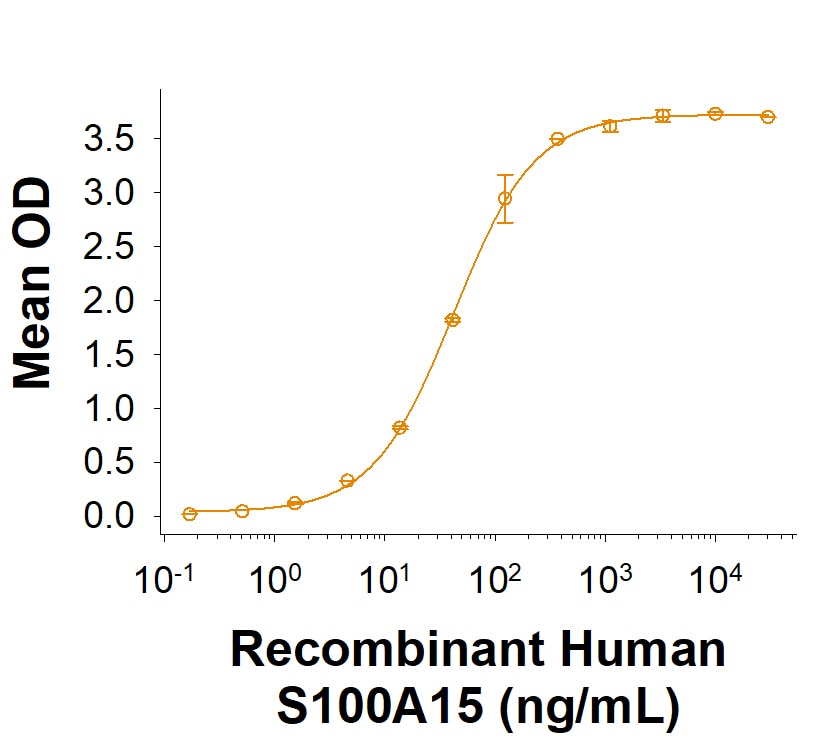
Measured by its binding ability in a functional ELISA.

Recombinant Human S100A15 (Catalog # 11804-SA) binds to Human S100A15 Antibody with an ED50 of <500 ng/mL.

Scientific Data Images for Recombinant Human S100A15 His-tag Protein, CF

Recombinant Human S100A15 Protein Binding Activity.

Recombinant Human S100A15 Protein (Catalog # 11804-SA) binds to Human S100A15 Antibody with an ED50 of <500 ng/mL.
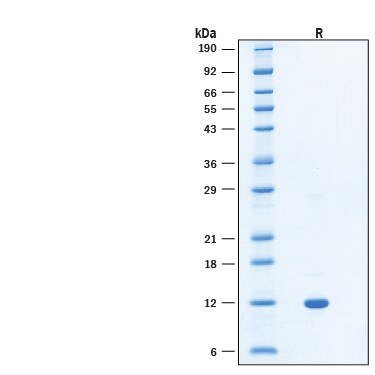
Recombinant Human S100A15 Protein SDS-PAGE.

2 μg/lane of Recombinant Human S100A15 Protein (Catalog # 11804-SA) was resolved with SDS-PAGE under reducing (R) condition and visualized by Coomassie® Blue staining, showing bands at 11-13 kDa.

Formulation, Preparation, and Storage

11804-SA
Formulation Lyophilized from a 0.2 μm filtered solution in Tris with Trehalose.
Reconstitution Reconstitute at 250 μg/mL in water.
Shipping The product is shipped with polar packs. Upon receipt, store it immediately at the temperature recommended below.
Stability & Storage Use a manual defrost freezer and avoid repeated freeze-thaw cycles.
  • 12 months from date of receipt, -20 to -70 °C as supplied.
  • 2 weeks, 2 to 8 °C under sterile conditions after reconstitution.
  • 3 months, -20 to -70 °C under sterile conditions after reconstitution.

Calculators

The reconstitution calculator allows you to quickly calculate the volume of a reagent to reconstitute your vial. Simply enter the mass of reagent and the target concentration and the calculator will determine the rest.

=
÷

Background: S100A7A

S100 calcium‑binding protein A15 (S100A15), also known as koebnerisin, is a small (~11 kDa) member of the S100 family of EF‑hand proteins encoded within the epidermal differentiation complex on chromosome 1q21. S100A15 emerged through primate‑specific gene duplication and is highly homologous (>90% sequence identity) to S100A7 (psoriasin), yet displays distinct regulation, cellular distribution, and biological function (1). S100A15 is predominantly expressed in stratified squamous epithelia, including the skin and mucosal surfaces, and is markedly upregulated in inflammatory skin disorders such as psoriasis, particularly in koebnerized lesions. Functionally, S100A15 acts as an innate immune alarmin and antimicrobial peptide, contributing to epithelial barrier defense and immune cell recruitment during inflammation (2, 3). Unlike many classical S100 proteins, S100A15 exhibits context‑dependent extracellular signaling activity that promotes chemotaxis and cytokine production in immune cells. Extracellular S100A15 functions as a pro‑inflammatory mediator, stimulating leukocyte migration and amplifying local inflammatory responses through receptor pathways that are distinct from those used by its paralog S100A7. While S100A7 signals via the receptor for advanced glycation end products (RAGE), S100A15 primarily acts through a Gi‑protein‑coupled receptor pathway, enabling synergistic yet nonredundant pro‑inflammatory signaling in epithelial tissues (4). This functional divergence allows the S100A7/S100A15 subfamily to fine‑tune immune responses at sites of tissue stress or damage. Beyond inflammatory disease, dysregulated S100A15 expression has been implicated in epithelial carcinogenesis, where it participates in shaping the tumor microenvironment through immune modulation, chemotactic signaling, and epithelial–immune crosstalk. Depending on cellular context, S100A15 may support chronic inflammation that promotes tumor progression or serve as a marker of epithelial immune activation (1, 5). Recombinant human S100A15 is therefore a valuable research tool for studying innate immunity, epithelial barrier biology, inflammatory signaling, alarmin function, and cancer‑associated inflammation, as well as for dissecting functional differences within the closely related S100A7/A15 protein subfamily.

References

  1. Wolf, R. et al. (2010) Amino Acids 41:789.
  2. Hattinger, E. et al. (2013) Curr. Opin. Pharmacol. 13:588.
  3. Kurpet, K. et al. (2022) Molecules 27:6640.
  4. Wolf, R. et al. (2008) J. Immunol. 181:1499.
  5. Liang, H. et al. (2023) Front. Immunol. 14:1191645.

Long Name

S100 calcium binding protein A7A

Alternate Names

NICE-2, NICE2, S100A15, S100A7f, S100A7L1

Entrez Gene IDs

338324 (Human); 102173556 (Goat); 114113225 (Sheep)

Gene Symbol

S100A7A

UniProt

Additional S100A7A Products

Product Documents for Recombinant Human S100A15 His-tag Protein, CF

Certificate of Analysis

To download a Certificate of Analysis, please enter a lot or batch number in the search box below.

Note: Certificate of Analysis not available for kit components.

Product Specific Notices for Recombinant Human S100A15 His-tag Protein, CF

For research use only

Customer Reviews for Recombinant Human S100A15 His-tag Protein, CF

There are currently no reviews for this product. Be the first to review Recombinant Human S100A15 His-tag Protein, CF and earn rewards!

Have you used Recombinant Human S100A15 His-tag Protein, CF?

Submit a review and receive an Amazon gift card!

$25/€18/£15/$25CAN/¥2500 Yen for a review with an image

$10/€7/£6/$10CAN/¥1110 Yen for a review without an image

Submit a review

Amazon Gift Card

FAQs

No product specific FAQs exist for this product.

View all FAQs for Proteins and Enzymes
Loading...