
Recombinant Human TMEM106B Fc Chimera Protein, CF
R&D Systems | Catalog # 11644-TM

Loading...
Key Product Details
- R&D Systems HEK293-derived Recombinant Human TMEM106B Fc Chimera Protein (11644-TM)
- Quality control testing to verify active proteins with lot specific assays by in-house scientists
- All R&D Systems proteins are covered with a 100% guarantee
Source
HEK293
Structure / Form
Disulfide linked homodimer
Applications
Bioactivity
Loading...
Product Specifications
Source
Human embryonic kidney cell, HEK293-derived human TMEM106B protein
| MD | Human IgG1 (Pro100-Lys330) |
IEGR | Human TREM106B (Pro118-Gln274) Accession # NP_001127704.1 |
| N-terminus | C-terminus | ||
Purity
>95%, by SDS-PAGE visualized with Silver Staining and quantitative densitometry by Coomassie® Blue Staining.
Endotoxin Level
<0.10 EU per 1 μg of the protein by the LAL method.
N-terminal Sequence Analysis
Met
Predicted Molecular Mass
45 kDa
SDS-PAGE
>60 kDa, under reducing conditions.
Activity
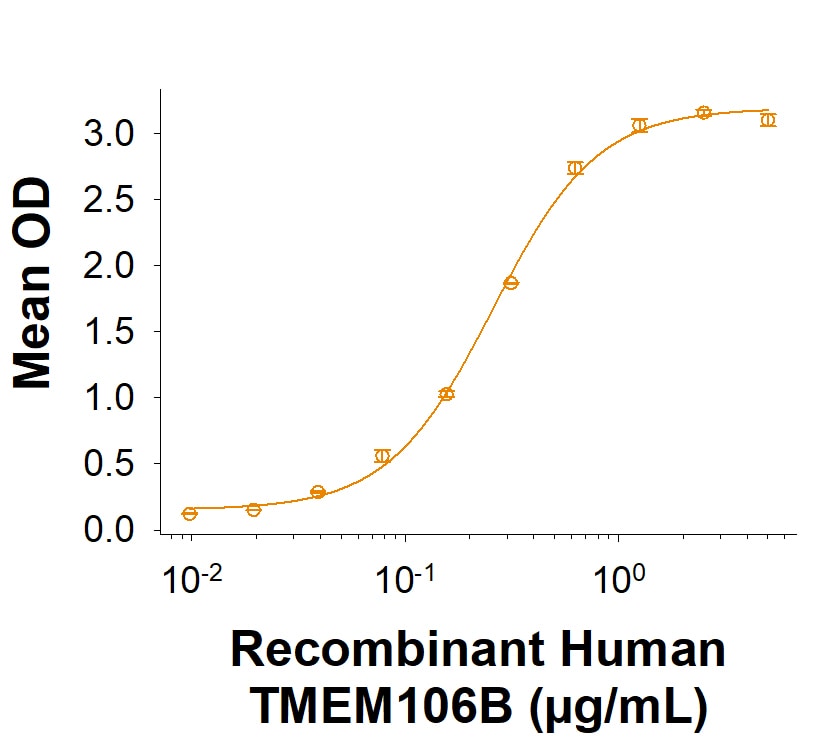
Measured by its binding ability in a functional ELISA.
Recombinant Human TMEM106B Fc Chimera (Catalog # 11644-TM) binds Recombinant SARS-CoV-2 Spike RBD His-tag (HEK293 Expressed) (Catalog # 10500-CV) with ED50 <2.00 μg/mL.
Recombinant Human TMEM106B Fc Chimera (Catalog # 11644-TM) binds Recombinant SARS-CoV-2 Spike RBD His-tag (HEK293 Expressed) (Catalog # 10500-CV) with ED50 <2.00 μg/mL.
Scientific Data Images for Recombinant Human TMEM106B Fc Chimera Protein, CF
Recombinant Human TMEM106B Fc Chimera Protein Binding Activity.
Recombinant Human TMEM106B Fc Chimera Protein (Catalog # 11644-TM) binds Recombinant SARS-CoV-2 Spike RBD His-tag (HEK293 Expressed) (10500-CV) with ED50Formulation, Preparation, and Storage
11644-TM
| Formulation | Supplied as a 0.2 μm filtered solution in PBS with Trehalose. |
| Shipping | The product is shipped with dry ice or equivalent. Upon receipt, store it immediately at the temperature recommended below. |
| Stability & Storage | Use a manual defrost freezer and avoid repeated freeze-thaw cycles.
|
Background: TMEM106B
References
- Baggen et al., 2023, Cell 186, 3427–3442.
- Xiaoyu et al., 2024 Jan 25, J Phys Chem Lett. 15(3), 671-680.
- Prerna et al., 2025, Jan 10;99(2).
Long Name
Transmembrane Protein 106B
Alternate Names
transmembrane protein 106B
Gene Symbol
TMEM106B
Additional TMEM106B Products
Product Documents for Recombinant Human TMEM106B Fc Chimera Protein, CF
Certificate of Analysis
To download a Certificate of Analysis, please enter a lot or batch number in the search box below.
Note: Certificate of Analysis not available for kit components.
Product Specific Notices for Recombinant Human TMEM106B Fc Chimera Protein, CF
For research use only
Customer Reviews for Recombinant Human TMEM106B Fc Chimera Protein, CF
There are currently no reviews for this product. Be the first to review Recombinant Human TMEM106B Fc Chimera Protein, CF and earn rewards!
Have you used Recombinant Human TMEM106B Fc Chimera Protein, CF?
Submit a review and receive an Amazon gift card!
$25/€18/£15/$25CAN/¥2500 for a review with an image
$10/€7/£6/$10CAN/¥1110 for a review without an image
Submit a review
Loading...