Recombinant Human Ubiquitin Mutant K48R Protein, CF


Discontinued Product

UM-K48R has been discontinued.
View all Ubiquitin products.
R&D Systems Recombinant Proteins and Enzymes
1 Image
Product Details
Citations (7)
FAQs
Reviews (1)

Recombinant Human Ubiquitin Mutant K48R Protein, CF Summary

Product Specifications

Purity
>95%, by SDS-PAGE under reducing conditions and visualized by Colloidal Coomassie® Blue stain
Activity
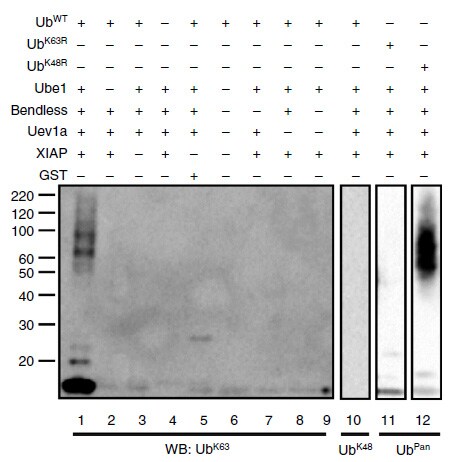
The lysine residue utilized for Ubiquitin chain formation is functionally important. Ubiquitin lysine to arginine mutants are ideal for investigating biological processes involving a particular Ubiquitin chain linkage. Recombinant Human Ubiquitin Mutant K48R prevents the formation of K48-linked Ubiquitin chains. Reaction conditions will need to be optimized for each specific application. We recommend an initial Recombinant Human Ubiquitin Mutant K48R concentration of 0.2-1 mM.
Source
E. coli-derived human Ubiquitin protein
Contains a Lys-to-Arg substitution at position 48.
Accession #
Predicted Molecular Mass
8.6 kDa

Product Datasheets

You must select a language.

x

UM-K48R

Carrier Free

What does CF mean?

CF stands for Carrier Free (CF). We typically add Bovine Serum Albumin (BSA) as a carrier protein to our recombinant proteins. Adding a carrier protein enhances protein stability, increases shelf-life, and allows the recombinant protein to be stored at a more dilute concentration. The carrier free version does not contain BSA.

What formulation is right for me?

In general, we advise purchasing the recombinant protein with BSA for use in cell or tissue culture, or as an ELISA standard. In contrast, the carrier free protein is recommended for applications, in which the presence of BSA could interfere.

UM-K48R

Formulation Lyophilized from a solution in deionized water.
Reconstitution Reconstitute at 10 mg/mL in an aqueous solution.
Shipping The product is shipped at ambient temperature. Upon receipt, store it immediately at the temperature recommended below.
Stability & Storage: Use a manual defrost freezer and avoid repeated freeze-thaw cycles.
  • 12 months from date of receipt, -20 to -70 °C as supplied.
  • 3 months, -20 to -70 °C under sterile conditions after reconstitution.
Reconstitution Calculator

Reconstitution Calculator

The reconstitution calculator allows you to quickly calculate the volume of a reagent to reconstitute your vial. Simply enter the mass of reagent and the target concentration and the calculator will determine the rest.

=
÷

Background: Ubiquitin

Ubiquitin is a 76 amino acid (aa) protein that is ubiquitously expressed in all eukaryotic organisms. Ubiquitin is highly conserved with 96% aa sequence identity shared between human and yeast Ubiquitin, and 100% aa sequence identity shared between human and mouse Ubiquitin (1). In mammals, four Ubiquitin genes encode for two Ubiquitin-ribosomal fusion proteins and two poly-Ubiquitin proteins. Cleavage of the Ubiquitin precursors by deubiquitinating enzymes gives rise to identical Ubiquitin monomers each with a predicted molecular weight of 8.6 kDa. Conjugation of Ubiquitin to target proteins involves the formation of an isopeptide bond between the C-terminal glycine residue of Ubiquitin and a lysine residue in the target protein. This process of conjugation, referred to as ubiquitination or ubiquitylation, is a multi-step process that requires three enzymes: a Ubiquitin-activating (E1) enzyme, a Ubiquitin-conjugating (E2) enzyme, and a Ubiquitin ligase (E3). Ubiquitination is classically recognized as a mechanism to target proteins for degradation and as a result, Ubiquitin was originally named ATP-dependent Proteolysis Factor 1 (APF-1) (2,3). In addition to protein degradation, ubiquitination has been shown to mediate a variety of biological processes such as signal transduction, endocytosis, and post-endocytic sorting (4-7).

Mutation of lysine 48 to arginine renders Ubiquitin (Ub) unable to form poly-Ubiquitin chains via lysine 48 linkages with other Ubiquitin molecules. Ubiquitin K48R can form a Ubiquitin-activating (E1) enzyme-catalyzed active thioester at the C-terminus allowing the molecule to be transferred to the lysines of substrate proteins (monoubiquitination). Ideal for the reduction in poly-Ubiquitin chain length/conjugation rates and determining if poly-Ubiquitin chains are K48 linked.

References
  1. Sharp, P.M. & W.-H. Li. (1987) Trends Ecol. Evol. 2:328.
  2. Ciechanover, A. et al. (1980 ) Proc. Natl. Acad. Sci. USA 77:1365.
  3. Hershko, A. et al. (1980) Proc. Natl. Acad. Sci. USA 77:1783.
  4. Greene, W. et al. (2012) PLoS Pathog. 8:e1002703.
  5. Tong, X. et al. (2012) J. Biol. Chem. 287:25280.
  6. Wei, W. et al. (2004) Nature 428:194.
  7. Wertz, I.E. et al. (2004) Nature 430:694.
  8. Chau V., et al. (1989) Science 243: 1576.
  9. Baboshina D.V., et al. (1996) J.Biol.Chem. 271: 2823.
  10. Finley D., et al. (1994) Mol. Cell. Biol. 14: 5501.
  11. Johnson E.S., et al. (1992) EMBO.J 11: 497.
  12. Johnson E.S., et al. (1995) J.Biol.Chem. 270: 17442.        
Entrez Gene IDs
7314 (Human); 298693 (Rat)
Alternate Names
RPS27A; UBA52; UBB ubiquitin B; UBB; UBC; Ubiquitin

Citations for Recombinant Human Ubiquitin Mutant K48R Protein, CF

R&D Systems personnel manually curate a database that contains references using R&D Systems products. The data collected includes not only links to publications in PubMed, but also provides information about sample types, species, and experimental conditions.

7 Citations: Showing 1 - 7
Filter your results:

Filter by:

  1. Hecw controls oogenesis and neuronal homeostasis by promoting the liquid state of ribonucleoprotein particles
    Authors: V Fajner, F Giavazzi, S Sala, A Oldani, E Martini, F Napoletano, D Parazzoli, G Cesare, R Cerbino, E Maspero, T Vaccari, S Polo
    Nature Communications, 2021-09-16;12(1):5488.
    Species: Human
    Sample Types: Recombinant Proteins
    Applications: Bioassay
  2. Stepwise multi-polyubiquitantion of p53 by the E6AP-E6 ubiquitin ligase complex
    Authors: Y Masuda, Y Saeki, N Arai, H Kawai, I Kukimoto, K Tanaka, C Masutani
    J. Biol. Chem., 2019-09-06;0(0):.
    Species: Human
    Sample Types: Recombinant Protein
    Applications: Bioassay
  3. Cbl interacts with multiple E2s in vitro and in cells
    Authors: MS Liyasova, K Ma, D Voeller, PE Ryan, J Chen, RE Klevit, S Lipkowitz
    PLoS ONE, 2019-05-23;14(5):e0216967.
    Species: Human
    Sample Types: Recombinant Protein
    Applications: Ubiquitination
  4. Ubiquitination and regulation of AURKA identifies a hypoxia-independent E3 ligase activity of VHL
    Authors: E Hasanov, G Chen, P Chowdhury, J Weldon, Z Ding, E Jonasch, S Sen, CL Walker, R Dere
    Oncogene, 2017-01-23;0(0):.
    Applications: Ubiquitination
  5. Arabidopsis ubiquitin-conjugating enzyme UBC22 is required for female gametophyte development and likely involved in Lys11-linked ubiquitination
    Authors: S Wang, L Cao, H Wang
    J Exp Bot, 2016-04-10;0(0):.
    Species: Plant - Arabidopsis
    Sample Types: Recombinant Protein
    Applications: Enzyme Assay
  6. Inhibition of a NEDD8 Cascade Restores Restriction of HIV by APOBEC3G.
    Authors: Stanley D, Bartholomeeusen K, Crosby D, Kim D, Kwon E, Yen L, Cartozo N, Li M, Jager S, Mason-Herr J, Hayashi F, Yokoyama S, Krogan N, Harris R, Peterlin B, Gross J
    PLoS Pathog, 2012-12-27;8(12):e1003085.
    Applications: Bioassay
  7. The APC/C subunit Mnd2/Apc15 promotes Cdc20 autoubiquitination and spindle assembly checkpoint inactivation.
    Authors: Foster S, Morgan D
    Mol Cell, 2012-08-30;47(6):921-32.
    Applications: Bioassay

FAQs

No product specific FAQs exist for this product, however you may

View all Proteins and Enzyme FAQs

Reviews for Recombinant Human Ubiquitin Mutant K48R Protein, CF

Average Rating: 5 (Based on 1 Review)

5 Star
100%
4 Star
0%
3 Star
0%
2 Star
0%
1 Star
0%

Have you used Recombinant Human Ubiquitin Mutant K48R Protein, CF?

Submit a review and receive an Amazon gift card.

$25/€18/£15/$25CAN/¥75 Yuan/¥2500 Yen for a review with an image

$10/€7/£6/$10 CAD/¥70 Yuan/¥1110 Yen for a review without an image

Submit a Review

Filter by:


Recombinant Human Ubiquitin Mutant K48R Protein, CF
By Anonymous on 10/20/2017
Application: Enzymatic activity in vitro