
Butyrophilin-like 3 (BTNL3), also referred to as BTNL1, Gm316, and Ng10, is a member of the BTN/MOG Ig-superfamily and shares structural resemblance to the B7 family (1). BTNL3 is a type I transmembrane protein that consists of an extracellular domain (ECD) containing two IgV domains, a single transmembrane domain, and a cytoplasmic domain with a B30.2/SPRY region. Mature mouse BTNL3 shares 30% and 80% amino acid sequence identity with human and rat BTNL3, respectively. BTNL3 mRNA has been identified in many tissues including small intestine, colon, liver, lung, bone marrow and spleen tissue, and it is highly expressed in neutrophils (2-6). The specific function of BTNL3 has yet to be fully elucidated, but BTNL3 is suggested to be a novel negative regulator for T cell activation and immune diseases (7). In humans, BTNL3 has been shown to form heterodimers with BTNL8 and overexpression of this complex leads to CD69 upregulation and T cell antigen receptor downregulation (8). In mice, BTNL3 can form heterodimers with BTNL6 and modulate local immune responses and intraepithelial lymphocytes–epithelial cell interaction pathways (9). Additionally, BTNL3 has been shown to bind directly to V gamma 4+ T cell receptor, suggesting a role in gamma delta T cell regulation (10). BTNL3 expression has also been found to be down-regulated in colon cancer tumors (11). R&D Systems in house data indicate that mouse BTNL3 protein inhibits the secretion of IL-2 from anti-CD3 activated mouse CD3+ T cells.
Recombinant Mouse BTNL3 Fc Chimera Protein, CF
R&D Systems | Catalog # 10222-BT

Loading...
Key Product Details
- R&D Systems NS0-derived Recombinant Mouse BTNL3 Fc Chimera Protein (10222-BT)
- Quality control testing to verify active proteins with lot specific assays by in-house scientists
- All R&D Systems proteins are covered with a 100% guarantee
Source
NS0
Accession Number
Structure / Form
Disulfide-linked homodimer
Applications
Bioactivity
Loading...
Product Specifications
Source
Mouse myeloma cell line, NS0-derived mouse BTNL3 protein
| Recombinant Mouse BTNL3 (Glu28-Pro241) Accession # Q7TST0.3 |
IEGRMDP | Mouse IgG2a (Glu98-Lys330) |
| N-terminus | C-terminus |
Purity
>95%, by SDS-PAGE visualized with Silver Staining and quantitative densitometry by Coomassie® Blue Staining.
Endotoxin Level
<0.10 EU per 1 μg of the protein by the LAL method.
N-terminal Sequence Analysis
Glu28
Predicted Molecular Mass
51 kDa
SDS-PAGE
45-65 kDa, under reducing conditions
Activity
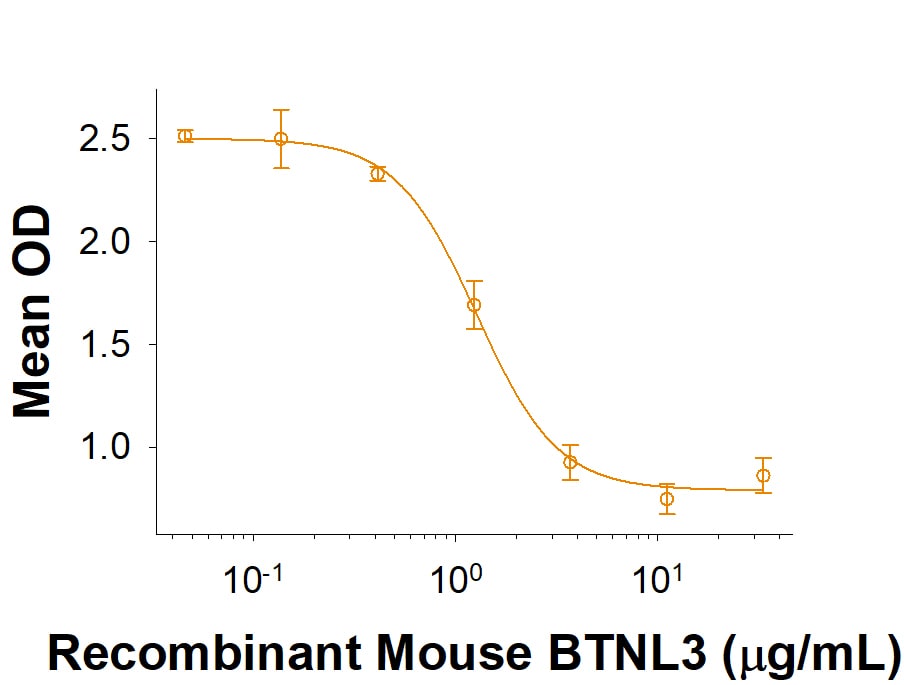
Measured by its ability to inhibit IL-2 secretion by mouse T cells in the presence of anti-CD3.
The ED50 for this effect is 0.4-4 μg/mL.
The ED50 for this effect is 0.4-4 μg/mL.
Scientific Data Images for Recombinant Mouse BTNL3 Fc Chimera Protein, CF
Measured by its ability to inhibit IL-2 secretion by mouse T cells in the presence of anti-CD3. The ED50 for this effect is 0.4-4 μg/mL.
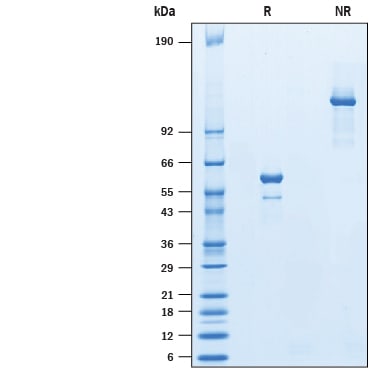
2 μg/lane of Recombinant Mouse BTNL3 Fc Chimera (Catalog # 10222-BT) was resolved with SDS-PAGE under reducing (R) and non-reducing (NR) conditions and visualized by Coomassie® Blue staining, showing bands at 45-65 kDa and 90-130 kDa, respectively.
Formulation, Preparation, and Storage
10222-BT
| Formulation | Supplied as a 0.2 μm filtered solution in PBS. |
| Shipping | The product is shipped with dry ice or equivalent. Upon receipt, store it immediately at the temperature recommended below. |
| Stability & Storage | Use a manual defrost freezer and avoid repeated freeze-thaw cycles.
|
Background: BTNL3
References
- Shibui, A. et al. (1999) J. Hum. Genet. 44:249.
- Arnett, H.A. et al. (2014) Nat Rev Immunol. 14:5596.
- Arnett, H.A. et al. (2009) Cytokine 46:370.
- Abeler-Dorner, L. et al. (2012) Trends Immunol. 33:34.
- Rhodes, D. et al. (2016) Annu. Rev. Immunol. 34:151.
- Guo, Y and Wang, AY (2015) Front. Immunol. 6:421.
- Yamazaki, T. et al. (2010) J Immunol 185:5907.
- Melandri, D. et al. (2018) Nat Immunol 19:1352.
- Lebrero-Fernández, C. et al. (2016) Front Immunol. 7:1.
- Wilcox, C.R. et al. (2019) Immunity 51:813.
- Lebrero-Fernandez, C. et al. (2016) Immun. Inflammation Dis. 4:191.
Long Name
Butyrophilin-like 3
Alternate Names
BTN9.1, BTNLR, COLF4100
Gene Symbol
BTNL3
UniProt
Additional BTNL3 Products
Product Documents for Recombinant Mouse BTNL3 Fc Chimera Protein, CF
Certificate of Analysis
To download a Certificate of Analysis, please enter a lot or batch number in the search box below.
Note: Certificate of Analysis not available for kit components.
Product Specific Notices for Recombinant Mouse BTNL3 Fc Chimera Protein, CF
For research use only
Related Research Areas
Customer Reviews for Recombinant Mouse BTNL3 Fc Chimera Protein, CF
There are currently no reviews for this product. Be the first to review Recombinant Mouse BTNL3 Fc Chimera Protein, CF and earn rewards!
Have you used Recombinant Mouse BTNL3 Fc Chimera Protein, CF?
Submit a review and receive an Amazon gift card!
$25/€18/£15/$25CAN/¥2500 for a review with an image
$10/€7/£6/$10CAN/¥1110 for a review without an image
Submit a review
Loading...