

Dr. Oi Wah Liew
Senior Scientist and Group Leader, Cardiovascular Research Institute (CVRI), Yong Loo Lin School of Medicine, National University of Singapore
Clarifying Heart Failure Biomarkers Through Scientific Rigor
“Simple Western allowed us to confidently identify and validate multiple circulating forms of neprilysin. That clarity was essential for explaining why different immunoassays produce conflicting results—and for advancing biomarker research toward real clinical impact.”
How NUS CVRI Leveraged Simple Western to Decode Circulating Neprilysin
Heart failure (HF) remains a leading cause of morbidity and mortality worldwide, driving an urgent need for reliable biomarkers that can improve diagnosis, risk stratification, and patient management. Yet the biomarker research landscape is often hindered by poorly validated immunoassays and antibodies—resulting in inconsistent and sometimes contradictory findings across studies. At the Cardiovascular Research Institute (CVRI) of the National University of Singapore (NUS), Dr. Oi Wah Liew and her team are addressing this challenge head-on by embedding quality, rigor, and reproducibility into every stage of biomarker research. Their recent work on circulating neprilysin (NEP)—a key enzyme implicated in heart failure biology—highlights how advanced protein characterization tools like Simple Western™ Technology can bring clarity to complex clinical questions.
Building a Foundation for Reliable Biomarker Science
Established as the research arm of the National University Heart Centre Singapore, CVRI leads basic and translational cardiovascular research across Singapore, working closely in partnership with the Christchurch Heart Institute in New Zealand. As CVRI’s inaugural senior scientist and leader of its biomarkers team, Dr. Liew helped build a state-of-the-art research infrastructure focused on high-quality sample handling and assay validation.
“We start with the premise that biomarker data are only as good as the samples and assays behind them,” Dr. Liew explained. “That’s why we established standardized procedures across collection, processing, storage, and analysis—and a quality framework spanning pre-analytical, analytical, and post-analytical phases.”
When reliable commercial immunoassays are unavailable, the CVRI team develops custom monoclonal antibodies, performing extensive validation that includes epitope mapping, affinity and specificity testing, and application-specific performance assessment.
The Neprilysin Challenge: Conflicting Data, Unclear Biology
Despite its importance as a therapeutic target in heart failure, circulating NEP has remained controversial. Published studies have reported conflicting conclusions on whether plasma NEP levels are increased or decreased in HF, whether concentration correlates with enzymatic activity, and whether NEP is associated with clinical outcomes. Dr. Liew’s team hypothesized that these discrepancies stemmed from a fundamental issue: circulating NEP
is heterogeneous, existing in multiple molecular forms that are not equally detected by different antibodies or immunoassays. To investigate this, the team turned to the Jess™ Automated Simple Western System with chemiluminescence detection.
Simple Western Reveals the Full Picture
Using Simple Western, the CVRI team was able to consistently and reproducibly detect multiple circulating forms of NEP in plasma samples from non-HF controls and two HF subtypes. These included fragments of varying molecular weights, likely arising from proteolytic processing, post-translational modifications, and homo-dimerization.
“Simple Western was instrumental in visualizing NEP heterogeneity,” said Dr. Liew. “The automation gave us highly reproducible banding patterns across different antibodies, reinforcing our confidence that these forms were real—and biologically meaningful."
The system’s digital data output allowed the team to easily reorder lanes and directly compare banding profiles between patient groups and antibodies. By aligning band sizes with known antibody epitopes, they demonstrated that certain immunoassays detect NEP fragments lacking the catalytic domain—explaining why some assays fail to correlate with enzymatic activity. This insight proved critical for interpreting immunoassay performance and resolving inconsistencies in the literature.
From Analytical Insight to Clinical Relevance
By combining Simple Western characterization with validated immunoassays that detect a broader range of NEP
fragments, the team showed that:
- Plasma NEP levels are upregulated in heart failure
- NEP concentration correlates with enzymatic activity
- NEP levels are associated with all-cause mortality and HF-related outcomes
These findings were published in Clinical Chemistry in 2025,1 while earlier mechanistic insights enabled by Simple Western were reported in Cellular and Molecular Life Sciences in 2024 (Figure 1).2
“Our work demonstrates that conflicting biomarker data aren’t necessarily wrong—they’re often incomplete,” Dr. Liew said. “Without understanding which molecular forms are being measured, interpretation becomes misleading.”
Advancing Biomarker Research with Confidence
Beyond NEP, Simple Western is envisaged to become a valuable platform for broader cardiac biomarker efforts –particularly for small proteins under 7 kDa, which are notoriously difficult to analyze using traditional western blotting.
“The lack of gel casting and membrane transfer eliminates many sources of protein loss and variability,” Dr. Liew noted. “It’s fast, easy to use, reliable, and cost-effective compared to conventional Westerns.”
So satisfied with the system’s performance, Dr. Liew has already recommended Simple Western to collaborators exploring diagnostic and therapeutic biomarkers in oncology.
Setting a Higher Standard for Translational Biomarkers
By emphasizing antibody characterization, biomarker heterogeneity, and analytical rigor, the CVRI team hopes to raise standards across the field—and accelerate the translation of biomarker discoveries into clinical tools.
“We believe identifying circulating biomarker forms and understanding antibody binding footprints should be non-negotiable,” said Dr. Liew. “Simple
Western helped us make that case with clear, reproducible data.”
Through technology-enabled rigor and thoughtful assay design, CVRI and NUS are helping ensure that cardiovascular biomarkers move from bench to bedside with confidence—and with clarity that clinicians and patients can trust.
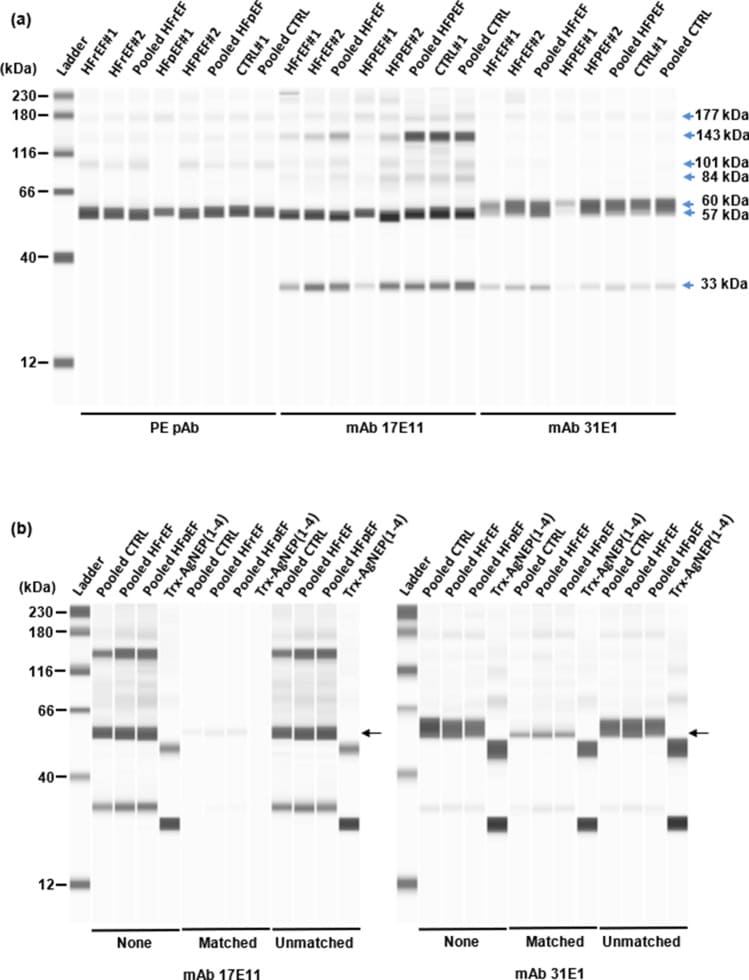
Circulating forms of plasma NEP as revealed by Simple Western analysis. (a) Individual (#1, #2) and pooled (n > 100) HFrEF, HFpEF, and CTRL (non-HF) plasma samples were probed separately with mAb 17E11 and mAb 31E1 and compared against the profile obtained with PE pAb. Ladder: 12–230 kDa biotinylated molecular weight ladder (ProteinSimple). Image exposure setting: High Dynamic Range 4.0. (b) Effect of peptide competition on immunodetected bands where interaction of the detection mAb with NEP targets is blocked in the absence (None) or presence of matched or unmatched peptides at tenfold excess concentration. The 57 kDa band position is indicated by black arrows. Image exposure setting: Exposure 8: 128 s. All images are representative of three independent experiments. Adapted with permission (CC BY 4.0).2